
Tile and grout floors are the workhorses of commercial kitchens, restrooms, food processing areas, and hospital corridors. They handle grease, foot traffic, chemical spills, and daily abuse. But here's the catch: the tile itself cleans easily, while the grout between those tiles acts like a porous sponge that absorbs dirty water, grease, and bacteria. Traditional mopping makes this worse — it redistributes up to 50% of surface contaminants directly into grout lines. The right floor scrubber for tile and grout floors uses mechanical brush action and vacuum recovery to pull contaminants out instead of driving them deeper. This guide covers what specs matter, which chemicals work, and which TerraScrub models fit different facility sizes.
Why Tile & Grout Floors Need a Different Cleaning Approach
The problem isn't the tile. Ceramic, porcelain, and quarry tile are essentially non-porous — liquids bead up on the surface. The problem is the grout. Cement-based grout lines sit slightly below the tile surface and function like tiny channels that collect everything: grease, soap scum, food particles, mineral deposits, and bacteria.
When you mop a tile floor, the dirty water flows into those grout channels. As the water evaporates, it leaves the dissolved solids behind. Do this every day for six months and your grout goes from clean grey to permanently black. A 2025 study of commercial facilities found that 40% of cleaning chemical residues create a tacky film that actually attracts more soil, accelerating the discoloration cycle.
The CDC reports that in 2020, 805 workers died from falls and 211,640 suffered injuries requiring days away from work, with total workers' compensation and medical costs estimated at $70 billion annually. Contaminants on floor surfaces — including dirty grout lines that trap moisture and grease — are a leading cause of same-level slips and falls. Source: CDC NIOSH Workplace Falls
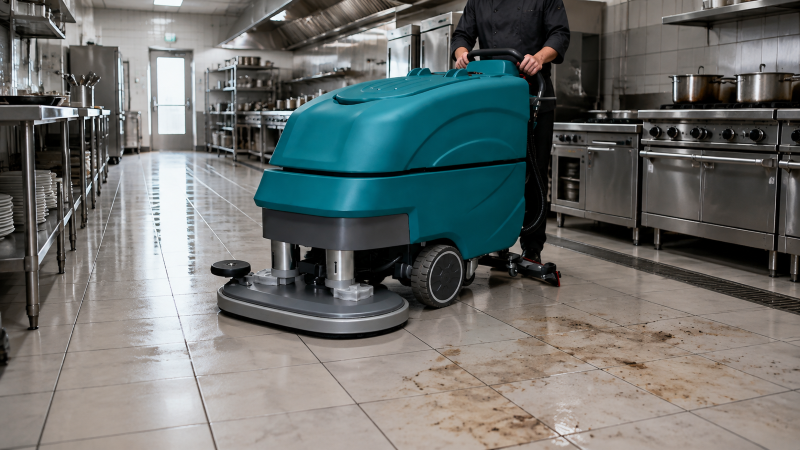
A floor scrubber solves this differently. Instead of spreading dirty water around, it applies clean solution, agitates it into the grout with brush pressure, then immediately vacuums the dirty water back into a recovery tank. The grout gets cleaned, not filled. The floor dries in seconds, not hours.
Key Specs to Look for in a Tile Floor Scrubber
Brush Type and Configuration
For tile and grout, dual counter-rotating brushes outperform single-disc brushes. Two brushes spinning in opposite directions create cross-scrubbing action that reaches into grout lines from multiple angles. If you're only cleaning smooth tile without deep grout issues, a single-disc brush with adequate down pressure (30-50 kg) can work, but dual brushes handle grout lines noticeably better.
Squeegee Width and Recovery
The squeegee must be at least as wide as the brush path. A wider squeegee — like the 1,100mm parabolic squeegee on the TerraScrub BA860 — captures dirty water before it can flow back into grout lines. Poor squeegee contact means water pools in grout channels, which is exactly the problem you're trying to fix.
Chemical Compatibility
Tile and grout tolerate a wider pH range than epoxy or polished concrete. Neutral cleaners (pH 7-9) handle daily soil. Alkaline cleaners (pH 9-11) cut grease in commercial kitchens. Acidic cleaners (pH 2-4) dissolve mineral deposits and hard water stains — but use sparingly, as repeated acid exposure degrades cement-based grout. The machine's solution system should support dilution ratios of 1:64 to 1:128 for economical chemical use.
Machine Size and Aisle Match
Restroom aisles and kitchen layouts are often narrow. A compact walk-behind machine (22-37 inches wide) fits where a ride-on cannot. For larger tile areas — hospital corridors, school hallways, warehouse entrances — a wider ride-on saves labor. Match the machine width to your narrowest cleaning aisle.
Recommended Floor Scrubbers for Tile & Grout
TerraScrub BA860 (Primary Pick)
Dual counter-rotating brush deck, 860mm cleaning path, 1,100mm squeegee. Self-propelled walk-behind. 95L solution / 105L recovery tanks. Covers 4,200 m²/h. Best for: commercial kitchens, food processing, large restroom complexes, hospital corridors with heavy grout soil.
TerraScrub A3 (Small Area Pick)
Single 21-inch disc brush, 50L tanks, walk-behind. Covers 2,200-2,400 m²/h. Compact 22-inch width fits tight restroom layouts. Best for: small commercial restrooms, entry areas, cafes, retail tile floors under 25,000 sq ft.
The TerraScrub BA860 is our primary recommendation for tile and grout because of its dual-brush design. Two counter-rotating brushes (560W each) attack grout lines from both directions, lifting embedded soil that single-brush machines leave behind. The 1,100mm squeegee — wider than the brush path — captures every drop of dirty water before it can settle back into grout channels. At 4,200 m²/h, one pass cleans a 50,000 sq ft facility in about an hour.
For smaller tile areas, the TerraScrub A3 offers a simpler, lighter option. Its single 21-inch disc brush with adequate down pressure handles daily soil on smooth tile, and the 22-inch width navigates restroom stalls and narrow corridors. It won't deep-clean heavily soiled grout as aggressively as the BA860's dual brushes, but for maintenance cleaning it gets the job done.
Chemical Selection Guide for Tile & Grout Floors
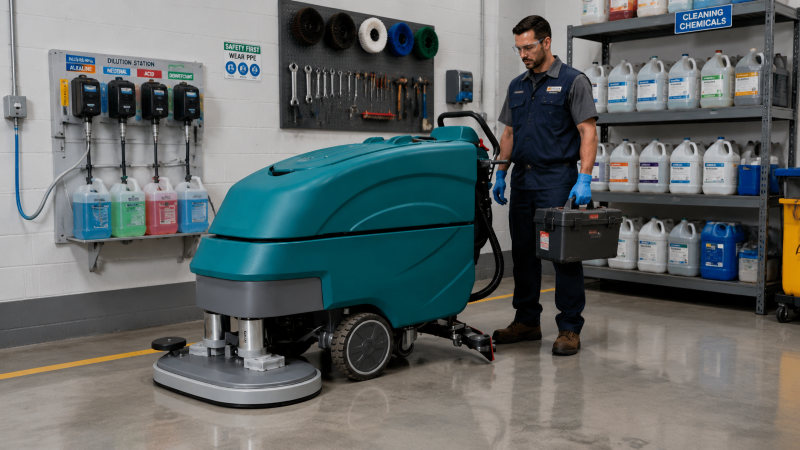
Choosing the right chemical matters as much as choosing the right machine. The wrong cleaner can damage grout, leave slip-hazardous residue, or simply waste money. Here's a breakdown by cleaning scenario:
Daily Maintenance
pH-neutral cleaner (7-9). Dilute 1:128. Safe for all tile types and sealed grout. Removes light soil, foot traffic dirt, and dust without degrading grout sealant.
Grease Removal (Kitchens)
Alkaline cleaner (pH 9-11). Dilute 1:64. Breaks down animal fats, cooking oils, and food residue. Rinse with clean water to prevent alkaline film buildup on grout.
Mineral & Hard Water
Acidic cleaner (pH 2-4). Use monthly, not daily. Dissolves calcium, lime, and rust deposits. Avoid on natural stone tile. Always pre-dilute and never pour directly into solution tank.
Biofilm & Bacteria
Quaternary ammonium disinfectant. Follow label contact time (typically 5-10 minutes). Use after cleaning, not as a cleaner. Critical for food service and healthcare tile floors.
ISSA cleaning standards recommend a two-step process for heavily soiled tile: first scrub with an alkaline solution to break down grease and organic matter, then rinse with clean water or a neutral cleaner to remove chemical residue. This prevents the tacky film that causes rapid re-soiling. Source: ISSA Cleaning Industry Standards
Maintenance Tips to Extend Grout Life
Even with the right scrubber, a few habits will keep your tile and grout in better shape for longer:
1. Clean daily in high-traffic areas. Letting grease and soil sit in grout lines for more than 24 hours allows it to bond chemically with the cement. Daily scrubbing with a BA860 or A3 prevents this bonding.
2. Use auto-dilution for chemicals. Hand-mixing leads to inconsistent ratios — too strong damages grout, too weak wastes time. An auto-dilution station delivers exact ratios every time.
3. Inspect squeegee blades weekly. Worn or damaged blades leave streaks and water on the floor. On tile floors, standing water flows straight into grout lines. Replace blades every 200-400 hours of operation.
4. Deep clean grout quarterly. For the deepest grout cleaning, run the BA860 with an alkaline solution at 1:64 dilution, then follow with a clean-water rinse pass. This pulls embedded soil that daily cleaning misses.
5. Reseal grout annually. A quality grout sealer fills the microscopic pores that trap dirt. After sealing, daily scrubbing becomes much more effective because contaminants can't penetrate as deeply.
Choosing the right floor scrubber for tile and grout comes down to brush configuration, squeegee width, and matching machine size to your facility. The TerraScrub BA860 with dual counter-rotating brushes is built specifically for the grout-cleaning challenge — pull contaminants out, don't push them deeper. Visit our homepage to see the full machine lineup, or check out our insights library for more floor cleaning guides.