
INDUSTRIAL BUYER GUIDE · 2026
“Heavy duty” is often used as a product adjective, but it does not have one universal specification. A standard scrubber may be heavy-duty for a small workshop and completely unsuited to a foundry aisle running two cleaning shifts. What matters is the combination of soil, floor condition, working hours, recovery demand and the consequences of downtime. The right question is not whether a machine looks industrial. It is whether a lighter machine can finish the route consistently without extra passes, repeated emptying or unacceptable strain on the operator and equipment.
The label may describe larger tanks, a wider cleaning path, higher brush pressure, stronger traction, more robust construction or a higher duty cycle. Buyers need to check which of those attributes solves their actual problem.
| Site condition | What it stresses | Feature to verify |
|---|---|---|
| Heavy oil or attached film | Brush action, cleaning chemistry and pass count | Brush or pad choice, pressure and realistic cleaning speed |
| Long cleaning shifts | Battery capacity, operator fatigue and tank refill interval | Runtime, traction drive, tank size and charging plan |
| Rough or uneven concrete | Brush contact, squeegee tracking and machine movement | Brush pressure, squeegee adjustment and a test on the actual surface |
| Frequent debris or mixed spills | Recovery capacity and cleaning sequence | Brush system, pre-cleaning method and recovery-tank capacity |
| High uptime expectation | Drive system, durability and support arrangements | Published operating conditions, inspection routine and local support |
A standard machine may be enough if…
Step up when…
The answer should be based on a measured route, not building size. A small, heavily soiled production area can demand a tougher machine than a much larger warehouse with light dust.

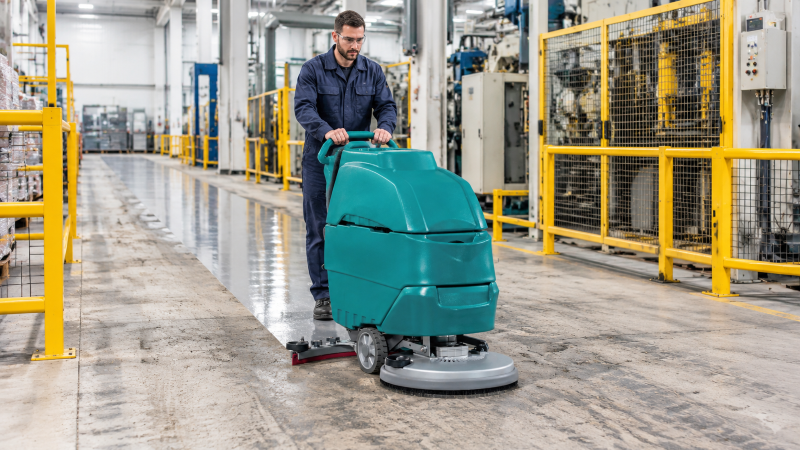
Brush pressure and machine weight are covered in more detail in the scrubber weight and pressure guide.
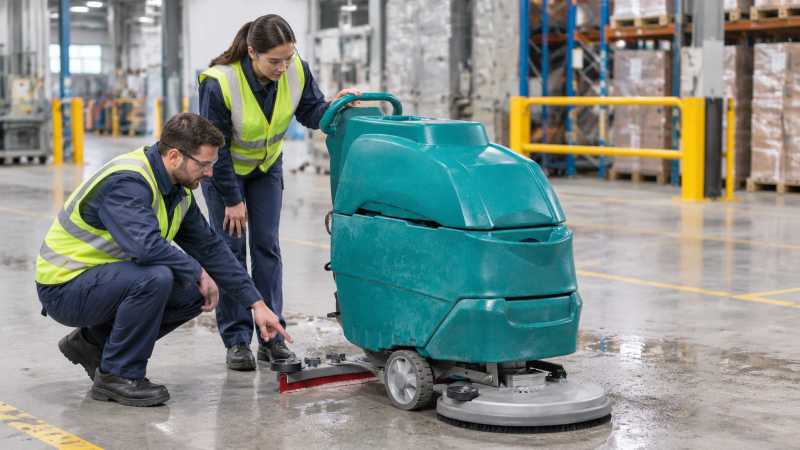
Buying the toughest available machine can create its own cost: more weight, larger dimensions, more space for charging and a machine that is difficult to maneuver in a tight route. A standard or compact scrubber may be the better choice when:
The high-traffic and low-traffic facility guide helps separate a genuinely demanding route from a floor that is simply large.

It is not one feature. Check the intended soil, duty cycle, brush pressure, traction, tanks, recovery system, build and support requirement against the site's actual workload.
No. Too much pressure can damage a finish or increase current draw and wear. Match pressure and brush type to the floor and soil.
Not automatically. Compare route length, aisle width, cleaning window and operator exposure. A wide walk-behind may fit better in mixed aisles, while a ride-on can reduce fatigue on long open runs.
A scrubber can remove dust with water and recovery, but the cleaning sequence and machine settings must suit the dust. For heavy debris, pre-cleaning may still be required.
Start with the route and soil, then compare brush pressure, recovery, tank capacity, runtime, dimensions and local support. The largest machine is not automatically the best fit.
Heavy-duty equipment is justified when the workload repeatedly exceeds what a standard scrubber can handle. Test the soil, water recovery, runtime and end-of-shift cleaning before deciding that a larger machine is necessary.
Specify a heavy-duty scrubber for your facility
Send the cleanable area, soil, floor type, cleaning window, aisle limits and number of shifts. We can narrow the appropriate machine class before a site trial.
Email: Donnie@terrascrubx.com
WhatsApp: +86 166 0187 1755
No. 600, Jiye Road, Sheshan Town, Songjiang District, Shanghai, China