

BRAND COMPARISON · 2026
“Powr-Flite vs Tennant” is usually not a question that can be answered by one brand logo. Both companies offer more than one floor-scrubber category, and the available models, dealers, voltage configurations and service arrangements vary by market. A compact commercial model from one brand should not be compared with a large industrial machine from the other and treated as a brand-level verdict. The useful comparison starts with the warehouse route and cleaning job, then puts two specific quoted models side by side. This guide shows what to compare, what each answer means and where buyers commonly make an expensive assumption.
A brand can be a useful place to build a shortlist, but it is a poor unit of comparison. Different model families within one company can use different brush systems, tanks, controls and support arrangements. Start with six facts about the facility.
| Requirement | What to define | Why it changes the shortlist |
|---|---|---|
| Floor and soil | Concrete, sealed concrete, epoxy, tile, dust, tyre film, oil or mixed soil | Brush, pressure, chemistry and recovery requirements must match the floor |
| Cleanable area | Area cleaned per day, not the total building footprint | Sets the required machine class and daily workload |
| Cleaning window | Available hours, shift pattern and time lost to refilling or congestion | Determines whether a walk-behind or ride-on can finish the work |
| Access route | Narrowest aisle and doorway, turning space, ramps, lift and charger access | A model that cannot reach the floor cannot be the right purchase |
| Operation | Who operates the machine, training level and traffic controls | Controls, visibility and handling need to match the team and site |
| Destination | Country, supply voltage, charger setup and local support coverage | An otherwise suitable model can fail on configuration or support |
This article is an evaluation framework, not a laboratory test or a claim that every Powr-Flite or Tennant model performs the same way. Brand literature and market availability should be checked for the specific models offered to you.
Put the exact model names and quoted configurations into the same table. If a figure is unavailable, leave it blank instead of assuming it is similar.
| Comparison item | Powr-Flite model | Tennant model |
|---|---|---|
| Machine class | Walk-behind or ride-on; model name and variant | Walk-behind or ride-on; model name and variant |
| Fit dimensions | Body L × W × H, cleaning width and squeegee width | Body L × W × H, cleaning width and squeegee width |
| Coverage claim | Rated m²/h and the assumptions behind it | Rated m²/h and the assumptions behind it |
| Power system | Battery type and capacity, charger input and documented runtime conditions | Battery type and capacity, charger input and documented runtime conditions |
| Tanks and recovery | Clean and recovery capacity, drainage and water pickup | Clean and recovery capacity, drainage and water pickup |
| Local support | Nearest authorised support, training and response arrangements | Nearest authorised support, training and response arrangements |
| Delivery scope | Packaging, delivery point, charger configuration and exclusions | Packaging, delivery point, charger configuration and exclusions |

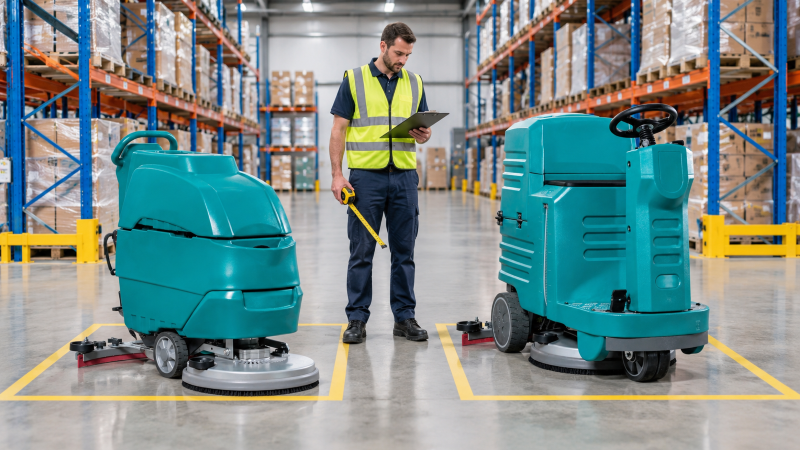
The lower machine figure is not automatically the lower-cost ownership decision. Ask both suppliers to describe the same operational and support assumptions.
Cleaning time
Include refilling, emptying, turns, congestion and a second pass where soil is heavy.
Training and changeover
Check how quickly a new operator can learn the controls and follow the daily cleaning routine.
Service reach
Confirm who supports the machine in your city and what information is needed for diagnosis.
Downtime exposure
If the machine stops, can the site cover the same floor with an existing process or another unit?
Use the floor scrubber buying checklist to turn these questions into a consistent scoring sheet.
Use the floor scrubber size chart to keep machine classes comparable before the test.


The broader floor scrubber brand comparison explains how to evaluate a shortlist without relying on logos alone.
There is no brand-level answer. Compare the quoted models against your floor, soil, aisle, cleaning window and local support. A better-fitting model is more useful than a general ranking.
No. Price depends on the model, configuration, battery, charger, destination, delivery scope and commercial terms. Ask for the same specification from both suppliers before comparing figures.
That cannot be concluded from the brand name alone. Model design, operating conditions, maintenance, operator behaviour and local service all affect reliability.
Use them as definitions to check, but confirm how each company measures coverage, runtime and tank capacity. Otherwise two similar-looking figures may describe different conditions.
Request the exact model, dimensions, cleaning and squeegee width, battery and charger configuration, delivery scope, support arrangements and assumptions behind the rated coverage.
Define the warehouse job first, compare current models with the same specification sheet, and test the two machines on the same floor. That produces a decision the operator can use every day, rather than a conclusion based only on brand recognition.
Compare a warehouse scrubber on your actual route
Send the cleanable area, floor and soil, narrowest aisle, cleaning window and destination voltage. We can define the required machine class before you compare multiple offers.
Email: Donnie@terrascrubx.com
WhatsApp: +86 166 0187 1755
No. 600, Jiye Road, Sheshan Town, Songjiang District, Shanghai, China