FACTORY EQUIPMENT GUIDE · 2026
Factory floor cleaning rarely means one machine cleaning one uniform surface. A production site may have oil and metal particles near machining, fine dust around packaging or cutting, dry ingredients in a process area and smooth coated floors in finished-goods zones. The cleaning machine also has to pass between guards, pallet trucks and production equipment while the next shift is waiting to start. Buying by building area alone often produces a machine that is either too wide for the route or too slow for the available cleaning window. The more reliable method is to start with the production zone, identify what must be removed and then choose the machine type and size around that job.
The same cleaning machine does not have to be ideal in every zone, but its limitations must be understood. Mark the areas where different soil or access rules apply.
| Production area | Main cleaning problem | Selection priority |
|---|---|---|
| Machining and metalworking | Coolant, oil film, metal particles and wet chips | Remove oversized material first, then check brush type, recovery and chemical compatibility |
| Cutting and packaging | Fine dust, carton fibres, trim and scattered packaging debris | Control airborne dust and avoid spreading wet debris into dry zones |
| Assembly and finished goods | Foot traffic marks, dust and occasional spills on sealed floors | Match brush pressure and water recovery to the floor finish |
| Paint and finishing | Dust that can contaminate a finish, plus overspray or coating residue | Control dust at the source and verify compatibility with the floor coating |
| Warehouse and dispatch | Tyre film, dust, pallet traffic and long open runs | Prioritise route width, coverage and safe separation from forklift traffic |
Factory buyers often ask whether they need a scrubber or sweeper. The safer question is whether the soil is mainly dry, mainly wet or a mixture that needs more than one step.
Dry dust and light debris
A sweeper or controlled dust removal may be appropriate before a scrubber is used. Avoid dry sweeping methods that lift fine dust back into the air.
Oil and attached film
A scrubber with suitable brush action, water flow and recovery is the primary tool. Chemical compatibility and correct dwell time matter.
Chips, trim and larger debris
Remove oversized material with the site's approved method before any machine brushes pass over it, reducing scratching and equipment damage.
Mixed wet and dry soil
Plan a two-stage cleaning sequence rather than forcing one machine to handle every type of material.
The broader industrial floor cleaning equipment guide explains the difference between machine categories when the cleaning plan needs more than one type.

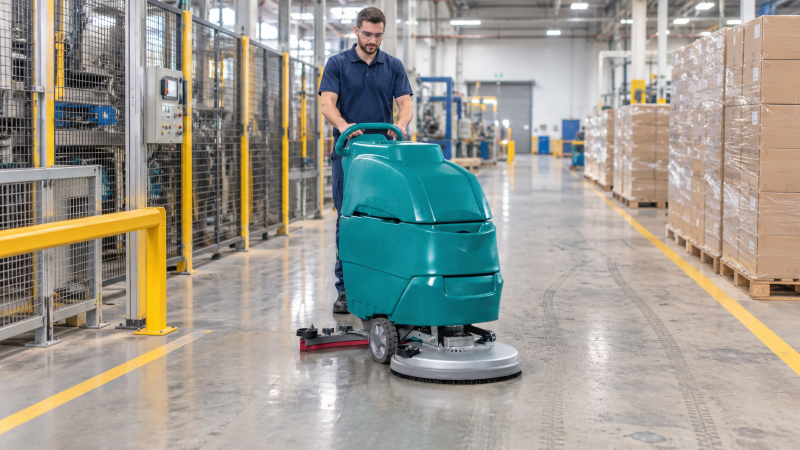
| Route pattern | Start with | Reason |
|---|---|---|
| Tight cells and frequent turns | Compact walk-behind | Easier to place around equipment and short production runs |
| Long open aisles and large bays | Wide walk-behind or ride-on | More coverage per pass and less operator fatigue |
| Mixed route with tight and open sections | Compare both sizes | The largest machine may not reach every area that needs cleaning |

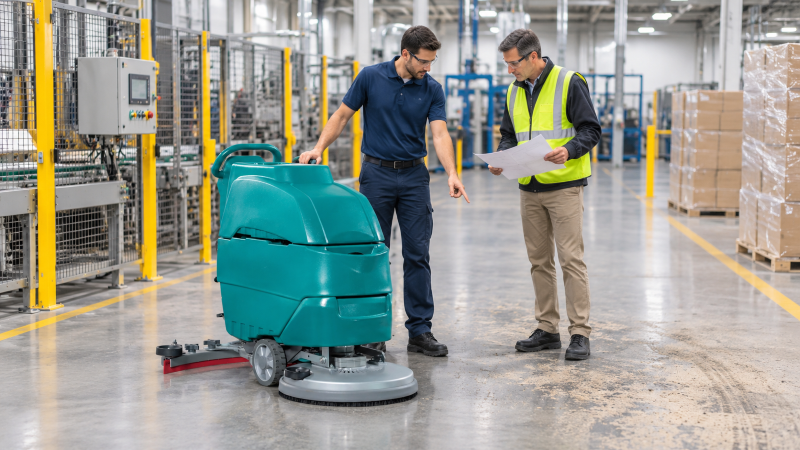
If the main risk is scheduling production around cleaning, the factory cleaning without stopping production guide covers zone release and timing. For mixed oil, coolant and metal particles, use the machine shop floor cleaning sequence.
It depends on the soil. A scrubber handles wet film and attached dirt; a sweeper is used for dry debris. Some factories need a defined two-stage cleaning process rather than one machine to do every task.
Start with the route and heaviest soil, then test the proposed machine in that area. No model is automatically best for every factory because access, floor finish and debris differ.
Use the rated area only as a comparison starting point. Turns, equipment, refilling, emptying and the number of passes determine real output in a production building.
That requires site-specific risk controls, route separation and approval from production and safety teams. Do not assume a cleaning machine can operate near active equipment simply because the path looks wide enough.
Map the production zones, define the soil and measure the real route. The right factory floor cleaning machine is the one that can complete those requirements repeatedly within the available cleaning window.
Match a machine to your factory floor
Send the production areas, main soil, cleanable area, narrowest access route and cleaning window. We can narrow the equipment class before a site trial.
Email: Donnie@terrascrubx.com
WhatsApp: +86 166 0187 1755
No. 600, Jiye Road, Sheshan Town, Songjiang District, Shanghai, China