
Falls are the leading cause of injury-related death among adults 65 and older, according to the CDC. At Willowbrook Senior Living in Lancaster County, Pennsylvania, the staff knew this statistic better than anyone. Between January and June 2024, they logged 11 fall incidents — seven of them traced back to wet or recently mopped floors. The facility director, Karen Kessler, made a decision that summer: no more mops in resident areas. What followed was a shift to battery-powered walk-behind scrubbers that cleaned quietly, dried instantly, and cut fall incidents nearly in half within eight months.

Why mopping was putting residents at risk in senior living facilities
The old routine at Willowbrook hadn't changed in 15 years. Night-shift custodians dragged string mops through 38,000 square feet of corridor, dining room, and common-area flooring. The problem wasn't effort. It was physics. A wet mop leaves a film of water on the floor. In a facility where residents shuffle, use walkers, or navigate in slippers, that film is a hazard that lasts 15 to 30 minutes per pass.
Karen's team tried everything. Wet floor signs. Restricting cleaning to 2 a.m. Switching to microfiber pads. Nothing solved the core issue: the floor stayed wet long enough for someone to slip. One resident fell outside the dining room at 6:15 a.m. — the floor had been mopped at 5:50. The sign was up. It didn't matter.
The CDC reports that 1 in 4 older adults falls each year, and 20% of those falls cause serious injury. In senior care facilities, wet floors are among the top three environmental contributors to fall incidents.
Switching to quiet battery-powered floor scrubbers for assisted living
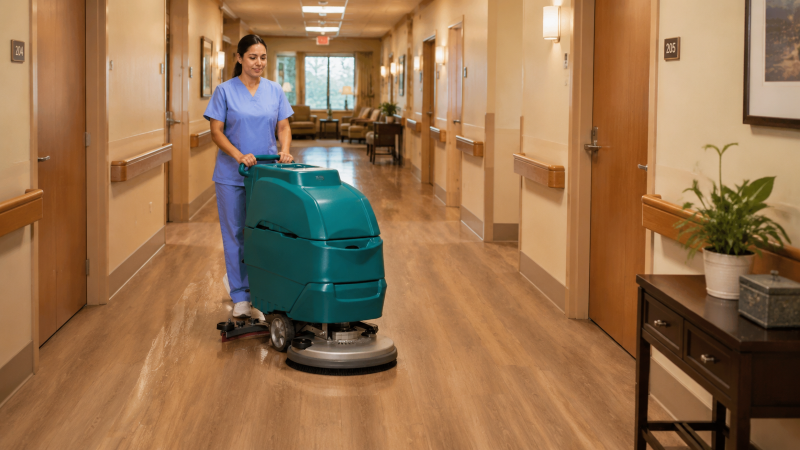
Karen contacted TerraScrub after a colleague at another community mentioned walk-behind scrubbers. The conversation focused on three things: noise, drying time, and maneuverability. The TerraScrub A3 walk-behind scrubber checked all three boxes. At 50 inches long, 22 inches wide, and 43 inches tall, it fits through standard 36-inch residential doors. Its brush and vacuum operate together, which means the floor gets scrubbed, rinsed, and dried in a single pass.
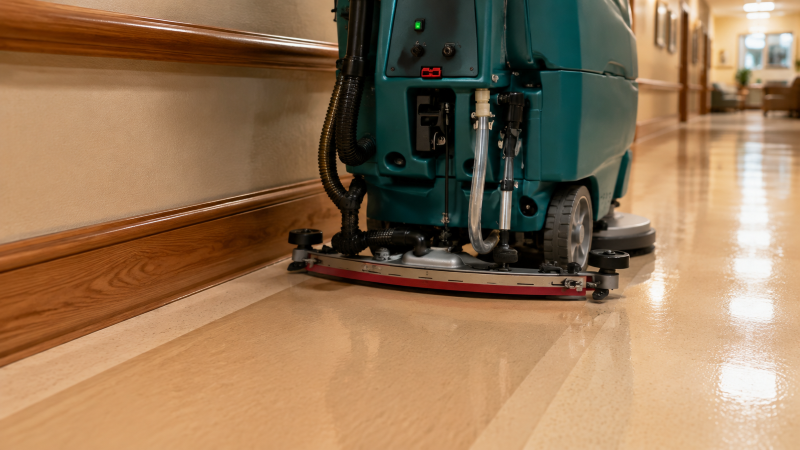
The machine applies cleaning solution through the brush, scrubs the floor, and a rear squeegee vacuums the dirty water immediately. The floor behind the machine is dry to the touch — not "will be dry in ten minutes" dry, but walkable the moment the squeegee passes. For a facility where a resident might round a corner at any hour, that difference is everything.
"I didn't even know they'd cleaned the hall until I saw the machine parked in the closet," said Margaret, an 82-year-old resident on the second floor. "Before, you could smell the bleach and the floor was slippery. Now I can't tell when they've been here, and that's a good thing."
How noise levels affect elderly residents during floor cleaning
Noise was the second concern. Traditional floor equipment — especially older ride-on scrubbers and burnishers — runs at 70 to 85 decibels. For residents with hearing aids, dementia, or simply light sleep, that level of noise at 3 a.m. causes agitation, sleep disruption, and in some cases, wandering behavior. The A3 operates at approximately 58 decibels, which is roughly the volume of normal conversation. Karen's staff can clean hallways outside resident rooms without triggering a single call light.
The battery-powered motor also means no cords. No extension cords running down hallways, no trip hazards, no need to unplug and replug as the operator moves from section to section. In a senior living environment, a cord on the floor is just another fall risk.

Daytime cleaning protocol for nursing home floor safety
Once the machines arrived, Karen rewrote the cleaning schedule. Instead of cramming all floor care into the 11 p.m. to 6 a.m. window, the team split cleaning into two shifts. High-traffic corridors — dining room approaches, activity room entries, and main lobbies — get cleaned between 10 a.m. and noon, when residents are in programmed activities. Resident hallways get cleaned between 1 p.m. and 3 p.m., during rest period. Night shift handles only spot cleaning and spills.
Willowbrook Daily Floor Care Protocol
- 10:00–12:00 — Common areas and dining room approaches (residents in activities)
- 13:00–15:00 — Resident hallways (rest period, minimal foot traffic)
- 15:00–16:00 — Physical therapy room and wellness center
- Night shift — Spot cleaning only, no full-floor passes
- Before each shift — Inspect squeegee blade, check solution level, verify battery charge
- Weekly — Deep clean with degreaser in kitchen and dietary prep areas
Before and after: fall incident data at Willowbrook
11 fall incidents in 6 months
7 traced to wet or recently mopped floors
3 resident complaints about chemical odor
Night-shift cleaning only, 11 p.m.–6 a.m.
6 fall incidents in 8 months
0 traced to wet floors (squeegee-dry on contact)
0 resident complaints about noise or odor
Daytime cleaning split across two shifts
The numbers speak for themselves, but Karen says the real change is harder to measure. "It's the things you don't see," she said. "Fewer call lights at night. Residents sleeping through the cleaning shift. Staff who aren't stressed about whether they remembered to put the wet floor sign back up. The machine does the worrying for us."
Staff training and adoption in elder care facilities
Willowbrook has 14 custodial staff members across three shifts. Training on the A3 took about 90 minutes per person. The machine has three controls: solution flow, brush pressure, and forward/reverse. There's no steering wheel, no throttle, no complex settings. Staff push it like a shopping cart. The squeegee lifts automatically when the machine stops moving backward, so dirty water doesn't pool.
Karen assigned two staff members per shift as "scrubber operators" and rotated the role weekly so everyone stayed familiar with the machine. Within three weeks, the entire staff was comfortable. The only recurring maintenance task is rinsing the squeegee blade and emptying the recovery tank — both take under five minutes.
TerraScrub A3 walk-behind scrubber: 50in × 22in × 43in, 21-inch cleaning path, 2,200–2,400 sq ft/hour productivity, 58 dB operating noise. Fits through standard 36-inch doors. Battery-powered, cordless.
What other senior living communities can learn from Willowbrook
Not every facility needs the same approach. Willowbrook is a 120-bed community with a mix of independent living, assisted living, and memory care units. A smaller 40-bed facility might need only one machine. A 300-bed continuing care retirement community might need two or three. But the principles are the same: dry floors on contact, low noise, cordless operation, and a cleaning schedule built around resident routines — not custodian convenience.
The other lesson is about the mop itself. Karen's team kept two string mops for emergency spills, but they haven't been used for routine floor care in over a year. "Once you see a scrubber leave a dry floor behind it," she said, "you can't go back to pushing water around with a mop."
Want to learn how TerraScrub battery-powered scrubbers can help your senior living community reduce fall risks? Reach out to Donnie — he'll walk you through machine specs, sizing for your facility, and dealer options in your region.