

WAREHOUSE OPERATIONS · 2026
A floor scrubber can be the right size, arrive with a full battery and still make the warehouse less productive. The problem usually appears in the first week: the operator starts at the loading lanes during the busiest hour, turns into an aisle that is being replenished, then waits for three forklifts to clear. Cleaning time goes up, traffic backs up, and the team begins to treat the machine as an obstruction rather than a tool. A route plan prevents that by deciding where the machine may work, when it may enter and how it leaves a zone. It also gives the operator a repeatable sequence, so the quality of the shift does not depend on who remembers to hold the handle.
Two warehouses with the same 20,000 m² footprint can need very different cleaning schedules. In one, pallets remain in the racking and forklift routes stay predictable. In the other, goods arrive throughout the day, aisles are repeatedly blocked for put-away, and the cleaning machine has to cross active loading lanes. The second site does not simply need a wider scrubber or a faster operator. It needs a route that separates the cleaning pass from the most disruptive traffic movements.
Traffic conflict
The machine enters an aisle while a forklift, pallet truck or replenishment team is already working there.
Route backtracking
The operator cleans an aisle, exits, then returns through the same zone to reach another section.
Hidden downtime
Refilling, dumping the recovery tank or parking the scrubber blocks a doorway or the only practical route to the charger.
The route plan should be owned by operations and cleaning together. Cleaning knows where soil gathers; warehouse operations knows when a lane can be released. A plan created by only one team tends to fail on the first busy shift.
A useful map does not need cleaning software. A warehouse floor plan printed on A3 paper is enough if it shows the zones where traffic behaves differently.
| Zone | Typical traffic | Cleaning approach |
|---|---|---|
| Loading and dispatch | Trucks, forklifts, pedestrians, trailers and door movements | Clean during closed-door windows or divide the dock into controlled sections |
| Main circulation lanes | Forklifts moving between docks, storage and production | Avoid peak movement; use one-way cleaning direction where the layout supports it |
| Storage aisles | Put-away, picking and occasional pedestrian access | Release one aisle or block at a time instead of closing the whole picking route |
| Cross aisles | Intersections, turning vehicles and people crossing between zones | Treat as conflict points; use barriers and a planned sequence |
| Low-traffic perimeter | Infrequent vehicle movement, walls, rack ends and open floor | Use as the first or last pass, not as a detour between main zones |
Use different symbols for closed aisles, one-way route sections, charging points and traffic crossings. Colour alone is not enough: floor plans may be printed in black and white, and some operators may find colour differences hard to distinguish.

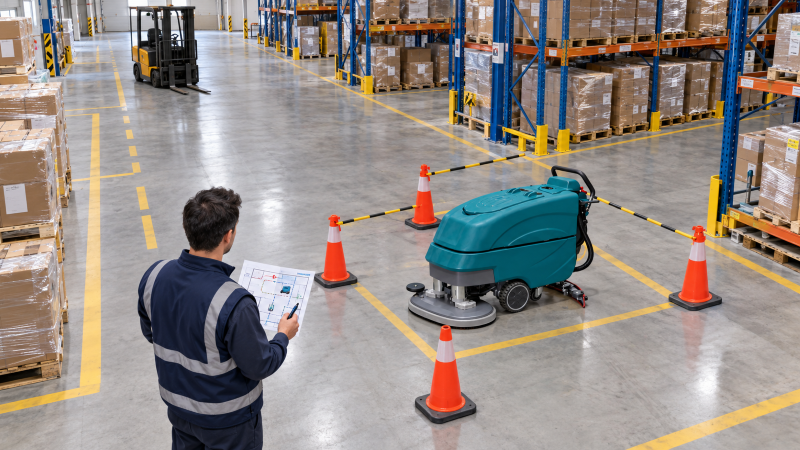
Build the first version during a normal operating day. A quiet weekend walk-through hides the traffic conflicts the cleaning team deals with every weekday.
Count vehicle movements at the docks, main lanes and cross aisles in 30-minute blocks. Ask shift leaders when put-away and replenishment peak. The best cleaning window is often a short gap between receiving and dispatch, not automatically the night shift.
Closing the entire warehouse for cleaning protects the machine but stops the operation. Closing one aisle or one section keeps other routes available. The exact safe zone must be agreed with the site's traffic-management plan and marked so pedestrians and vehicle operators can see it.
A practical sequence moves through a block of aisles and exits at a cross aisle without returning through the same wet floor. Where possible, keep the scrubber on the outer edge of the cleaning zone and work inward. Wet-floor signs alone do not make a route safe, particularly where forklift sightlines are restricted.
The scrubber should not be refilled or parked in a doorway, at the foot of a ramp or beside the busiest dock lane. Place the routine stop where the operator can pull fully clear of vehicle traffic. This is also the point where the route plan should consider the machine's actual tank size and charging routine, not a generic assumption about how long a battery lasts.
Docks, entrances, cross aisles and spill-prone production areas usually need attention first. Storage aisles farther from external doors can follow a less frequent cycle. The route can then be shortened on a busy day without abandoning the areas most likely to create dust, marks or slip concerns.
Record four numbers: machine-on time, waiting time, number of route interruptions and total shift time. A route that looks efficient on the plan but generates repeated waiting is not efficient. Run the trial at the intended shift, with the normal forklift activity and the normal loading schedule.
Seasonal stock, temporary racking and new pick faces can turn a clear lane into an obstruction. Put the route on the same review cycle as the warehouse layout. The operator should be able to report a persistent conflict without waiting for an annual cleaning review.
Planning rule: if the scrubber moves after the floor is already wet, the route order is usually wrong unless a second pass is intentional.
The largest scrubber is not automatically the least disruptive choice. A wide machine may reduce the number of passes, but it can also need a larger temporary exclusion zone. A compact walk-behind may take longer yet fit into short, narrow windows while other aisles stay open.
| Route pattern | Machine characteristic to check | Route-planning consequence |
|---|---|---|
| Long open aisles and large floor plates | Wider cleaning path, traction drive and large tanks | Fewer passes and fewer water stops, provided the clear aisle allows continuous movement |
| Narrow aisles and frequent turns | Compact body, practical turning clearance and simple operation | Short zone closures may be easier than reserving one wide route for a large machine |
| Multiple floors or frequent ramp transitions | Weight, battery configuration and route between levels | Plan the machine movement separately from the cleaning pass; confirm lift and floor limits |
| Heavy dust or frequent refill needs | Tank capacity and recovery-tank routine | Place the service point on the route; avoid returning across a cleaned lane |
Measure the narrowest practical passage after pallets, guard rails and open doors are in place. The warehouse aisle width and scrubber size guide explains why the brush width alone is not enough for this decision.

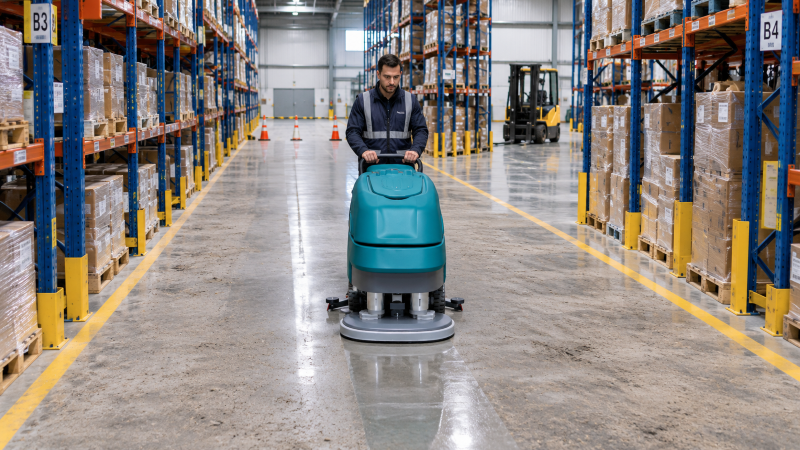
Assume a 3PL warehouse has 15,000 m² of cleanable floor, receiving peaks from 07:00 to 09:00 and dispatch peaks from 15:00 to 17:30. The narrowest rack aisle cannot be closed while a pick wave is active. This is a planning example, not a site survey, but it shows how the route changes the equipment decision.
THEORETICAL STARTING POINT
At a rated 4,200 m²/h, 15,000 m² equals 3.6 continuous machine hours. That is not a promise that one operator will finish in 3.6 hours. Turns, waiting, refilling, congestion and a second pass all add time.
A practical trial could divide the work into three route blocks:
If the trial shows three hours of cleaning plus two hours of waiting, the answer is not automatically a faster machine. Move one route block, combine adjacent aisles, or release a different section during the gap. The route should be adjusted until the machine is working through a clear zone rather than competing with every vehicle movement.
Route efficiency cannot override the site's traffic-safety rules. The scrubber still needs a planned stopping distance, adequate visibility and separation from powered industrial trucks. OSHA's powered industrial trucks eTool outlines the interaction between vehicle types, pedestrians, loads and operating areas. It is a useful reference, but the employer's local risk assessment and applicable regulations remain the controlling standard.
The cleaning plan should also be included in shift handover. A temporary route that only the day cleaning operator knows will be ignored by the next crew. The multi-shift floor-care schedule guide covers how ownership and timing need to carry across shift changes.


A route is only an improvement if it reduces the delay it was meant to solve. Track a few simple measures before and after the change.
| Measure | How to record it | What it reveals |
|---|---|---|
| Route completion time | Start and finish when the machine enters and leaves the zone | Whether the planned sequence is realistic |
| Waiting time | Time stopped for vehicles, pedestrians or blocked access | Whether the cleaning window is poorly chosen |
| Repeat passes | Areas scrubbed twice for the same soil | Whether machine settings or route order cause wasted work |
| Traffic disruption | Shift-leader report of delays or unsafe crossings | Whether the savings came at the expense of warehouse flow |
Starting at the dock every time
It is the most visible area, but not necessarily the area that must be cleaned first. Plan around when the dock can be released.
Closing the whole warehouse
A smaller controlled zone often causes less disruption than reserving one long window for the entire floor.
Treating rated coverage as a schedule
The m²/h figure excludes turns, refills, waiting and second passes. Measure the real route instead.
Leaving the plan with one operator
Post the current route at the handover point and update it when racking, stock levels or traffic patterns change.
No. Night is only better if vehicle traffic and cleaning staffing actually make it lower-risk. Some warehouses have a stronger gap between receiving and dispatch or before the first outbound wave. Choose a window based on observed traffic and safe access.
Only within a traffic-management method accepted by the site. The cleaning machine, pedestrians and forklifts should not share an unmanaged aisle by assumption. Many operations use zoned closures, dedicated lanes or planned windows instead.
There is no universal figure. Start with the cleanable area, machine capacity, available window and measured interruptions. A route that covers 5,000 m² without blocking receiving may be better than a theoretical 15,000 m² route that causes two hours of traffic delay.
Check the narrowest clear passage, turning route and length of continuous runs first. A wider brush can reduce passes, but it may require a larger exclusion zone. The machine should match the route that operations can safely release.
Review it after any racking change, new product flow, shift-pattern change or repeated traffic conflict. A short monthly check is also useful for catching seasonal stock and temporary storage that have narrowed the planned route.
Mark the traffic zones, measure the narrowest route, agree when each section can close, and time a trial with normal warehouse traffic. That information is also the right basis for machine selection. For a more detailed walk-behind specification example, see the TerraScrub BA860 route and specification guide.
Discuss a warehouse or factory cleaning route
Send the cleanable area, narrowest aisle, traffic peaks and daily cleaning window. We can compare compact and wide walk-behind formats for the route you actually need to keep open.
Email: Donnie@terrascrubx.com
WhatsApp: +86 166 0187 1755
No. 600, Jiye Road, Sheshan Town, Songjiang District, Shanghai, China