
FOOD PLANT EQUIPMENT · 2026
Search for a “food-grade floor scrubber machine” and many listings use the phrase as if it settles the specification. It does not. One supplier may mean that selected machine materials are suitable for food-contact applications; another may mean the machine is easy to clean or resistant to a certain washdown chemical. A third may simply use the term because the scrubber is sold to food factories. Those are different claims, and none automatically proves that the machine is appropriate for a particular production zone. Food-plant buyers need to ask what is being asserted, where the machine will operate and what evidence supports the claim.
A floor scrubber is primarily cleaning equipment; it is not normally an ingredient-contact surface. The relevant risks usually come from what the machine leaves behind, releases, spreads or fails to remove. That may include cleaning-chemical residue, dirty water, dust, grease, debris, aerosols or moisture carried into a sensitive area.
For that reason, a useful food-grade claim should have a scope. It should explain which part, condition or use is being addressed.
| Possible meaning | What the buyer should ask |
|---|---|
| Material compliance | Which materials comply with which standard, and do any of them have a food-contact function? |
| Cleanable design | Can the tanks, hoses, squeegee and brush areas be inspected, drained and cleaned without concealed pockets? |
| Washdown resistance | Which water, chemicals, temperatures and exposure times were tested? Is protection certified or merely described? |
| Chemical compatibility | Can the tanks, seals, hoses and pump path tolerate the plant's actual cleaning agents at the stated dilution? |
| Audit documentation | What manuals, material declarations, cleaning instructions and test records are provided? |
| Third-party certificate | Which organisation issued it, what is the certificate number, and exactly which product and standard are covered? |
If a seller cannot separate those points, treat “food grade” as a marketing description until the details are documented.
The same scrubber may be acceptable in an ambient warehouse and unsuitable in a high-care area. Start with the plant's food-safety risk assessment, then define where the machine will enter, clean, drain, park and leave.
High-care or ready-to-eat areas
Prioritise controlled water and aerosol movement, cleanable surfaces, dedicated storage and documented cleaning. Confirm the equipment plan with the site's food-safety team.
Wet processing
Check chemical resistance, recovery capacity, drainage and how easily grease, food residue and dirty water can be removed.
Dry-ingredient areas
Think about dust generation and accidental moisture, not only scrubbing performance. A wet method may be inappropriate in some sensitive zones.
Ambient warehouse
Focus on dust, debris, pallet traffic and route separation. The cleaning demands may be lower, but cross-contamination paths still need review.
List every transition: from low-care to high-care, from wet to dry, from a dirty floor to a cleaned one. A machine that cleans the floor while carrying contamination on its wheels or squeegee has not solved the full problem.

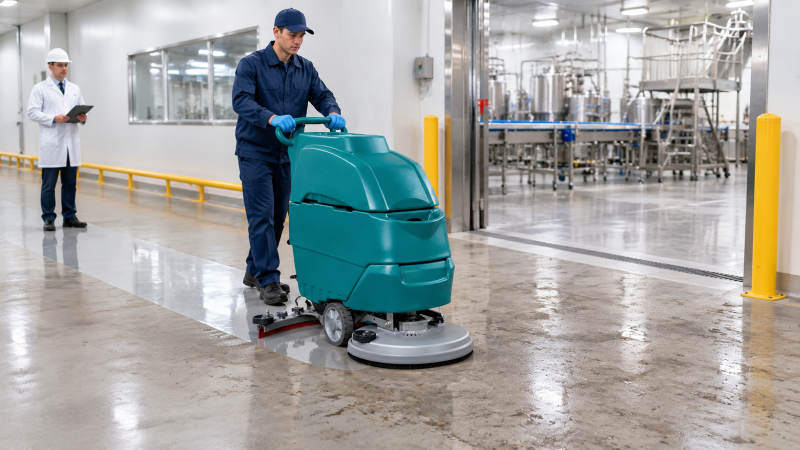
Inspect lids, tank openings, squeegee mounts, brush guards and hose connections. Look for sharp corners, cloth-covered panels, exposed foam and narrow gaps that cannot be reached with the plant's normal cleaning method. A smooth-looking cover is not useful if the soil goes behind it.
The recovery tank should drain fully, and the outlet should be accessible without dismantling major components. Inspect the route from the squeegee through the hose to the tank. Dirty water left in a low point after routine emptying becomes a new cleaning problem.
Ask how the brush type suits the floor and soil, and how larger debris is controlled before scrubbing. A scrubber can spread wet food residue if the cleaning sequence does not first remove loose material appropriate to the area.
In a food plant, a wet floor can be more than an appearance issue. Test on a representative surface and inspect the floor behind the squeegee. Note streaks, standing water and how much water remains around joints or damaged floor areas.
Do not accept “sealed electronics” without asking for the documented rating and the conditions it covers. A machine used near washdown, hoses or wet floors may require a different protection strategy from one used in a dry ambient warehouse. The site's electrical and safety teams should review the installation.
Provide the supplier with the approved product names, concentration and temperature used by the plant. Check the tank, seals, hoses and pump path against those conditions. Our guide to cleaning chemicals used with floor scrubbers explains why chemical compatibility and residue control need to be considered together.
Ask for the exact standard, issuing body, certificate scope and expiry date. A generic PDF or a logo is not enough if it does not identify the machine or component. If a phrase such as “food-safe material” is used, ask which material and which test or declaration supports it.
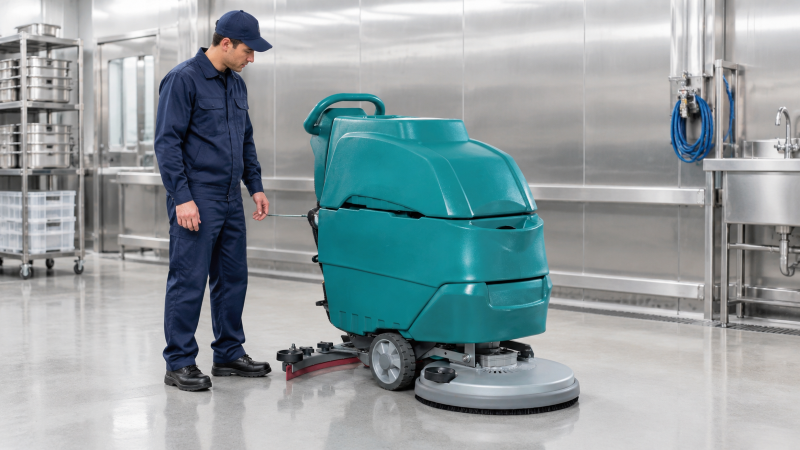
The supplier should be able to describe how the machine is emptied, rinsed, inspected and stored between uses. A clear procedure is more valuable than a vague promise that the machine is “easy to clean.”

Ask these questions before sending a purchase order, not after the machine has been used in production.
| Question | Evidence to request |
|---|---|
| What exactly do you mean by food grade? | A written statement linking the term to a material, component, test or cleaning purpose |
| Which chemicals and temperatures have been tested? | Compatibility chart, test conditions and named materials for tanks, seals and hoses |
| What electrical protection is documented? | The exact rating and the applicable environmental limits |
| Which certificate applies to this model? | Certificate number, issuing organisation, product identifier and scope |
| How should the machine be cleaned between zones? | A step-by-step procedure covering tank, squeegee, brush area, hoses and storage |
A demonstration in a supplier showroom cannot prove how the machine will perform at the plant. If the facility allows an on-site trial, test the zone that creates the hardest cleaning condition rather than the cleanest open aisle.
Use plant-specific swabbing, ATP checks or other verification methods only within the site's established food-safety procedure. The equipment supplier should support the trial, but the facility remains responsible for deciding whether the cleaning method controls its identified risks.


HACCP is a systematic approach to identifying and controlling food-safety hazards; a floor scrubber is not “HACCP certified” merely because the seller says so. The equipment should fit into the plant's documented cleaning and preventive-control programme, with procedures and records that the site can verify.
In the United States, the FDA notes that applicable food facilities need a written food-safety plan with preventive controls. A supplier can provide equipment information, cleaning instructions and evidence for a claim, but it cannot replace the facility's hazard analysis or decide local regulatory compliance on the buyer's behalf. See the FDA's preventive controls rule for human food for the general framework.
For machine selection by plant size, cleaning workflow and common equipment features, continue with the broader floor scrubber buying guide for food processing plants. Use the floor scrubber specification guide when checking electrical ratings, tank capacity and water-recovery details.
There is no single answer that applies to every listing. The claim may refer to materials, cleanability, washdown resistance, chemical compatibility or documentation. Ask the supplier to identify the exact scope and evidence.
Do not assume that a floor-cleaning machine carries individual “FDA approval.” Ask for the exact regulation, material declaration or certificate being referenced, then confirm how it applies under the site's food-safety plan and local requirements.
Not automatically. Stainless steel can suit some wet or corrosive environments, but material choice depends on the zone, cleaning chemicals and construction quality. A poorly designed stainless-steel machine can still have inaccessible soil traps.
It may be possible in a lower-risk area if the plant's risk assessment and cleaning controls support it. High-care, wet-processing and dry-ingredient zones have different requirements, so the answer cannot be based on the machine name alone.
HACCP is a food-safety management approach rather than a machine certificate. A supplier can provide equipment data and cleaning instructions that help the facility build and verify its programme, but the facility's food-safety plan and applicable regulations determine what is required.
A food-grade floor scrubber machine should be assessed against the zone, soil, chemicals, cleaning routine and documentation of the plant where it will work. Ask what the term covers, verify the supporting document and test the tank, squeegee and recovery path as a complete cleaning system.
Discuss a food-processing floor cleaning application
Send the production zone, floor type, main soil, approved cleaning chemicals, cleaning window and audit requirement. We can help match a scrubber configuration and the documentation needed for your review.
Email: Donnie@terrascrubx.com
WhatsApp: +86 166 0187 1755
No. 600, Jiye Road, Sheshan Town, Songjiang District, Shanghai, China