

Mark Chen manages a 10-building office portfolio for a regional real estate firm in the Pacific Northwest. The numbers were not adding up. His nightly cleaning bill across all ten properties had crept up to where it was eating 14% of gross operating expenses, well above the 9-11% benchmark that BOMA International recommends for Class A office space. Something had to give.
The root cause was fragmentation. Each building had its own cleaning contractor, its own equipment purchases, and its own idea of what "clean" looked like. Building A used a mop-and-bucket crew. Building B leased a ride-on scrubber but only ran it three nights a week. Building C had two ride-on machines sitting broken in a closet. Nobody tracked labor hours per square foot. Nobody compared notes.
What follows is the 14-month story of how Mark consolidated equipment, standardized protocols, and cut his portfolio-wide cleaning costs by 28% without firing a single janitor or cutting service frequency.
10 office buildings | 850,000 sq ft total | Floor types: polished concrete (40%), ceramic tile (30%), VCT (20%), carpet tile (10%) | Buildings range from 45,000 to 120,000 sq ft
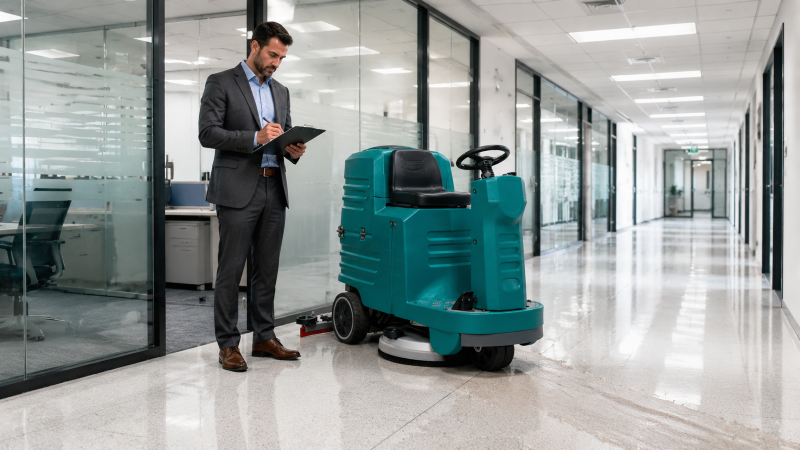
Before touching equipment, Mark needed a map. He audited every building, logging square footage, floor type, current cleaning method, nightly labor hours, and equipment condition. The results were messier than expected.
Two buildings were still on mop-and-bucket. Three had broken or underused scrubbers. Zero buildings shared equipment. That was the gap.
Mark's first move was killing the mop habit. According to ISSA's Cleaning Industry Management Standard, a single mop covers roughly 2,000-3,000 sq ft per hour. A ride-on scrubber like the TerraScrub A5 handles 2,700 sq ft per hour, but the difference is night and day: the scrubber applies solution, scrubs, and vacuums the dirty water in one pass. The mop spreads it around.
He split the portfolio into two tiers based on square footage and floor layout:
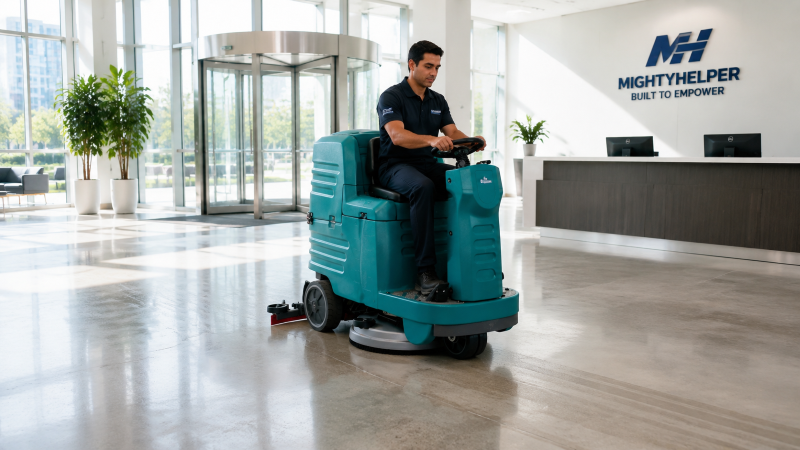
Buildings A and B got the TerraScrub A7 ride-on machines. With 34-inch cleaning paths and 5,500 sq ft/hour productivity, a single operator could finish 80,000+ sq ft in a shift without walking the entire distance. The operator rides, which means less fatigue and more consistent cleaning pressure.
The TerraScrub A5, at 50 inches long, 24 inches wide, and 41 inches tall, fits through standard office doors and navigates tight corridors, elevator lobbies, and restroom entries. Mark deployed A5 units to Buildings C, D, E, F, and J. At 21-inch cleaning width and 2,700 sq ft/hour, one pass covers what a mop crew needs three passes to achieve.

These two were the lowest-hanging fruit. Replacing mops with ride-on scrubbers cut labor time by 45% in Building G alone. The ROI was immediate because the buildings were paying for labor that the mop was wasting.
2 ride-on scrubbers A7 (Buildings A, B) | 7 compact ride-on scrubbers A5 (Buildings C, D, E, F, G, I, J) | 1 carpet extractor retained (Building H, carpet tile floors) | Total fleet: 10 machines
Buying machines was the easy part. Mark knew that without a shared protocol, each building supervisor would run the equipment differently and the savings would evaporate. He wrote a one-page cleaning playbook and posted it in every janitor's closet.
Inspect squeegee blade, check solution tank, verify battery charge above 80%. Log in the shared Google Sheet. Takes 4 minutes.
Each building has a mapped zone route starting from the farthest point and working toward the supply closet. No backtracking. Reduces machine runtime by 12%.
Neutral pH detergent at 1:200 dilution for polished concrete, 1:150 for ceramic tile. Pre-mixed in 5-gallon jugs at the central supply room. No on-site guessing.
Ride-on machines at 50% throttle in lobby areas, 75% in open corridors. Prevents solution from outrunning the squeegee.
Record square footage cleaned, solution used, and any floor issues (stains, damage, slip hazards). Flagged issues get photographed and sent to Mark's phone via the building WhatsApp group.
Not every building needed its own backup machine. Mark created a shared equipment pool housed at Building B, the portfolio's geographic center. Two spare ride-on scrubbers and a spare squeegee blade kit sit there, ready for same-day swap if any building's primary machine goes down for maintenance.
Before the pool, a broken scrubber meant three days of mop-and-bucket fallback while waiting for parts. Now a courier delivers a replacement within 4 hours. That single change prevented an estimated 180 hours of lost productivity in the first year.
2 backup ride-on units serve 7 primary ride-on locations. Not every building needs a spare. The pool covers 100% of downtime risk at 28% of the cost of buying one backup per building.
Mark tracked every dollar for 12 months after full deployment. Here is the portfolio-wide comparison, averaged across all 10 buildings.
Chemical usage dropped 43% because scrubbers apply solution at a controlled rate (1:200 dilution) while mops waste solution in overflow buckets and dirty water. The ISSA estimates that controlled-dilution scrubbing uses 70% less water and chemical than traditional mopping for equivalent square footage.
The payback period was the number Mark cared about most. At 11 months, the equipment paid for itself through labor savings alone. The chemical savings, complaint reduction, and slip-and-fall reduction were all bonus. By month 14, the portfolio was running at 9.8% of gross operating expenses for cleaning, right in line with the BOMA benchmark.
Here is what surprised Mark the most: the biggest savings did not come from the largest buildings. They came from the two mop-and-bucket holdouts, Buildings G and I. Those buildings saw 45% labor reduction overnight, because the mop was that inefficient. The ride-on machines in Buildings A and B were already productive, so their gains were modest by comparison.
If you are managing multiple buildings and still running mops anywhere, those buildings are your fastest ROI. Replace them first.
If you oversee a portfolio of office buildings and want to see what standardized floor cleaning equipment could do for your bottom line, reach out to Donnie at TerraScrub. We help property managers calculate fleet sizing, dilution protocols, and ROI timelines for multi-building deployments. No pressure, just numbers.