

EQUIPMENT FIT GUIDE · 2026
A ride-on scrubber can have a cleaning width that suits the floor and still be the wrong machine for the building. The number that matters at a doorway is the machine body width. At the end of an aisle, length and steering room matter. On a ramp or mezzanine, the weight and route matter. Buyers often compare only the brush width and later discover that the squeegee catches a rack leg, the machine cannot turn cleanly or the doorway is 20 mm too narrow. The published dimensions below give a realistic starting point, but the final decision still needs a route survey with pallets, doors and turning points in their normal positions.
The table uses the currently published product dimensions. Custom battery configurations, options and production revisions can change the final figures, so confirm the exact quotation before relying on a critical doorway or lift measurement.
| Model | Body L × W × H | Cleaning width | Squeegee width | Rated coverage | Weight |
|---|---|---|---|---|---|
| A5 Mini | 1,260 × 620 × 1,030 mm | 530 mm | 770 mm | 2,700 m²/h | Confirm in quotation |
| A7 | 1,650 × 900 × 1,300 mm | 860 mm | 1,100 mm | 5,500 m²/h | 330 kg |
| BA850 | 1,700 × 950 × 1,500 mm | 850 mm | 1,100 mm | 5,800 m²/h | 580 kg |
| A17 | 2,230 × 1,240 × 1,480 mm | 1,015 mm | 1,245 mm | 7,000 m²/h | 1,525 kg |
Dimensions are shown as length × body width × height. They do not include a safety margin, operator judgement, turning sweep or packaging.
Body width
The main measurement for a doorway, lift entrance or tight straight aisle.
Cleaning width
The path covered by the brush deck; it is not the same as how much space the complete machine requires.
Squeegee width
Usually wider than the body; check rack legs and door frames at the rear of the machine.
Machine length
Controls how much room is needed to enter, reverse, turn and leave a lift or aisle.
For example, the A7 has a 900 mm body width, an 860 mm cleaning path and a 1,100 mm squeegee. A 900 mm clear doorway leaves no practical separation once the body fills it, and the wider squeegee still has to pass. The buyer should measure the entire operating envelope, not just the brush.

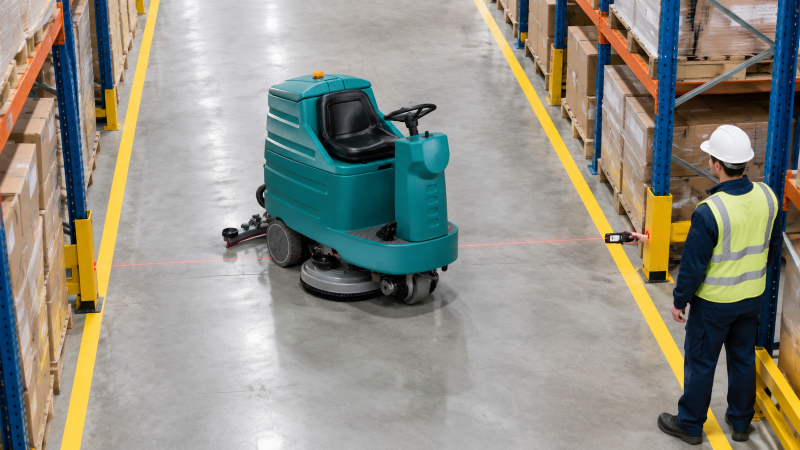
Measure between the parts that actually reduce clearance: pallet corners, rack-end protection, columns, guard rails and stored goods. Take the smallest clear width, not the nominal aisle width on the drawing.
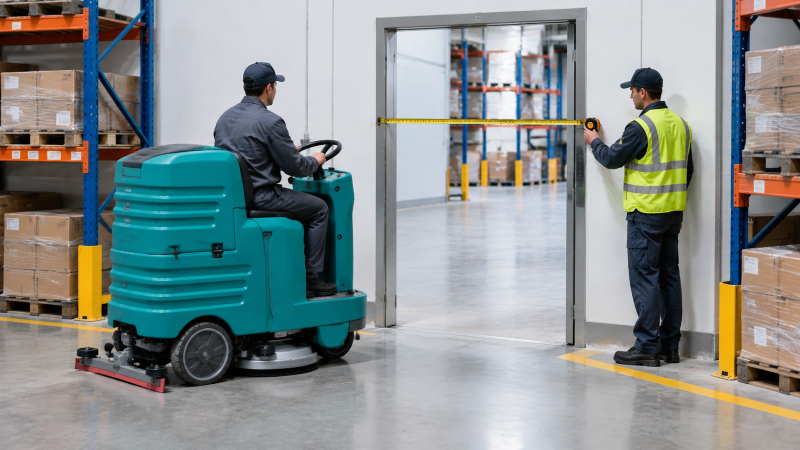
Measure the clear opening with the door open and any gate secured. Record the threshold height and approach angle. A machine can fit the opening and still be difficult to align because the approach is short or obstructed.
Measure the cross aisle from the last rack leg to the opposite obstruction. Published length and width do not replace a turning test because the scrubbing deck, rear squeegee and steering path move through a larger envelope.
Check the entrance, internal cabin dimensions, rated load, ramp width and any slope transition. The A17 weighs 1,525 kg before water, the operator or carried items; floor-load and transport approvals belong in the selection process.
Measure the route into the parking area, not only the parking space. The machine should not have to reverse through a busy loading lane or block an exit to reach the charger.
A common mistake is subtracting the machine width from the aisle width and treating the remaining space as usable clearance. That ignores rack protection, operator steering, uneven pallets, floor joints and the sweep of the rear squeegee.
| Site condition | How to interpret it |
|---|---|
| 1,000 mm clear aisle | The 900 mm-wide A7 body leaves only 100 mm total before the squeegee, steering and obstructions are considered; measure the real route and test before selecting it. |
| 1,200 mm doorway | The 1,240 mm-wide A17 body cannot pass as a simple straight fit; check opening trim, door position and approach. |
| Tight elevator | Compare the whole body length and width, then confirm cabin depth, door swing, threshold and rated load. |
| Large open floor | A wider model may reduce passes, but only after every access point on the route has been checked. |
Clearance requirements vary by site, operator, speed and traffic controls. The examples show why nominal fit is not enough; they do not create a universal minimum clearance rule.
A5 Mini
Shortest and narrowest body in this comparison at 620 mm wide and 1,260 mm long. Start here when doorways, lifts or tight routes dominate.
A7
A 900 mm body and 1,650 mm length suit medium facilities with standard routes, subject to measured clearances and a trial.
BA850
A 950 mm body, 1,700 mm length and 580 kg weight need a more generous industrial route and appropriate floor access.
A17
A 1,240 mm body, 2,230 mm length and 1,525 kg weight are intended for very large floors with a route that can accommodate the full machine.


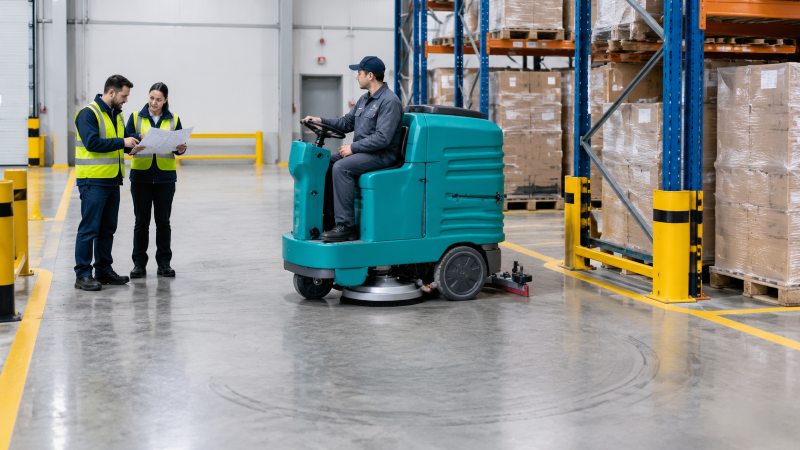
The general warehouse aisle width and scrubber fit guide covers the machine-class decision. Use the complete ride-on scrubber buying guide for wider model differences and the ride-on buying comparison for coverage, tanks and power.
Start with body width and length, then check the squeegee, turning envelope and route obstructions. Cleaning width alone cannot answer whether the machine will fit.
Physically, the body may enter, but only 100 mm remains before the squeegee, steering, rack protection and operator corrections are considered. Measure the actual route and run a controlled trial; do not use body width as proof of safe operation.
Usually not. Machine dimensions describe the machine. Ask for shipping dimensions and package weight separately if the delivery route, lift or storage area is constrained.
The squeegee can be wider than the body and sits at the rear of the scrubber. Check that it clears rack legs, door frames and other projections throughout the turn, not only while travelling straight.
Yes. Include the narrowest aisle and doorway, lift or ramp limits, longest clear run and any turning constraints. That lets the supplier shortlist a machine that has a realistic chance of fitting.
Compare body dimensions, cleaning width, squeegee width, weight and turning space together. The floor area determines how much work the scrubber has to cover; the route determines whether that scrubber can do the work in the building.
Check a ride-on scrubber against your warehouse route
Send the narrowest aisle and doorway, longest clear run, turning area, lift or ramp limits and daily cleanable area. We can narrow the model class before you arrange a site trial.
Email: Donnie@terrascrubx.com
WhatsApp: +86 166 0187 1755
No. 600, Jiye Road, Sheshan Town, Songjiang District, Shanghai, China