
A 280-room beachfront resort in Clearwater, Florida, deployed the TerraScrub C80 autonomous floor cleaning robot to handle sand, salt residue, and humidity-fueled grime across its lobby, corridors, and pool deck access points. The driverless machine runs 3-4 hour autonomous cycles covering 2,040 m²/h, navigates around guests and luggage carts without human input, and leaves floors dry on contact — all during overnight hours when the front desk is quiet but the building never fully sleeps.
Why Florida Beach Hotels Need an Autonomous Floor Cleaning Robot
Beach resorts fight a losing battle against sand. Guests track it from the beach through sliding doors, into elevators, down carpet runners, and onto hard floors in lobbies and dining areas. Add salt air corrosion, Florida humidity that turns dust into paste, and sunscreen oil transfers on tile — and you have a floor environment that defeats mops by 10 AM.
The American Hotel & Lodging Association reports that slip-and-fall incidents cost U.S. hotels an average of $48,000 per claim, with pool decks and lobby entrances being the top two locations. Source: AHLA Safety & Security Resources.
The resort's director of housekeeping had been running three staff members on the night shift just to mop the lobby and ground-floor corridors. They couldn't keep up. Sand would reappear within an hour of cleaning. The floors stayed damp too long, creating slip risks for early-morning guests heading to breakfast.
The C80 Driverless Scrubber: What It Does Differently
The TerraScrub C80 isn't a ride-on machine with an autopilot bolted on. It's built from the ground up as a driverless floor scrubber with dual navigation — vision cameras paired with 270° LiDAR. It maps the space on its first run, then plans optimal cleaning paths on every subsequent cycle.

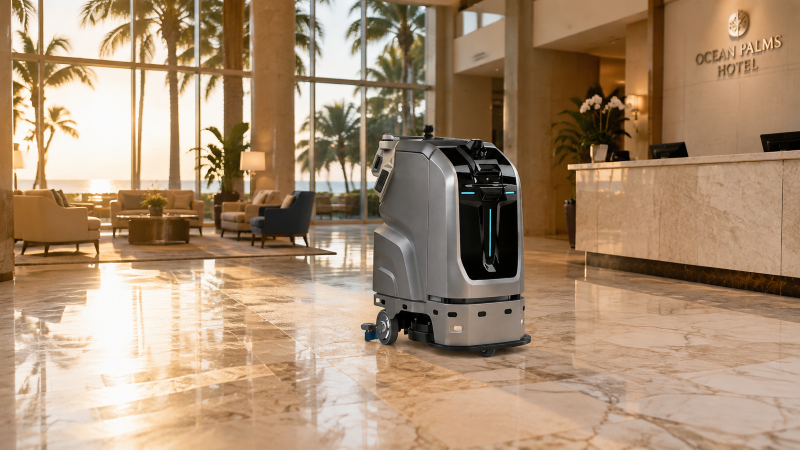
For the Clearwater resort, that meant the C80 learned the lobby layout in one training pass. After that, housekeeping staff simply pressed "start" on the touchscreen each night, and the machine went to work. It cleaned around luggage carts, slowed for late-night guests crossing the lobby, and returned to its charging station when the cycle finished.
Sand, Salt, and Humidity: The Florida Triple Threat
Three things make Florida beach hotel floors harder to maintain than a typical commercial building:
Sand tracking
The C80's 510 mm brush and 70L solution tank flush sand out of grout lines and textured tile that mops just push around. Its parabolic squeegee recovers the dirty water in one pass — no residue, no damp streaks. Floors are dry and walkable imhttps://terrascrubx.com/insights/solutions/floor-scrubber-startup-procedure-daily-preop-checklist.htmlmediately.
Salt air residue
Coastal properties get a fine salt film on everything, including floors near open doors and windows. The C80's solution system delivers consistent chemical concentration, cutting through salt residue without over-wetting the surface.
Humidity paste
When Florida humidity hits 85%+ and guests track wet footprints indoors, dust turns into a paste that sticks to floors. The C80's brush pressure stays constant regardless of floor condition, scrubbing that paste loose and recovering it in the same pass.
Results After 90 Days of Autonomous Operation

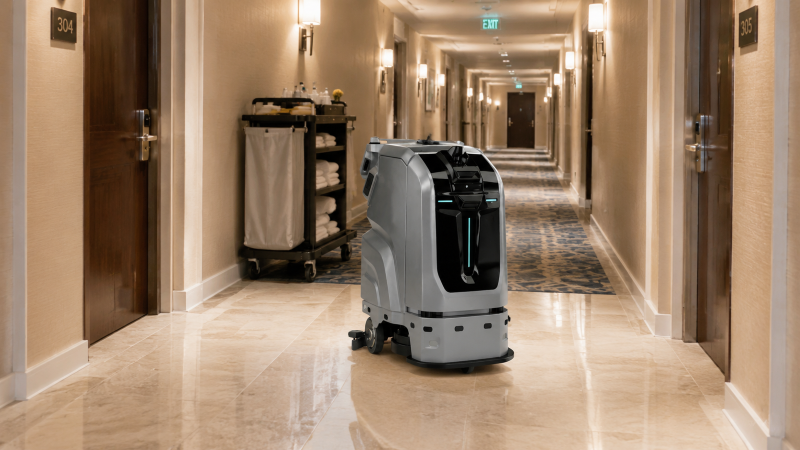
After three months of nightly C80 deployment, the resort reported the following:
- Night-shift floor cleaning labor reduced from 3 staff to 1 supervisor
- Guest complaints about sandy lobby floors dropped to near zero
- Slip-risk incidents on lobby tile: zero during the 90-day period
- Estimated labor savings: $58,000 annually at current staffing rates
The resort now follows a daily pre-op checklist before launching the C80 each evening — a 5-minute routine that keeps the machine in peak condition. They also switched to a low-disruption cleaning schedule that runs the robot between 2 AM and 5 AM, when guest traffic is lightest.
For hotels comparing autonomous robots against traditional equipment, the complete buyer guide to commercial floor scrubbers breaks down the trade-offs. And if you're running the numbers on labor savings, the ROI of switching from manual mopping to floor machines shows typical payback periods of 12-18 months for properties over 200 rooms. For reference, a 400-room hotel group that standardized floor care across 12 properties cut cleaning time 35% using battery-powered scrubbers — the C80 takes that further by removing the operator entirely.
Recommended: TerraScrub C80 Intelligent Driverless Floor Scrubber
The C80 is built for exactly this use case — large indoor commercial spaces that need consistent, autonomous floor cleaning without operator supervision. Here's why it fits Florida beach hotels:
| Spec | Details |
|---|---|
| Cleaning Width | 510 mm (20.1") |
| Area Performance | 2,040 m²/h |
| Working Time | 3-4 hours continuous |
| Solution / Recovery Tank | 70L / 50L |
| Navigation | Vision + Laser (Dual System) |
| Sensors | 270° LiDAR / 360° Depth Camera / Ultrasonic / IMU |
| Machine Size | 1160 × 580 × 1210 mm (46in × 23in × 48in) |
| Battery | 24V / 120Ah (Maintenance-free) |
Best for: Hotel lobbies, corridors, retail areas, airport terminals, hospital floors — any large indoor space that needs overnight cleaning without staffing up.
View C80 Intelligent Driverless Floor ScrubberRunning a beachfront property in Florida and tired of fighting sand with mops? The C80 autonomous floor cleaning robot handles the dirty work while your guests sleep. Tell us your floor area and layout — we'll show you exactly how the C80 fits your resort.