Michigan's auto plants run 24/7, and the floors take a beating from oil, coolant, metal shavings, and forklift traffic. Here's how a ride-on floor scrubber handles the job, what to look for, and why the BA850 is built for this environment.
Michigan employs roughly 170,000 workers in automotive manufacturing, concentrated in plants across Detroit, Flint, Lansing, and Ann Arbor. These facilities range from 500,000 to over 3 million square feet, and every square foot of that floor sees oil drips, coolant spills, metal fines, rubber tire marks, and forklift traffic on a daily basis.
OSHA standard 1910.22(a)(2) requires that "the floor of every workroom shall be maintained in a clean and, so far as possible, dry condition." In an auto plant, that's not a one-time job — it's a continuous cycle. Manual mopping can't keep up with the scale, and walk-behind machines are too slow for facilities this size.
A ride-on floor scrubber covers 5,800 m²/h (about 62,400 ft²/h). A 100,000 sq ft production area takes under two hours. The same job with a walk-behind would eat up an entire shift.

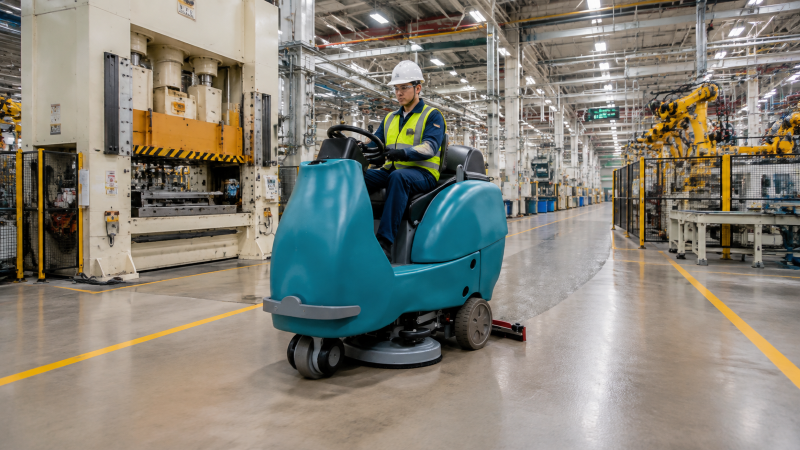
Auto plant floors aren't like warehouse floors. The contamination profile is nastier and more varied. You're dealing with four distinct problems:
Synthetic coolants leave a sticky film that regular detergents won't touch. You need a degreaser-rated solution and brushes aggressive enough to break the film without damaging sealed concrete.
Stamping and machining areas generate fine metal particles. These should be swept or vacuumed before scrubbing, otherwise they clog the squeegee and scratch the floor finish.
Press lines and robotic welders leak hydraulic fluid continuously. The scrubber needs enough brush pressure to cut through oil, and enough vacuum power to recover it before it spreads.
Rubber tire marks build up over months of forklift traffic. Heated water and stiff brushes remove them, but only if the machine has the weight to press the brushes into the floor.
The practical approach is a two-step process: sweep first to remove dry debris (metal fines, dust, scrap), then scrub to remove wet contaminants. This indoor vs outdoor floor cleaning equipment guide breaks down when you need a sweeper versus a scrubber versus both.
The BA850 weighs 580 kg (1,279 lb). That weight isn't a drawback — it's the reason the machine works on auto plant floors. Heavier machines apply more scrubbing pressure to the floor, and the dual 650W brush motors use that weight to grind through oil films and rubber marks that lighter machines just glide over.
At 580 kg, the BA850's brushes maintain consistent contact even on uneven concrete. Lighter machines bounce over expansion joints and floor seams, leaving streaks. The BA850's weight keeps the brushes planted, which means fewer passes and a cleaner floor. For facilities evaluating whether their floor conditions require a heavy-duty machine, this high-traffic vs low-traffic floor scrubber comparison covers durability and cleaning frequency tradeoffs.
The 180L clean water tank and 195L recovery tank cover roughly 4,000-5,000 m² before refilling. On a 200,000 sq ft production floor, that's about one refill mid-shift. The 36V/200Ah battery runs 4-5 hours continuously, which covers 23,000-29,000 m² on a single charge. For shift-level battery management, this battery charging best practices guide walks through charge cycles and maintenance.
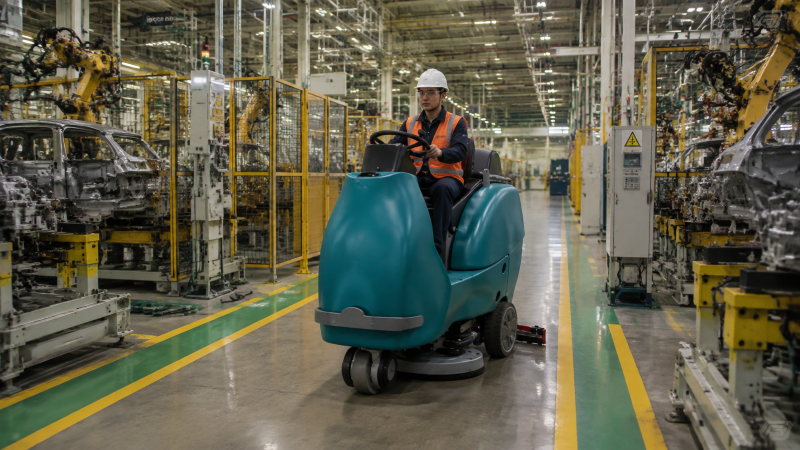
Auto plants have tight spots — between stamping presses, around robotic welder cells, and along narrow assembly line corridors. The BA850 has a front anti-collision bar that absorbs impacts if the operator clips a rack or pillar. A warehouse manager in Michigan told us that bar saved him from three costly wall repairs in the first six months. For detailed operation procedures, the step-by-step ride-on floor scrubber operation guide covers pre-run checks, squeegee adjustment, and turning technique.

 https://terrascrubx.com/insights/solutions/indoor-vs-outdoor-floor-cleaning-equipment-guide.html
Not every ride-on scrubber is right for auto manufacturing. Here's what to evaluate:
The BA850's 850mm (33.5-inch) dual-brush path covers 5,800 m²/h. For auto plants with 100,000+ sq ft of floor to clean per shift, that coverage rate is the difference between finishing before the next production run starts and falling behind. If you're comparing machine sizes, this complete buyer guide to commercial floor scrubbers walks through sizing by facility type.
Most auto plant floors are sealed or polished concrete. The brush type matters — soft pads for polished areas, stiff brushes for production zones with heavy oil. This guide to cleaning concrete floors covers brush selection by surface condition. For chemical selection, verify your detergent supplier offers an industrial degreaser rated for coolant and hydraulic fluid removal.
In a 24/7 auto plant, the scrubber runs hard. Check squeegee blades, brush wear, and battery charge before every shift. A worn squeegee blade leaves streaks. A low battery dies mid-aisle. Two minutes of inspection prevents two hours of downtime. Use this daily pre-op checklist as your starting point.
The BA850 is built for facilities that need serious cleaning power without jumping to a full industrial machine. At 580 kg with dual 650W brush motors, it breaks down oil films, coolant residue, and rubber tire marks that lighter machines skip over. The 850mm dual-brush path covers 5,800 m²/h, and the 180L/195L tanks keep it running for hours between refills.
For Michigan auto plants running continuous production, the BA850's anti-collision bar, low-noise suction system, and maintenance-free battery make it a practical fit for both day-shift and overnight cleaning schedules.
View BA850 Ride-On Floor ScrubberFor another perspective on how industrial facilities handle aggressive floor contamination, this Texas petrochemical plant case study covers oil and chemical residue cleaning in a similarly demanding environment.
Need help matching a ride-on floor scrubber to your Michigan auto plant? Donnie at TerraScrub can talk you through BA850 specs, brush selection for your floor type, and pricing for single or multi-unit orders. Straight answers, no pressure.