
News Center

How to Operate a Ride-On Floor Scrubber: Step-by-Step Guide

Release Time:2026-07-31 Browse:6
Ride-On Pilot's Manual

How to Operate a Ride-On Floor Scrubber: Step-by-Step Guide

The complete ride-on floor scrubber operation guide — pre-run cockpit checks, seat and pedal setup, drive and steering controls, cleaning technique, squeegee adjustment, battery management, and the safety habits every operator should know.

Operating a ride-on floor scrubber follows a repeatable flight plan: complete the pre-run cockpit checks, adjust the seat and mirrors, set the brush and squeegee before you drive, move to the cleaning area with the scrub deck raised, lower the deck and engage the brush and vacuum at the edge of the zone, drive steady passes with overlap while monitoring the solution and recovery gauges, and at the end of the run raise the deck, drive back, empty both tanks, and charge the battery. Following these steps in order keeps the machine running safely, cleans floors evenly, and prevents the most common operator and equipment errors. This guide walks through every step with the details ride-on operators learn from experience.
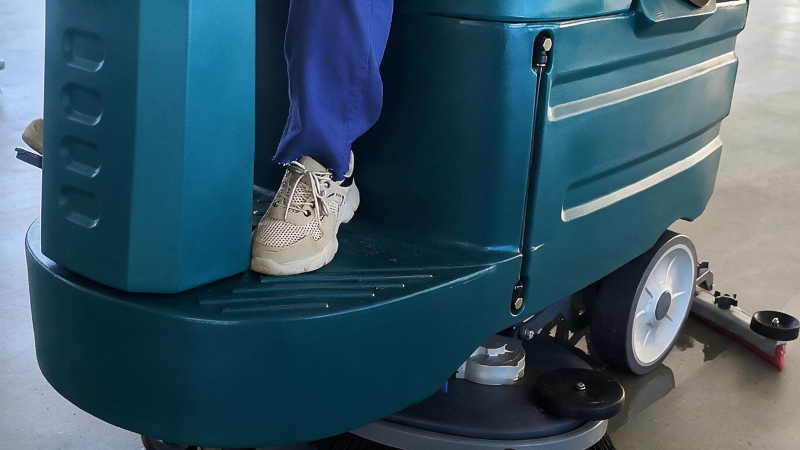
Operator seated on ride-on floor scrubber steering through warehouse aisle
CHK 01

How to Use a Ride-On Floor Scrubber: Pre-Run Cockpit Checks

  • Battery charge — verify the gauge shows enough charge for the full run >50% for full run
  • Seat safety switch — most ride-ons cut power when the operator leaves the seat
  • Squeegee blades — check for wear, nicks, and proper mounting
  • Brush deck — confirm brushes are mounted and free of debris
  • Vacuum hose and filter — connected at both ends, no clogs
  • Both tanks — empty recovery tank, solution tank filled and capped
  • Area clear — check the cleaning path for obstacles, cords, and people
WHY THE SEAT CHECK MATTERS

Ride-on scrubbers use a seat safety switch that stops the machine when the operator stands up. Operators often chase a "dead machine" for minutes when the real issue is the seat switch tripping on a bump. Always sit fully and center your weight before troubleshooting.

CHK 02

Ride-On Floor Scrubber Operation: Getting Settled In

  • Adjust the seat so both feet reach the pedals comfortably and you can see over the hood
  • Adjust the steering column or handle position for a relaxed grip
  • Locate the emergency stop button before starting — reachable from the seat
  • Learn the pedal layout: drive pedal, brake, and brush lift pedal (usually foot-operated)
  • Check mirrors and horn before moving in occupied areas
FIRST-TIME OPERATOR NOTE

Spend 5 minutes driving with the brush deck raised before cleaning anything. Get comfortable with acceleration, braking distance, and turning radius in an open area. Ride-ons are heavy — 500–2,000 lbs — and stopping distance is longer than operators expect.

CHK 03

Ride-On Scrubber How to Operate: Brushes, Squeegee, and Solution

Set the brush deck before you start cleaning. Match brushes to your floor: soft for sealed and polished concrete, medium for general commercial surfaces, hard for unsealed concrete and heavy soil. Dual-disc machines should always use matching brush pairs — one worn and one new brush causes uneven scrubbing.

Set the squeegee height while the deck is down. The rear blade should contact the floor along its full width with a slight deflection. Lower the squeegee only when you start cleaning and raise it when driving between zones — dragging a lowered squeegee at speed wears the blades fast.

Set the solution flow to the lowest effective setting and select neutral pH, low-foam cleaner. High-foam chemicals flood the recovery tank float and stop the vacuum mid-run.

CHK 04

Driving and Cleaning Technique on the Ride-On

  • Drive to the far end of the zone with the deck raised
  • Lower the brush deck and squeegee at the starting edge
  • Engage brush rotation and vacuum, open the solution flow
  • Drive steady passes at a controlled speed — not max speed
  • Overlap each pass by 4–6 inches to avoid stripe lines
  • Raise the deck and squeegee before turns, reversals, and thresholds
  • Monitor solution and recovery gauges during the run
SPEED CONTROL TIP

Ride-on scrubbers cover ground fast, but speed is the enemy of clean. At max speed the brush contact time drops and floors come out streaky. Most operators find a comfortable mid-range speed produces the best results — about 3–4 mph, roughly a fast walking pace.

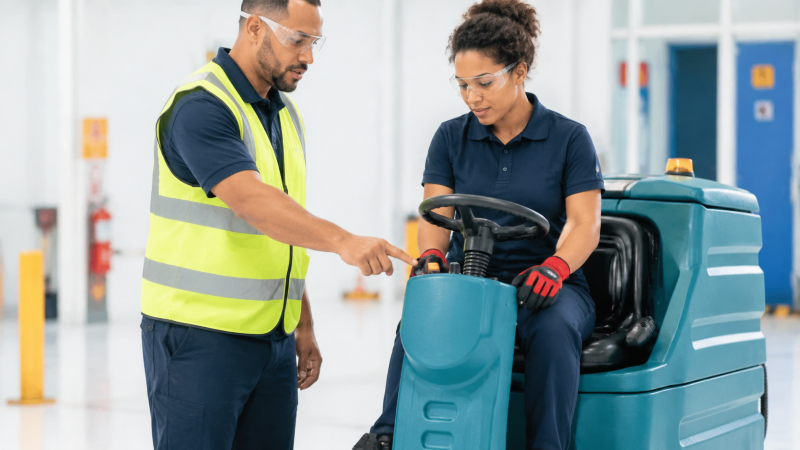
Supervisor training new operator on ride-on scrubber control panel
CHK 05

End of Run: Recovery Tank, Squeegee, and Shutdown

  • Raise the deck and squeegee, drive to the drain or service area
  • Empty and rinse the recovery tank — never let dirty water sit
  • Empty the solution tank and flush the line
  • Rinse squeegee blades and check for debris
  • Clean the brush deck and remove wrapped debris
  • Leave tank lids open to dry
  • Park with the deck raised and the brake set
BATTERY RULE

Charge after every use. A ride-on scrubber battery is the most expensive component on the machine — a partially discharged lead-acid battery left overnight develops sulfation that permanently reduces capacity. Charge it every time, without exception.

Ride-On Operating Targets

Reference values for a typical mid-size ride-on scrubber

3–4MPH
Drive Speed
4–6"OVERLAP
Pass Overlap
65 dBNOISE
At Ear Level

Clear To Operate

  • Wear the seatbelt if fitted
  • Use the horn in blind intersections
  • Raise deck before all turns and travel
  • Pre-sweep debris before scrubbing
  • Charge the battery after every shift
  • Wet the squeegee before first pass

Do Not Operate If

  • Seat safety switch is bypassed or faulty
  • Recovery tank is full — empty before running
  • Driving over ramps with the deck down
  • Operating in areas with loose cables or hoses
  • Squeegee blades are visibly worn or damaged
  • Battery shows low charge — recharge first

Operator Quick Reference

  • Pre-run checks:7 items / ~4 minutes
  • Cleaning speed:3–4 mph steady passes
  • Pass overlap:4–6 inches
  • Solution flow:Lowest effective setting
  • Floor dry time:3–5 minutes
  • End-of-shift:7 steps / ~10 minutes

Buying your first ride-on or training operators on a new machine? Donnie at TerraScrub helps facility managers choose the right ride-on size and set up operator training programs. Tell Donnie your facility size, floor type, and operator count for practical guidance. Reach out at Donnie@terrascrubx.com or on WhatsApp.

Get Factory-Direct Pricing

Contact Donnie for confidential pricing, spec sheets, and distributor partnership details.


Message Inquiry

*
*
*
*
验证码
*
Submit