News Center

How to Clean Grocery Store Floors: Complete Guide

Release Time:2026-08-17 Browse:19
Guide | Floor Care

How to Clean Grocery Store Floors: Complete Guide

Spills, foot traffic, cart wheels, and produce debris make grocery store floors some of the hardest surfaces to keep clean. This guide walks through five store zones, a three-shift cleaning schedule, and the two TerraScrub machines that handle everything from tight produce aisles to wide warehouse-club layouts.

Grocery store floors face a mix of spills no other facility deals with: milk leaks in dairy aisles, broken glass in the beverage section, produce trimmings near open bins, and salt tracked in from the parking lot. A mop and bucket cannot keep up. You need a floor scrubber that lays down clean solution, scrubs it in, and picks up the dirty water in one pass, leaving the floor dry enough for shoppers to walk on within seconds.

Why grocery store floors need daily scrubbing

The FDA Food Code requires retail food establishments to keep floors clean and dry to prevent slips and contamination. In a store that sees 2,000 to 5,000 shoppers a day, that is not a weekly job. It is a daily one, sometimes twice daily in high-traffic zones.

Mopping redistributes dirty water across the floor. It does not remove it. A walk-behind floor scrubber like the BA860 applies fresh solution, scrubs with dual 860mm brushes, and vacuums the dirty water into a recovery tank in a single pass. The floor is dry almost immediately. That matters in a grocery store where customers walk through the same aisle 30 seconds after you finish cleaning it.

If you want to compare scrubber models side by side, the complete floor scrubber spec comparison table lists every TerraScrub model with cleaning width, coverage rate, and tank capacity.
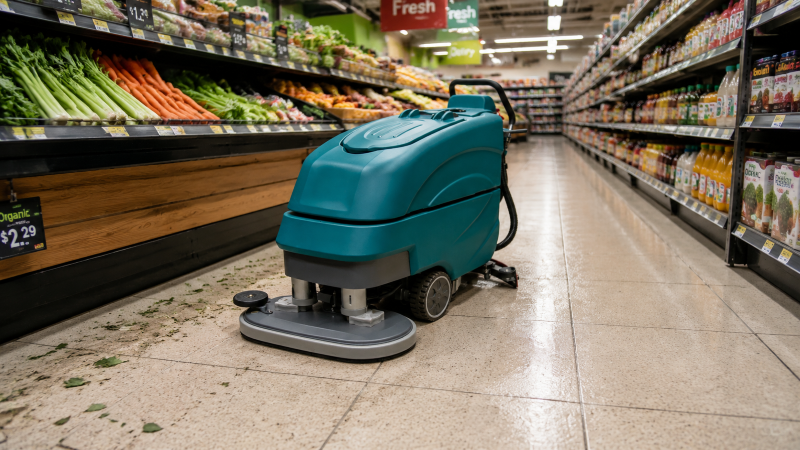
TerraScrub BA860 walk-behind floor scrubber cleaning grocery store aisle between shelves with produce displays leaving dry clean floor trail behind

Mapping your store: five grocery floor zones

Not every part of a grocery store needs the same cleaning approach. Breaking the floor into zones helps you match the right method and machine to each area.

1
Produce departmentLeaf trimmings, dirt on roots, mist overspray, broken fruit. Wettest zone in the store.Daily scrub, morning and evening. Highest priority.
2
Bakery and deliFlour dust, oil drips, frosting smears, grease from rotisserie cases.Daily scrub with degreaser solution. Watch for slippery patches near fryers.
3
Frozen and dairy aislesCondensation pooling, milk leaks, melted ice near freezer cases.Daily scrub. Use low-foam detergent to avoid residue on cold surfaces.
4
Center store aislesCart wheel marks, spilled cereal, broken jars, packaging dust.Daily scrub in high-traffic aisles. Every other day for low-traffic ends.
5
Entry and checkoutSalt, mud, rain water tracked in. Gum, coin spills, receipt scraps near registers.Scrub twice daily during wet weather. Once daily in dry season.

Choosing the right floor scrubber for grocery store aisles

Aisle width is the single biggest factor. Most grocery aisles run 48 to 72 inches wide. You need a machine narrow enough to fit between shelves but wide enough to cover the floor in a reasonable number of passes. Two TerraScrub models cover the range:

BA860
Walk-Behind
Best for: Standard grocery aisles (48-72 in wide)

Dual 860mm brush deck scrubs 4,200 m²/h. 95L solution tank covers a full store on one fill. Self-propelled with 500W traction motor, so the operator does not push. 59 inches long, fits through standard stockroom doors. Squeegee leaves the floor dry in one pass.

Cleaning width860 mm (34 in)
Coverage4,200 m²/h
Solution / Recovery95L / 105L
Battery24V / 200Ah
Weight300 kg
A7
Ride-On
Best for: Large supermarkets and warehouse clubs (10,000+ m²)

34-inch dual-brush deck covers 5,500 m²/h. The operator rides, cutting labor time in half on large floors. 140L tank means fewer refill stops. 65 inches long with a 35-inch width, fits wide aisles and open floor areas. Soft-start brush motor prevents solution splashing onto lower shelves.

Cleaning width860 mm (34 in)
Coverage5,500 m²/h
Solution / Recovery140L / 150L
Battery24V / 200Ah
Weight330 kg

For stores under 3,000 m², the BA530 with a 530mm deck is a more compact option. The full floor cleaning equipment resource guide covers every model if you need more options.
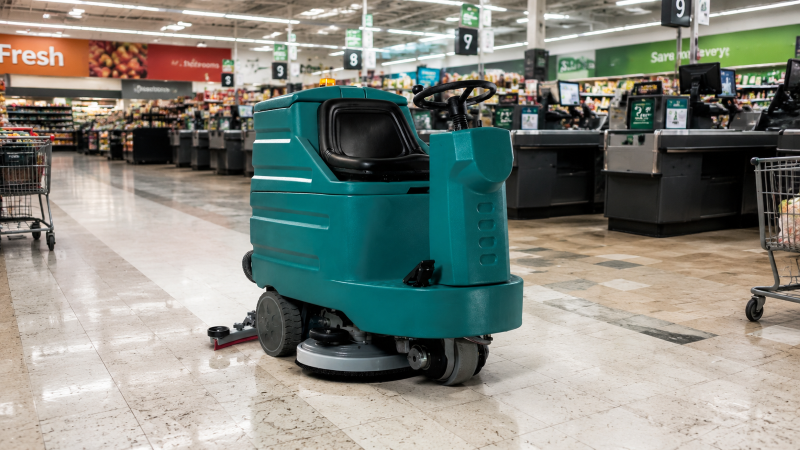
TerraScrub A7 ride-on floor scrubber cleaning wide supermarket floor near checkout area leaving clean dry trail behind on tiled surface

Three-shift cleaning schedule for grocery floors

One cleaning pass per day is not enough for a busy grocery store. Split the work across three windows to keep floors safe without blocking shoppers.

5:00 AM - 7:00 AM (Pre-open)

Full store scrub with BA860 or A7. Focus on produce, entry, and checkout zones. Refill solution tank, check squeegee blades for wear. Floor must be completely dry before doors open at 7 or 8 AM.

1:00 PM - 2:00 PM (Midday spot clean)

Targeted scrub of high-spill zones only: produce, deli, dairy. Use the BA860 in spot-clean mode with reduced solution flow. Skip center aisles unless there was a spill. This pass takes 20-30 minutes.

9:00 PM - 11:00 PM (Post-close deep clean)

Full store scrub with degreaser in bakery and deli. Hot water in solution tank for oil breakdown. End with a clean-water rinse pass in produce to remove detergent residue. Empty recovery tank, rinse squeegee, park on charge.

Common grocery floor cleaning mistakes to avoid

  • Using the same solution for produce and deli zones. Deli needs a degreaser; produce needs a food-safe neutral cleaner. Switch tanks between zones.
  • Skipping the squeegee inspection. A worn squeegee blade leaves streaks and wet patches. Check daily, replace when the edge rounds over.
  • Running the scrubber with dirty solution from the previous shift. Always start with fresh solution and an empty recovery tank.
  • Cleaning in the same direction every time. Alternate north-south and east-west passes to catch streaks the previous pass left behind.
  • Ignoring the area under display cases. Pull out low mobile racks weekly and scrub underneath. Dust and spilled product accumulate fast.
Cost of skipping daily scrubbing: A single slip-and-fall claim in a grocery store averages $20,000 to $50,000 in settlement and legal fees, according to NFSI data. A BA860 at $X pays for itself by preventing one incident. Daily scrubbing is not a cost. It is insurance.

Keeping your floor scrubber running shift after shift

A grocery store scrubber runs 365 days a year. That is 1,000+ hours of brush time annually. Three habits keep it reliable:

1. Charge after every shift. Lead-acid batteries last longest when charged fully after each use. Do not let the battery sit below 30% charge overnight. The BA860 and A7 both use 24V/200Ah batteries that need 6-8 hours for a full charge, which fits perfectly between the post-close and pre-open shifts.

2. Flush the system weekly. Detergent residue builds up in the solution lines and recovery tank. Run clean warm water through the system once a week, then drain completely. This prevents clogs and odors, especially in the recovery tank where organic matter from produce and dairy can ferment.

3. Replace squeegee blades before they fail. Flip the blade when the leading edge shows wear (usually every 2-3 months in a grocery store). Replace entirely when both edges are rounded. If your scrubber stops picking up water, the squeegee is the first thing to check. The water pickup diagnostic guide walks through seven common causes and fixes.

Need help matching a floor scrubber to your store layout? Send your aisle width and total floor area to Donnie at TerraScrub. We will recommend the right model and send a quote within 24 hours.


Message Inquiry

*
*
*
*
验证码
*
Submit