FOODSERVICE FLOOR CARE · 2026
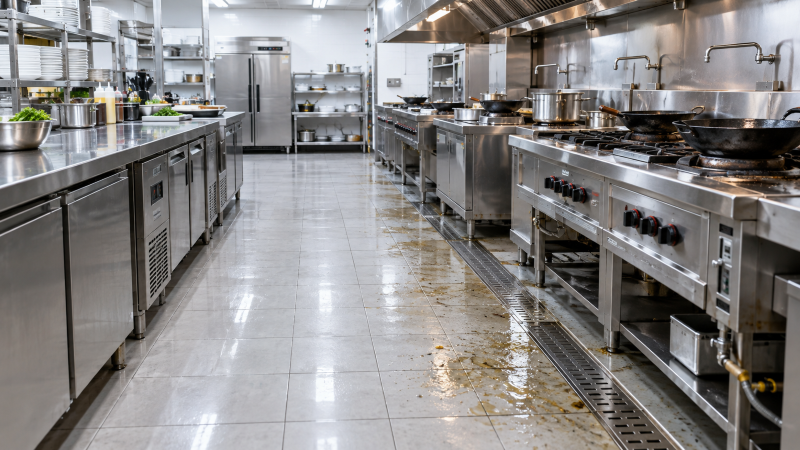
Kitchen floors don't fail because they're dirty — they fail because they're wet and greasy at the exact moment someone walks through with a full tray. The routine that prevents that is different from ordinary floor cleaning: you degrease first, scrub, then recover every drop of water so the floor is dry before service resumes.
Step 1: Clear food debris and dry sweep
Food scraps and flour turn into paste the moment water hits them. Sweep or vacuum dry first — it takes a minute and saves a re-clean.
Step 2: Apply degreaser and let it dwell
Spray or lay down degreaser along the cooking line, fryer area, and pass — the greasiest zones. Give it 5–10 minutes. Dwell time is what breaks the grease bond; scrubbing immediately just pushes grease around.
Step 3: Scrub with a machine, not a mop
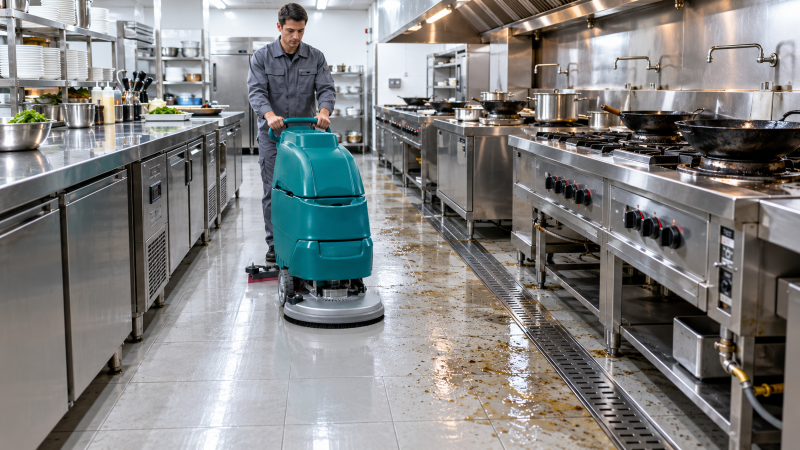
A mop spreads grease and leaves water behind. A walk-behind scrubber with a disc brush scrubs the film off tile and grout and lifts it into the recovery tank. In tight kitchens, a compact machine fits between stations — the BA430 is built for exactly this.
Step 4: Recover the water completely
This is the step kitchens skip. The floor must be dry before service, not "mostly dry." Let the scrubber's squeegee and vacuum do the work, and check the floor by hand behind the machine — if it's wet, the squeegee or vacuum needs attention, as covered in our streaks guide.
Step 5: Manage the floor during service
During service you're not deep cleaning — you're spot-managing. Keep a spill kit within reach, wipe grease splashes immediately, and never leave water standing in a walkway.
| Kitchen type | Machine | Why |
|---|---|---|
| Tight line kitchen | BA430 (430mm, 57cm body) | Fits between stations and through doorways |
| Medium kitchen / bistro | BA530 (530mm, 50L/55L) | Balances width and maneuverability |
| Large kitchen or canteen | A7 ride-on | Covers open kitchen floors and dining areas fast |
Comparing kitchen machines side by side? Our guide to floor scrubbers for restaurants and commercial kitchens covers the selection process in detail.
How often should a commercial kitchen floor be cleaned?
Deep clean nightly after service, with spot treatment throughout the day. Kitchens that fry heavily often need the cooking line done twice — once mid-shift and again at close.
Can I just mop instead of using a machine?
Mopping works for spot spills, but it spreads grease and leaves water behind — the two conditions that cause slips. A scrubber with water recovery is the safer tool for routine cleaning.
What degreaser should I use?
Use a foodservice-rated degreaser at the dilution on the label, and give it dwell time. Over-concentrated product leaves a film that attracts dirt again — see our chemical guide.
How do I keep floors dry during service hours?
Work in sections, keep the machine's squeegee and vacuum in good order, and never leave a section wet while another crew member is walking through. Mat the splash zones and treat spills immediately.
Commercial kitchen floors are a safety system, not just a cleaning task: degrease, scrub with a machine, recover the water, and keep the floor dry before anyone walks through with a tray. Done nightly, that routine keeps kitchens out of the slip-and-fall column and stops grease from building into a layer that takes days to strip. For machine selection, see our restaurant and commercial kitchen scrubber guide.
Contact TerraScrub
Email: Donnie@terrascrubx.com
WhatsApp: +86 166 0187 1755
No. 600, Jiye Road, Sheshan Town, Songjiang District, Shanghai, China