This resource guide breaks down every category of floor cleaning equipment TerraScrub manufactures — walk-behind and ride-on scrubbers for indoor hard floors, enclosed-cabin sweepers for outdoor lots and grounds, and autonomous driverless machines for facilities that need round-the-clock cleaning. Below you will find equipment specs, industry-specific application guides, a comparison table, and maintenance resources with links to detailed articles on each topic.
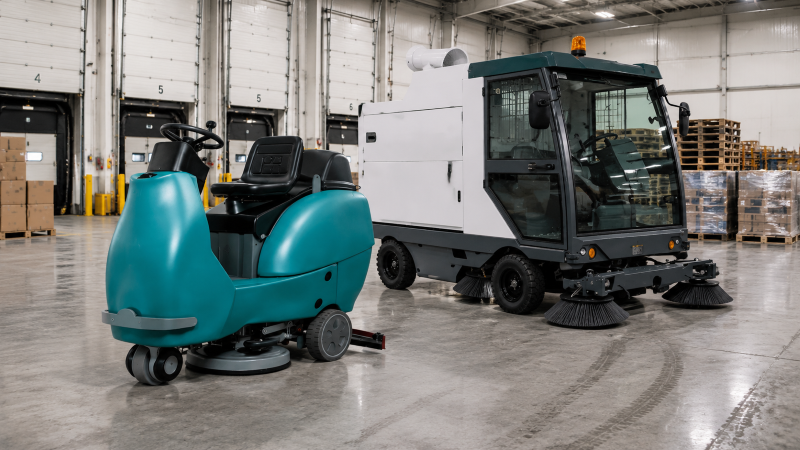
Walk-behind scrubbers like the BA860 cover 4,200 m² per hour with a dual-brush deck and fit through standard doorways — ideal for retail aisles, school hallways, and medical corridors under 10,000 m². For larger indoor spaces, the BA850 ride-on scrubber delivers 5,800 m²/h with a 195L recovery tank and 6-hour battery runtime, built for warehouse floors, exhibition halls, and food production facilities where a walk-behind would take too long.
Outdoor sweepers handle debris that scrubbers cannot — gravel, leaves, sawdust, litter, and bulk material on asphalt, concrete, and compacted dirt. The BA1900 is TerraScrub's flagship enclosed-cabin sweeper, covering 14,000 m² per hour with a 620L water tank for dust suppression and a 35% gradeability rating for inclined lots. The lighter BA2100 matches the same sweeping width at 680 kg with a sunshade cabin, suited to flat distribution yards and campus walkways where a heavier machine is unnecessary.
For detailed dust management strategies during outdoor sweeping, see our dust control sweeping guide covering six field-tested methods. For sawmill-specific wood debris cleanup, the Oregon sawmills sweeping guide breaks down bark and sawdust handling zone by zone.
Sweepers collect dry debris into a hopper bin. Scrubbers wash and recover liquid into a dirty water tank. They are not interchangeable — using a scrubber on loose gravel clogs the vacuum hose, and using a sweeper on sticky grease just pushes it around.
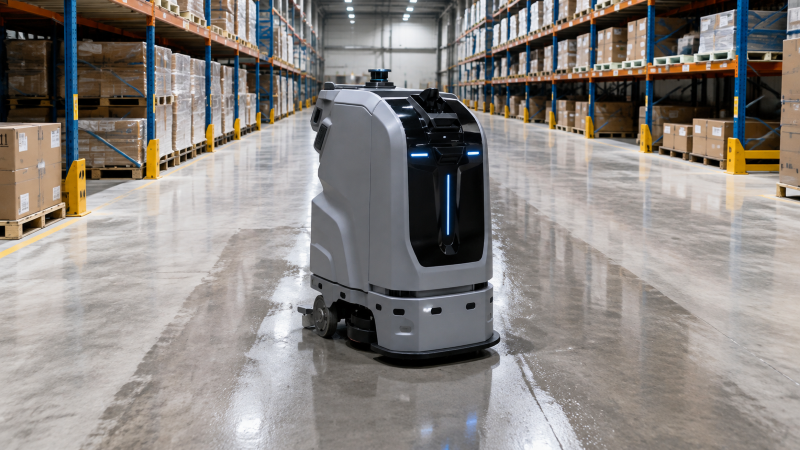
The C80 driverless scrubber uses LiDAR and vision navigation to clean 2,040 m² per hour without an operator. It maps routes automatically, avoids obstacles in real time, and runs on a 24V/120Ah battery for 3-4 hours per charge. Facilities like airports, shopping malls, and hospital lobbies use it for overnight cleaning when foot traffic is low — one machine can cover the same area as a walk-behind scrubber without paying someone to push it.
| Model | Type | Cleaning Width | Coverage | Best For |
|---|---|---|---|---|
| A3 | Walk-behind scrubber | 21" (530mm) | 2,400 m²/h | Small retail, clinics |
| A7 | Ride-on scrubber | 34" (860mm) | 5,500 m²/h | Warehouses, food courts |
| BA850 | Ride-on scrubber | 850mm | 5,800 m²/h | Exhibit halls, factories |
| BA860 | Walk-behind scrubber | 860mm | 4,200 m²/h | Retail aisles, schools |
| BA1900 | Ride-on sweeper | 1,700-2,000mm | 14,000 m²/h | Parking lots, fairgrounds |
| BA2100 | Ride-on sweeper | 1,700-2,000mm | 12,000 m²/h | Campuses, logistics yards |
| C80 | Autonomous scrubber | 510mm | 2,040 m²/h | Airports, malls, hospitals |
According to ISSA, the right equipment can cut labor hours by up to 60% compared to manual mopping and sweeping. Matching machine type to surface type and debris type is what determines whether you see that savings.
Not sure which machine fits your facility? Tell us your square footage, surface type (asphalt, concrete, tile, epoxy), and the debris you deal with daily. We will match the right scrubber or sweeper and build a cleaning route that fits your operating hours.
Questions about floor cleaning equipment for your facility?
Donnie@terrascrubx.com WhatsApp: +86 166 0187 1755