Coverage math, aisle sizing, battery runtime, and payback in four variables.
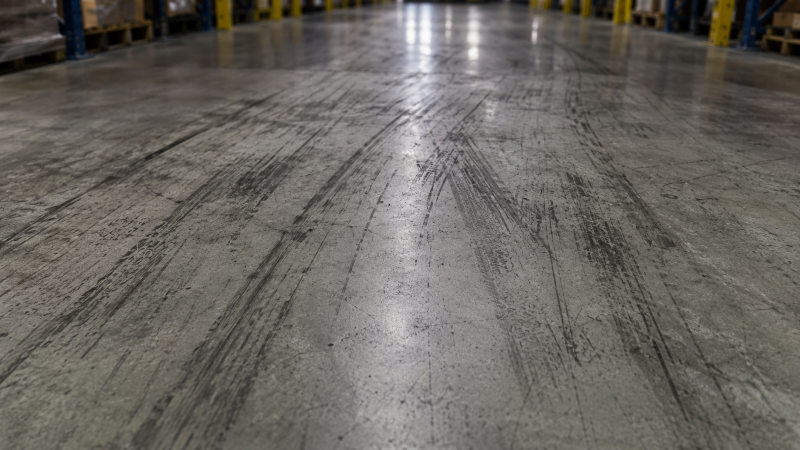
It's 10:30 on a Tuesday night. Second shift just clocked out of your 100,000 sq ft (9,290 m²) warehouse, and the floor tells the story of the day: black forklift tire marks down every main aisle, a film of concrete dust over the pick modules, oil sheen near the dock plates. Your cleaning window is four hours before first shift rolls in at 6 a.m., and a mop and bucket covers 2,000–3,000 sq ft per hour.
A warehouse floor scrubber rated at 5,500 m²/h (about 59,000 sq ft/h) turns that impossible window into a two-to-three-hour routine: one operator, one machine, floors dry before the trucks start. Here's how to pick the right one using four variables that matter more than any spec-sheet headline.
Key takeaways
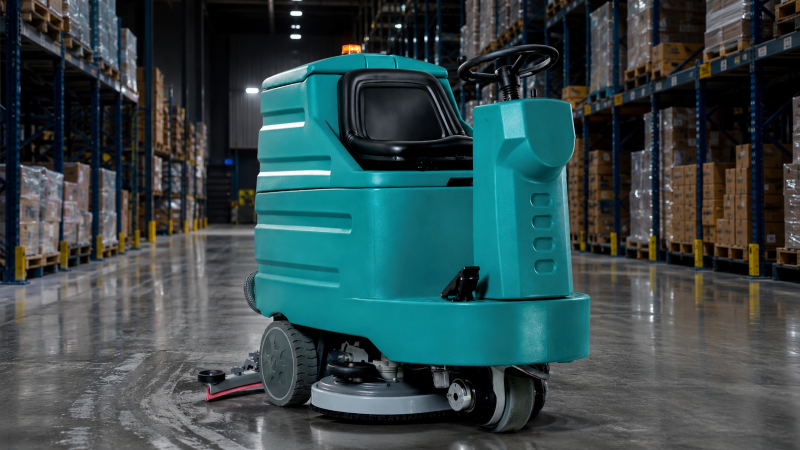
A warehouse floor scrubber is a powered machine that scrubs, rinses, and dries large hard floors in one pass. What separates warehouse use from retail or office cleaning is the soil, the compliance exposure, and the clock.
Forklift tire marks are the headline problem. Standard forklift tires shed thermoplastic rubber onto concrete under load. Those black streaks are baked-on polymer, not dirt, and a mop only spreads them. Removing them takes brush pressure, a degreaser, and pad-on-floor time only a powered machine delivers. For the full method, see how to remove forklift tire marks from concrete floors.
Oil lives near the docks. Dock plates, staging lanes, and charging areas collect drips that plain detergent won't touch. OSHA's Walking-Working Surfaces standard (29 CFR 1910.22) requires walking-working surfaces to be clean and free of hazards. A scrubber recovers solution as it goes and leaves floors dry; a mop leaves a wet film.
Dust is a compliance issue. Untreated concrete abrades under forklift traffic. If your operations generate respirable crystalline silica, OSHA's Respirable Crystalline Silica standard (29 CFR 1910.1053) caps exposure at 50 µg/m³. Wet scrubbing captures dust at the surface instead of pushing it airborne.
And then there's the clock. Warehouse cleaning happens in the 3-to-5-hour gap between second shift and first, and whatever machine you buy has to finish inside it. Which brings us to the four variables.
Most buyers start with price. Managers who get this right start with four variables and let the machine class fall out of the math. For the general-purpose framework, see what to look for when buying a floor scrubber.
Not your building's footprint. Your cleanable square footage: aisles, staging lanes, dock interiors. In most warehouses that's 55–70% of gross footprint after subtracting racking and storage. The worked examples below treat the full 100,000 sq ft as cleanable, a worst-case figure that keeps your margin conservative.
| Cleanable area | Model | Rated coverage |
|---|---|---|
| Up to 20,000 sq ft | A3 (walk-behind) | 2,400 m²/h (~25,800 sq ft/h) |
| 20,000–50,000 sq ft | A5 (mini ride-on) | 2,700 m²/h (~29,000 sq ft/h) |
| 20,000–60,000 sq ft | BA860 (walk-behind) | 4,200 m²/h (~45,200 sq ft/h) |
| 50,000–150,000 sq ft | A7 (ride-on) | 5,500 m²/h (~59,200 sq ft/h) |
| 50,000–200,000 sq ft | BA850 (ride-on) | 5,800 m²/h (~62,400 sq ft/h) |
| 150,000+ sq ft | A17 (ride-on, dual brush) | 7,000 m²/h (~75,300 sq ft/h) |
Two adjustments. For a side-by-side of all 14 models, see the complete floor scrubber model comparison.
First, discount the rated number. Rated coverage assumes straight runs at full speed: no turns, no rack legs, no refills. Plan on 60–70% of rated coverage. The A7 at 5,500 m²/h realistically cleans 3,300–3,850 m²/h in a racked building, so your 9,290 m² floor is done in 2.5–3 hours, inside the window.
Second, check the window, not just the area. A 100,000 sq ft floor on a 4-hour window needs an effective rate of at least 25,000 sq ft/h. That rules out mopping and most compact walk-behinds, and points straight at the ride-on class.
A facilities manager at a 3PL outside Columbus learned this the hard way: a 21-inch walk-behind in a 180,000 sq ft building, rated for six hours, actually took nine every night. They cleaned half the building on rotation and apologized to site auditors for the rest. A dual-brush ride-on at 7,000 m²/h turned the same floor into a 3.5–4 hour run. For the audit-schedule playbook, see how 3PL warehouses keep floors clean.
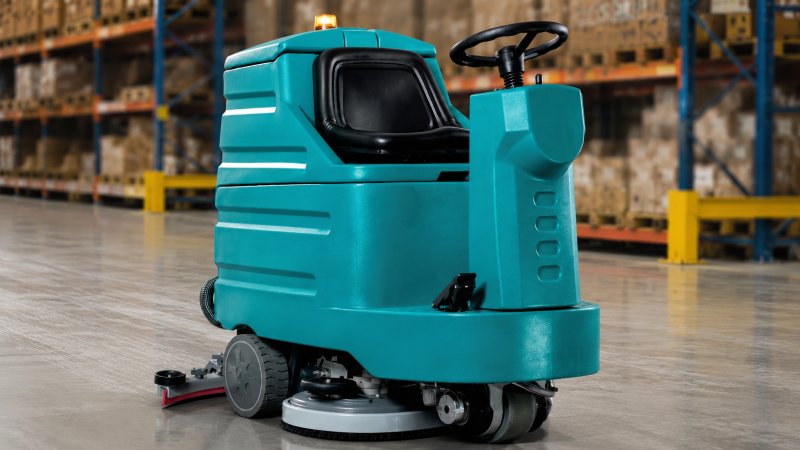
Measure your tightest scrub zone, not your widest aisle. Most warehouses have 10–12 ft main aisles that fit any ride-on, then pick-module aisles at 6–8 ft where the decision actually happens. A 34-inch-path ride-on needs roughly a 5-foot clear lane.
Multi-floor or mezzanine sites need a machine that fits a freight elevator. The A5 mini ride-on (220 kg, 530 mm path) exists for exactly this case.
Bare, unsealed concrete drinks solution and dusts constantly: budget more water and chemical per square foot, and expect to pre-sweep. Sealed concrete cleans faster and holds up better under brushes. For the long-term fix, see how to stop concrete floor dusting in warehouses. Epoxy floors (food and pharma) need softer pads and neutral detergent.
Here's the tank math that surprises people. The A17 carries 300 L/350 L solution/recovery tanks versus the A7's 140 L/150 L. On a big floor, that's one refill stop instead of three, and every stop burns 10–15 minutes of your window.
At 5+ nights per week with full coverage, size the machine to finish in 60–70% of your window, so refills and the occasional missed night don't cascade. At 2–3 nights per week, rotate zones with a smaller machine, but expect soil to build between passes.
What if your aisles never close? Then noise and pedestrian-safety features matter as much as coverage, and lithium matters because you'll opportunity-charge between passes. 24/7 sites should split the job: a compact machine for active zones, a large ride-on for the open floor.
Walk-behinds (1,500–2,500 m²/h, 16,000–27,000 sq ft/h) fit smaller cleanable areas, tight pick modules, and budget buys. Ride-ons (3,000–7,000 m²/h, 32,000–75,000 sq ft/h) are the default above ~50,000 sq ft, on any hard 4-hour window, and anywhere operator fatigue is real. An operator walking behind a machine for six hours is at half speed by hour four.
For most warehouses above 50,000 sq ft, the answer is a ride-on for the open floor (the BA850 ride-on floor scrubber, 850 mm path, 5,800 m²/h, is the common pick) plus a compact walk-behind for zones the big machine can't reach. For the full trade-off analysis, see the complete floor cleaning equipment comparison guide.
The battery decides whether the machine finishes the window. This is where cheap machines get expensive.
| Lead-acid | Lithium | |
|---|---|---|
| Runtime per charge | 3–4.5 hours | 5–6.5 hours |
| Cycle life | 500–800 cycles | 2,000–5,000 cycles |
| Lifespan at 5 nights/week | ~2–3 years | 7+ years |
| Mid-shift top-up | No (damages battery) | Yes (opportunity charging) |
A lead-acid pack rated at 3–4.5 hours covers a 4-hour window, barely, with zero margin, and you can't top it up mid-shift without shortening its life. Lithium at 5–6.5 hours covers the window plus refill stops plus the night an aisle needs a re-run, and at 2,000–5,000 cycles the pack outlives the finance term on the machine.
One maintenance manager at a two-shift parts distribution center described it plainly: their lead-acid ride-on was dying at hour three and a half, mid-aisle, four or five nights a month by year two. The lithium spec made the problem disappear. "It was never the machine," he said. "It was the clock."
Scrubbers scrub. They don't vacuum bulk debris. Run a scrubber over stretch wrap, pallet chips, and label backing, and you'll clog the squeegee, streak the floor, and spend the last hour of your window with a putty knife. The workflow that works:
Annual labor cost = (cleanable area ÷ effective coverage rate) × labor rate × cleaning nights per year. Worked example: 100,000 sq ft, 5 nights a week (260 nights/year), $21/hour fully-loaded labor (roughly the national range per BLS wage data).
| Method | Effective rate | Hours/night | Annual labor |
|---|---|---|---|
| Manual mop & bucket | ~2,700 sq ft/h | ~37 | ~$202,000 |
| Walk-behind (BA860 class) | ~31,000 sq ft/h | ~3.2 | ~$17,500 |
| Ride-on (A7 class) | ~40,000 sq ft/h | ~2.5 | ~$13,700 |
Read the manual-mop line again. Nobody staffs 37 hours of mopping per night. Facilities that stay manual clean the docks and the offices, dust-mop the main aisles, and let tire marks accumulate until there's a slip incident, an audit finding, or a floor restoration bill.
The realistic comparison is a machine versus a contract cleaning crew. A two-person crew at four hours a night typically invoices $50,000–75,000 a year with overhead included. A ride-on in the $15,000–28,000 range (typical factory-direct pricing) with one operator at 2.5 hours a night runs under $15,000 a year in labor, and covers every aisle, every night.
For more cost levers, see how to cut floor cleaning labor costs and what floor cleaning costs per square foot. Payback typically lands between 6 and 18 months. Everything after that is savings.
What size floor scrubber do I need for a 100,000 sq ft warehouse?
A ride-on rated 5,500 m²/h or higher: the A7 (34 in path) or BA850 (850 mm path). At 60–70% effective coverage, either cleans ~9,290 m² in 2.5–3 hours. For smaller buildings, see choosing a floor scrubber for a 10,000 sq ft warehouse.
Can a floor scrubber remove forklift tire marks from concrete?
Yes, with a disc brush, adjustable pressure, and an alkaline degreaser. Light residue lifts in one pass; baked-on streaks need a weekly deep-scrub.
How long do warehouse scrubber batteries last on one charge?
3–4.5 hours for lead-acid, 5–6.5 hours for lithium. For a 4-hour window, lead-acid works with zero margin. Lithium's cycle life usually closes the price gap by year three.
How much does a warehouse floor scrubber cost?
Factory-direct, roughly $4,000–8,000 for a quality walk-behind and $15,000–28,000 for a ride-on, with premium Western brands running 30–50% more.
That's how a warehouse floor scrubber earns its keep: four variables, one machine class, and a floor that's dry before first shift. You already know your square footage, your aisle widths, and your window. Send them to Donnie at Donnie@terrascrubx.com and he'll tell you which model class fits your floor plan.
Four hours is enough time to clean a 100,000 sq ft floor. With the right machine, it's almost comfortable.
Want a straight answer on which model fits before you talk pricing? Email Donnie your facility specs and get a recommendation in one reply. TerraScrub ships factory-direct through its distributor network, with a 1-year warranty on every machine.
Email: Donnie@terrascrubx.com
WhatsApp: +86 166 0187 1755