If there's a fine gray powder on your racking, equipment, and inventory no matter how often the floor is swept, the dust isn't coming from outside. It's coming from the floor itself. Concrete dusting is what happens when the surface of a concrete slab wears away, and it's one of the most frustrating warehouse problems because a broom never seems to end it — sweep today, and the powder is back tomorrow. The difference between a broom and a machine is that a floor scrubber doesn't just move the dust, it washes the floor and collects the water. This guide explains what dusting is, why it happens, and why a proper scrubber wash is the fastest way to get it under control.
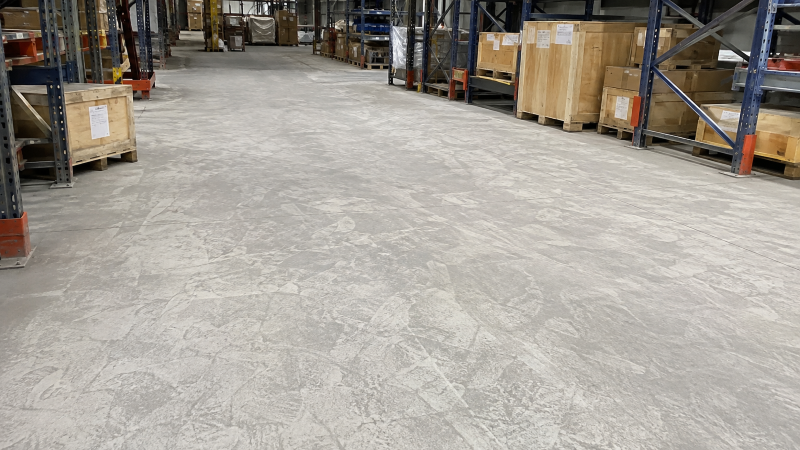
Dusting isn't tracked-in dirt, and it isn't a cleaning failure. It's the concrete surface itself breaking down into powder. The top layer of the slab wears away under forklift traffic, leaving fine gray particles that settle on everything. That's why sweeping doesn't fix it — every sweep removes today's dust, and tomorrow's dust is already forming underneath. If the floor has been dusting for a while, the surface may also look lighter or feel sandy, which is the same wear we cover in our forklift damage guide.
The fastest way to get a dusty warehouse floor under control is a proper wet wash with a floor scrubber. Here's why it works where a broom doesn't:
On most warehouse floors, a weekly wet wash keeps the dust visibly under control. For the odd case where the powder comes back within a couple of days even after a proper wash, the surface itself may be wearing — that's worth a flooring contractor's look, not more sweeping.
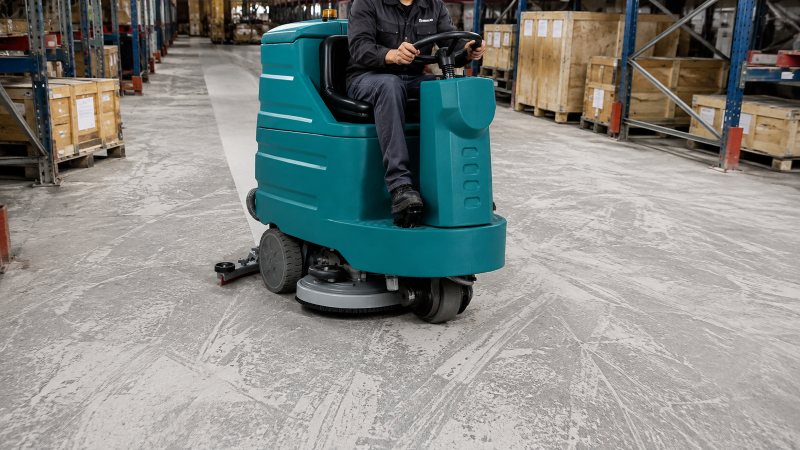
Until the floor is sealed, and after it is, the routine matters:
The frequency logic is the same as our warehouse cleaning frequency guide: more traffic, more passes.
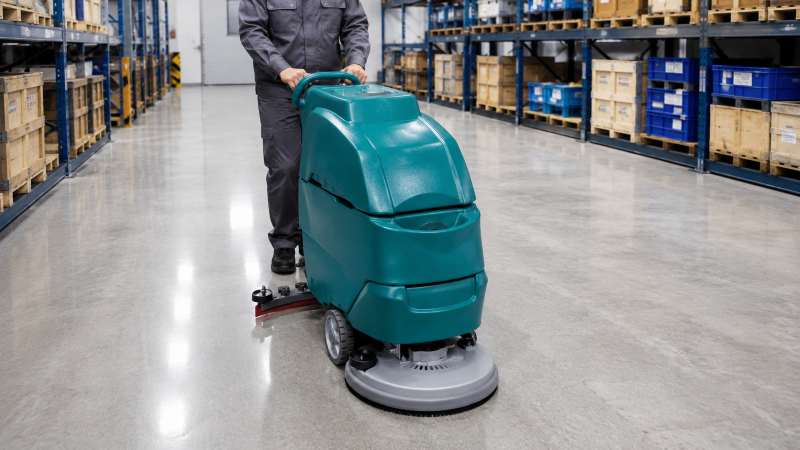
Most of what looks like "dusting" in a warehouse is loose dust and fine dirt on the surface — and that responds well to a wet wash. The real tell is timing. If the floor stays clean for a week after a scrubber wash, the problem was dust on the floor, and your cleaning routine was the issue. If the powder is back within two days, the surface itself is wearing, and that's a floor problem rather than a cleaning one. The labor you spend sweeping a dusty floor is exactly the waste our labor cost guide is about — a machine wash does the same job in a fraction of the time.
Mostly it's a cleanliness and equipment problem — dust gets into machinery and products. It can also be a respiratory irritant in confined spaces. Sealing the floor eliminates the source.
Yes — that's the first fix. A wet pass washes the dust off the surface and collects it in the recovery tank instead of pushing it around. On most warehouse floors, a weekly wash keeps it under control.
Start weekly with a wet scrubber pass and adjust by how fast the dust returns. If it comes back within two days even after a proper wash, the surface itself may be wearing — have a flooring contractor take a look.
Because a broom moves dust instead of removing it — the powder settles right back. A scrubber wash collects it in the recovery water, which is why wet cleaning stays done much longer.
Concrete dusting looks like a floor problem that needs a big fix, but in most warehouses the practical solution is simpler: wash it with a floor scrubber. A wet pass removes the dust and collects it in the recovery tank, which is what a broom can't do. Run an A3 walk-behind for aisles or an A7 ride-on for open floors on a weekly schedule, and keep loose dust out of the building with a ride-on sweeper at the dock. For the wider picture, our forklift floor protection guide and 5S floor guide round out the routine.
Contact TerraScrub
Email: Donnie@terrascrubx.com
WhatsApp: +86 166 0187 1755
No. 600, Jiye Road, Sheshan Town, Songjiang District, Shanghai, China