
The right cleaning chemical makes or breaks your floor scrubber's results. Neutral cleaners (pH 7-9) handle daily maintenance on sealed concrete, VCT, and tile. Alkaline solutions (pH 9-11) cut grease in warehouses and food plants. Acidic cleaners (pH 2-4) dissolve mineral buildup in restrooms and entryways. Match each chemical to the right pad color, dilute at the manufacturer's ratio, and you'll extend pad life, protect solution tank seals, and get cleaner floors in fewer passes.
Why the Right Floor Scrubber Cleaning Chemical Matters
Pour the wrong chemical into your floor scrubber and you'll know within a week. Squeegee blades turn hard and crack. Solution lines clog. Floors come out streaky no matter how many passes you run. The fix starts with matching the chemical to the soil type and floor material — something ISSA cleaning standards https://terrascrubx.com/machineshave been recommending for years.
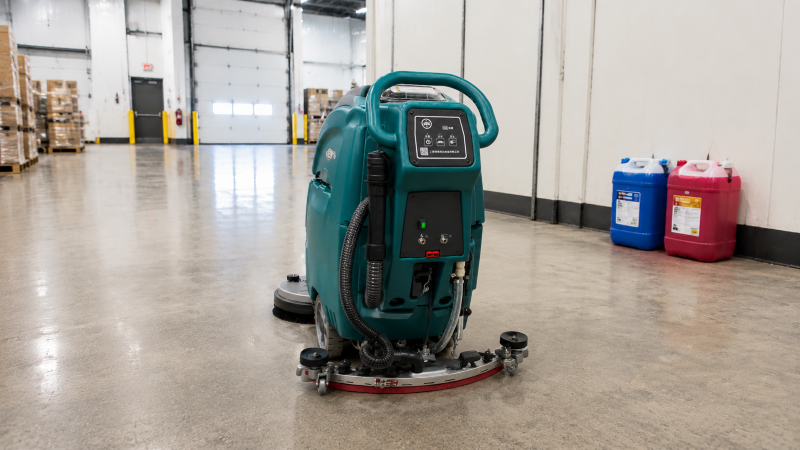
A 50L solution tank on a compact walk-behind scrubber covers roughly 3,000 m² per fill. Over-concentrate your chemical and you'll leave sticky residue that grabs dirt faster than you can clean it off.
Neutral vs Alkaline vs Acidic: Matching Floor Scrubber Chemicals to Floor Types
Neutral (pH 7-9)
Daily cleaning on sealed concrete, VCT, epoxy, tile. Gentle on floor finishes. Won't strip wax or coating.
Alkaline (pH 9-11)
Grease, oil, food residue. Best for warehouses, commercial kitchens, and food processing plants.
Acidic (pH 2-4)
Mineral stains, hard water spots, rust. Restrooms, entryways, concrete etching prep.
Enzymatic
Living bacteria break down organic waste. Good for restrooms and food areas with heavy organic soil load.
Dilution Ratios and Solution Tank Sizing for Floor Scrubbers
Most daily-use floor scrubber chemicals dilute at 1:64 to 1:128 — one part chemical to 64 or 128 parts water. Heavier soil? Push it to 1:32. But don't eyeball it. Use an auto-dilution station or a calibrated measuring cup. Over-concentration wastes money and leaves film. Under-concentration means you run the same aisle three times instead of once.
Cleaning Chemicals That Damage Floor Scrubber Components
Some chemicals are fine for floors but brutal on your machine. Here's what to avoid putting in your solution tank:
Chlorine bleach — hardens squeegee rubber in weeks, not months, leading to streaking and blade replacement.
Solvent-based degreasers — swell and crack solution tank seals and pump gaskets over time.
Unrinsed alkaline residue — leaves a film that grabs dirt and turns floors dull within hours of cleaning.
Abrasive powders — scratch solution pump impellers and clog spray jets inside the brush deck.
Stick to liquid, low-foam, auto-scrubber-rated formulationsEPA Safer Choice Certified Cleaning Solutions for Floor Scrubbers
If you're cleaning in occupied spaces — hospitals, schools, retail floors — look for the EPA Safer Choice label. The EPA Safer Choice program certifies products with ingredients that are safer for human health and the environment without sacrificing cleaning performance. You can browse their certified floor cleaner database online. For facility managers buying in volume, Safer Choice-certified chemicals also support LEED credits for green cleaning operations.
Looking for the right TerraScrub machines to pair with your cleaning chemicals? Our insights library covers pad selection, brush types, and maintenance schedules. Visit our homepage for the full product catalog.
Not sure which cleaning chemical pairs best with your TerraScrub model? Donnie can walk you through chemical-to-pad matching for your specific floor type and soil load. Send your floor details and daily cleaning square footage — he'll recommend a dilution ratio and pad color combo that fits.