News Center

Warehouse Floor Care Program: A 90-Day Plan (2026)

Release Time:2026-10-12 Browse:128

FACILITY MANAGEMENT · 2026

Warehouse Floor Care Program: A 90-Day Plan

Most warehouses don't have a floor care program — they have a machine and good intentions. A program is three things written down: what "clean" means per zone, who owns it, and how you measure it. This is a 90-day plan for putting those three in place, without shutting down operations to do it.

1Days 1–30: Audit and Set Standards

Don't buy anything yet. The first month is about knowing what you're dealing with:

  • Walk the floor zone by zone — dock, main aisles, racking areas, packing lines, offices. Note what dirt each zone produces and where it comes from.
  • Measure the real constraints: narrowest aisle, door and lift clearances, available charging points, and where water can safely be used.
  • Write a one-line standard per zone — for example: "no standing oil or tracked mud" (dock), "no visible tyre marks" (aisles), "presentable, no buildup" (storage).
  • Set a starting frequency per zone and expect to adjust it later; the logic is straightforward traffic-based scheduling.

Deliverable by day 30: a one-page zone standard with frequencies, signed off by operations — not a cleaning plan nobody has read.

Supervisor auditing warehouse floor conditions zone by zone

2Days 31–60: Equipment and Operators

Now the standards tell you what the machine has to do — not the other way round.

  • Size the machine to the floor, not to the catalogue. Coverage rate, tank size, and battery capacity should follow from your floor area and shift length — our warehouse sizing guide walks through the calculation.
  • Check it fits before you buy. Body width against your narrowest aisle, and deck width against the aisle you'll actually clean.
  • Train the people who'll run it — not just a demonstration. A short structured session plus supervised first shifts is what makes habits stick; the format is in our operator training guide.
  • Set up charging before the machine arrives: where it parks, who plugs it in, and when. Untrained charging kills batteries faster than heavy use.

Deliverable by day 60: machine on site, operators signed off, charging routine posted at the station.
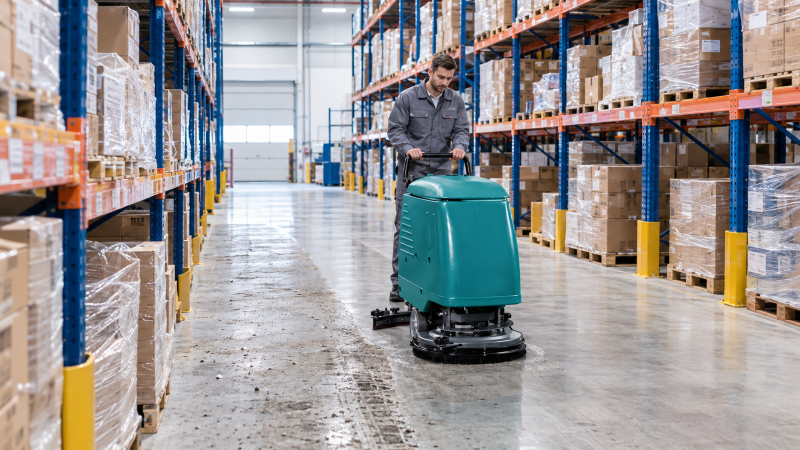
Walk-behind scrubber cleaning a warehouse aisle during a floor care program

3Days 61–90: Schedule, Measure, Hand Over

  • Lock in a weekly schedule that fits around shifts and dock traffic, not one that assumes the building stands still.
  • Start measuring one number: minutes per 1,000 square feet per zone. That single figure tells you whether the program is working, and it's the basis for any labor saving you'll report — the method is in our floor cleaning labor cost guide.
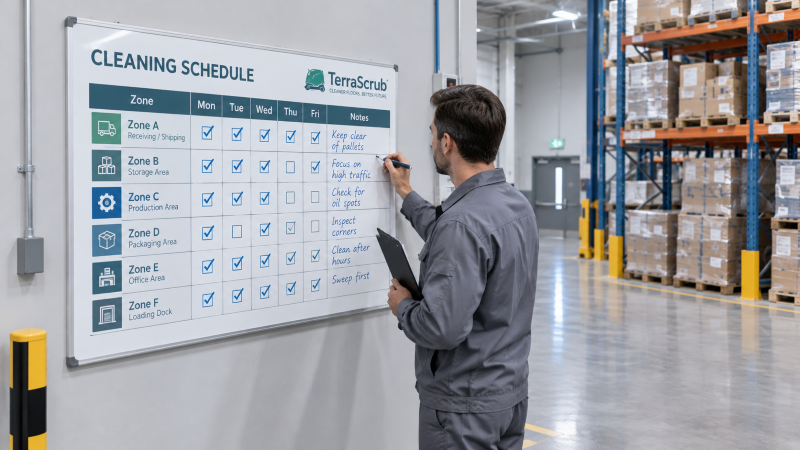
  • Name an owner for each zone. Programs fail when the floor belongs to everyone.
  • Put maintenance on the calendar: daily operator checks, weekly deep clean, monthly service, and a battery charging routine.

Deliverable by day 90: a posted schedule, a simple log per zone, named owners, and a first month of measurement data to compare against.

4What "Working" Looks Like at Day 90

IndicatorWhat to check
Zones meet their written standardSpot-check each zone against the one-line standard from month one
Cleaning hours are stable or fallingMinutes per 1,000 sq ft trending flat or down, not rising
The machine is ready every shiftCharged, clean tanks, no "it was flat again" conversations
Ownership is visibleNames on the board per zone, checks logged without chasing
Dock is under controlNo tracked mud or standing oil at the busiest entry point
Warehouse floor care schedule board with zone assignments

5How Floor Care Programs Fail

  • Buying the machine first. Equipment chosen before standards usually ends up the wrong class for the floor.
  • No named owner. Shared responsibility means no responsibility.
  • No measurement. Without one number, nobody can tell whether the program is improving or drifting.
  • Training that stops at a demo. Operators who weren't supervised in their first week develop habits that are expensive to undo.
  • Ignoring charging discipline. The most common cause of a "bad machine" is a battery that was never charged properly.

Common Questions

How long does it take to set up a floor care program?

Ninety days is a realistic window for a single site: one month for the audit and standards, one for equipment and training, one for schedule, measurement, and handover.

Can a small warehouse do a simplified version?

Yes. Keep all three elements but shrink them: one page of zone standards instead of five, two zones instead of eight, and the same single measurement.

What if the program slips after a few weeks?

Look at the measurement first. If hours rise while standards hold, the schedule is unrealistic. If standards lapse, ownership or training is the gap — in that order.

Do I need new equipment to start?

Not necessarily — months one and two often reveal that the existing machine is fine for two zones and the wrong class for the third. Fix the program first, then fill the equipment gap.

How do I keep it running after day 90?

Review the measurement monthly, re-baseline the standards once a year, and re-train whenever a machine or an operator changes. Programs decay through staff turnover more than through anything else.

A warehouse floor care program isn't a document — it's a sequence: audit the floor, write down what clean means, then buy the machine that fits those standards, train the people who'll run it, and measure one number. Ninety days, three deliverables, and the floor stops being a recurring surprise.

Contact TerraScrub

Email: Donnie@terrascrubx.com

WhatsApp: +86 166 0187 1755

No. 600, Jiye Road, Sheshan Town, Songjiang District, Shanghai, China


Message Inquiry

*
*
*
*
验证码
*
Submit