SCRUBBER OPERATIONS · 2026
There's no single "litres per hour" answer, because water use depends on your flow setting, how dirty the floor is, and how fast the operator drives. What you can calculate precisely is the number that matters operationally: how many square metres one tank covers — and therefore how many refill stops your shift will have.
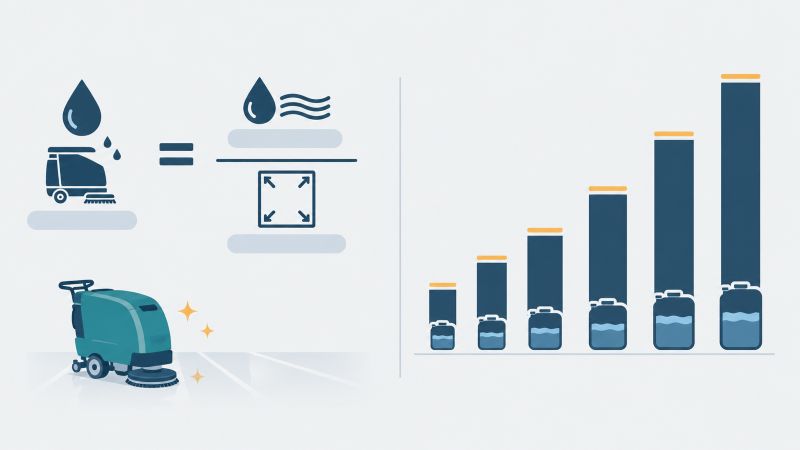
Water consumption per square metre depends on two variables: the solution flow rate (litres per minute) and the coverage rate (square metres per minute). Divide the first by the second and you get litres per square metre.
Litres per 1,000 m² = (flow in L/min ÷ coverage in m²/min) × 1,000
A worked example, with the assumptions stated so you can substitute your own: a mid-range flow setting of 1.5 L/min on a machine covering 2,100 m²/h (35 m²/min). That's 1.5 ÷ 35 = 0.043 litres per m² — roughly 43 litres per 1,000 m².
From there, refills are simple: tank capacity ÷ litres per m².
Both figures in the example are typical mid-range values, not a universal rule: a heavy-soil pass on high flow can use two to three times as much, and a light maintenance pass on low flow far less.
| Machine class | Clean water tank | Area per fill at ~43 L/1,000 m² (illustrative) |
|---|---|---|
| Compact walk-behind | 28 L | ~650 m² |
| Mid-size walk-behind (BA530) | 50 L | ~1,160 m² |
| Larger walk-behind (BA680 / BA730) | 65–68 L | ~1,510–1,580 m² |
| Dual-brush walk-behind (BA860) | 95 L | ~2,210 m² |
| Mid-size ride-on (A7) | 140 L | ~3,260 m² |
| Oversized ride-on (A17) | 300 L | ~6,980 m² |
Use this table to compare classes, then recalculate with your own flow rate and floor conditions. The point is to predict refill stops before you buy — not to trust a marketing number.
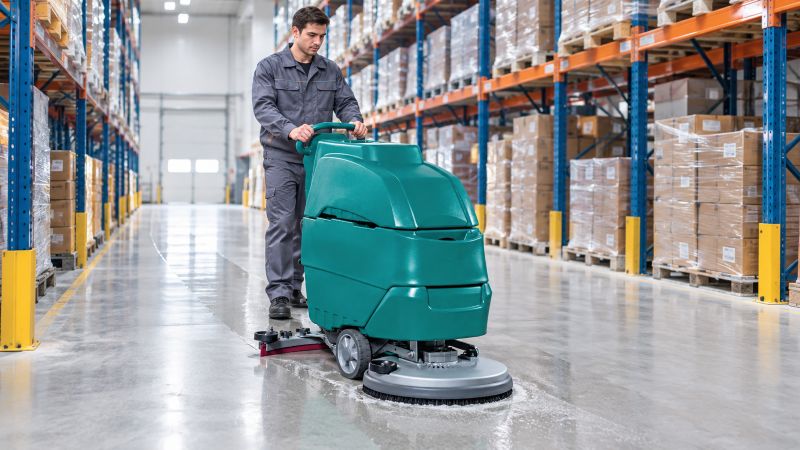
Once you know area per fill, refill planning becomes arithmetic:
How much water does a floor scrubber use per hour?
At a mid-range flow of about 1.5 L/min, that's roughly 90 litres per hour of continuous cleaning. Heavy-soil work on high flow can double or triple that; light maintenance passes use far less.
Does using more water clean better?
No. Past a point, extra water dilutes the chemistry, floods the squeegee, and leaves the floor wetter — which often means a second pass. Water is a tool, not a measure of effort.
Can I reduce water on polished or epoxy floors?
Yes, and you should. These surfaces clean well on lower flow with a soft brush, and less water reduces the risk of residue and dulling.
How do I find my machine's flow rate?
Check the spec sheet for flow settings, or measure it: fill the tank, run a timed pass over a known area, then measure how much water was used. That gives you a real litres-per-square-metre figure for your floor.
Is a bigger tank always better?
Bigger tanks mean fewer stops, but they also add weight and water to move. Match tank size to the area you clean between breaks, not to the largest number available.
Water use isn't a single spec — it's a calculation. Work out litres per 1,000 m² from your flow rate and coverage, convert that into area per fill, and you can predict every refill stop before the machine arrives. Then cut the waste: sweep first, dwell the chemistry, recover the water, and keep the squeegee in shape.
Contact TerraScrub
Email: Donnie@terrascrubx.com
WhatsApp: +86 166 0187 1755
No. 600, Jiye Road, Sheshan Town, Songjiang District, Shanghai, China