Workplace falls cost $70 billion a year. Here is what causes them, what they cost, and how dry floor scrubbing stops them.
Slips, trips, and falls cost U.S. workplaces an estimated $70 billion annually in medical expenses and workers' compensation, according to the CDC NIOSH. In factory environments, the main culprit is not workers being careless. It is wet floors. Traditional mopping leaves surfaces damp for 5 to 15 minutes. A forklift driver rounding a corner during that window hits a slick spot and the result is a lost-time injury, a workers' comp claim, and possibly an OSHA citation. The fix is not to stop cleaning. It is to clean with equipment that recovers water instantly and leaves the floor dry before the next person walks through. This guide breaks down the real costs of slip incidents, maps the common factory floor hazards, and shows how TerraScrub scrubbers with parabolic squeegees prevent slips by drying floors in under 60 seconds.
The CDC NIOSH reports that in 2020 alone, 805 workers died from falls and 211,640 suffered injuries severe enough to require days away from work. The total cost of workplace falls in the U.S. is estimated at $70 billion per year in workers' compensation and medical expenses alone. That number does not include lost production time, replacement labor, equipment damage, or the cost of OSHA fines.
A single slip and fall claim in a manufacturing setting typically runs $20,000 to $30,000 in direct costs. Add indirect costs like training a replacement worker, production downtime during the incident investigation, and increased workers' compensation premiums, and the real cost per incident often doubles.
OSHA's walking-working surfaces standard (29 CFR 1910.22) requires employers to keep working surfaces clean, dry, and free of hazards. A floor that is wet from mopping during production hours is a violation, not an inconvenience.
Factory floors are not slippery by default. They become slippery through specific, predictable conditions. Understanding which conditions exist in your facility is the first step in slip and fall prevention.
The National Floor Safety Institute reports that wet contaminated surfaces account for the majority of slip and fall claims. The combination of water and oil or grease creates a film that reduces coefficient of friction to near-zero. This is why factories that mop floors with degreaser during production are creating the exact hazard they are trying to remove.

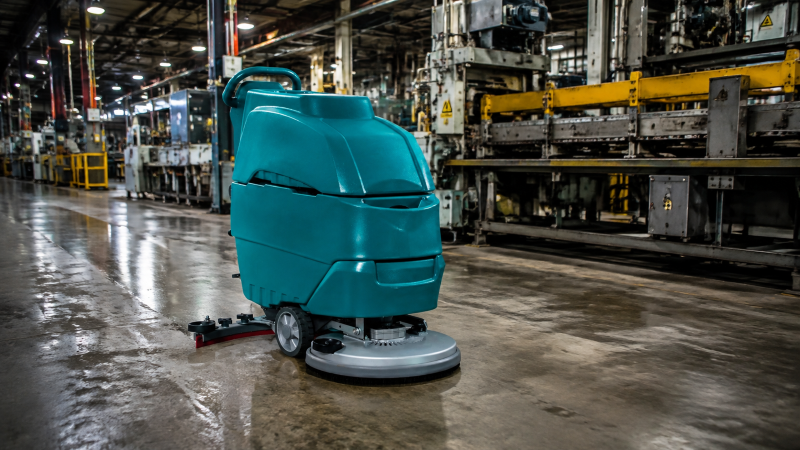
The difference between a floor scrubber and a mop is not just speed. It is moisture recovery. A mop spreads dirty water across the floor and leaves it to evaporate. A scrubber with a parabolic squeegee applies cleaning solution, agitates it with the brush, and then vacuums it back into the recovery tank before the next wheel rolls over the surface.
The TerraScrub A3 and A7 both use parabolic high-efficiency squeegees that recover water immediately. The floor behind the squeegee is dry within 45 to 60 seconds. That means a cleaning operator can run the machine through an active production aisle and the floor is safe to walk on before the machine reaches the end of the row.
Traditional mopping leaves floors wet for 5 to 15 minutes depending on ventilation and humidity. During that window, any worker or forklift entering the area is at risk. A scrubber reduces that window to under a minute.
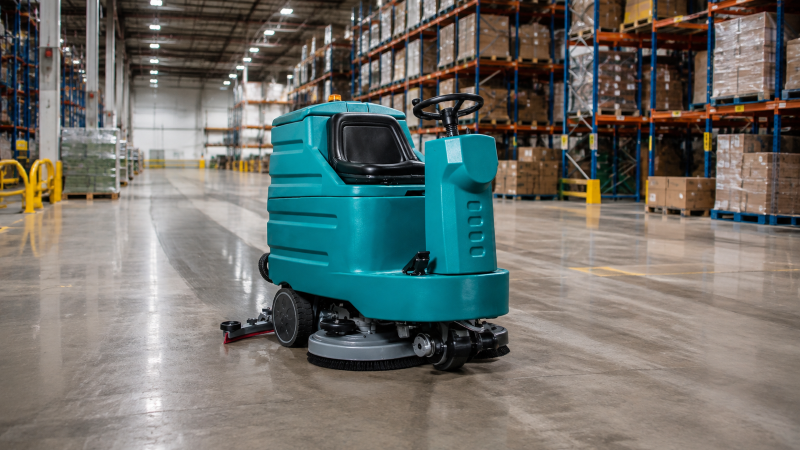
The right scrubber depends on aisle width and floor area. A machine that is too wide for the aisle will skip zones, leaving slip hazards in the areas that need cleaning most.
For a broader comparison of scrubber options across concrete floor types common in factories, see our concrete floors buyer's guide.

Equipment alone does not prevent slips. It needs to be part of a system. Here is a checklist that covers daily, weekly, and monthly actions. Print it, post it near the cleaning station, and have the shift supervisor sign off each week.
One slip and fall incident in a factory can cost more than a year's worth of cleaning equipment and chemicals combined. Here is how the costs break down for a typical manufacturing facility that experiences a single lost-time fall injury.
A TerraScrub A3 starts at a fraction of a single workers' comp claim. The A7 covers 5,500 m² per hour, meaning a full warehouse floor can be cleaned and dried during one 15-minute shift change. The math is simple: one prevented slip incident pays for the machine.
Want to reduce slip risks in your factory? Tell us your floor area, current cleaning method, and incident history. We will recommend the right TerraScrub model, pad type, and cleaning chemical for each zone.
Email: Donnie@terrascrubx.com
WhatsApp: +86 166 0187 1755