

INDUSTRIAL BUYER GUIDE · 2026
There is no single best industrial floor scrubber for every warehouse or factory. The best machine for a 30,000 m² distribution centre with long aisles is unlikely to be the best machine for a machine shop, food plant or congested production bay. A useful buying decision starts with five site facts: the route, the soil, the floor finish, the cleanable area and the time available. Only then can walk-behind, ride-on, brush type, tank size and recovery capacity be compared properly.
| Site factor | What to measure | Why it matters |
|---|---|---|
| Route | Narrowest aisle and doorway, turns, ramps and lift access | Decides the largest practical machine and whether the operator can use it repeatedly |
| Soil | Dust, tyre film, oil, food residue, coolant or mixed debris | Changes brush choice, cleaning chemistry, pressure and pass count |
| Floor finish | Sealed concrete, epoxy, tile, polished coating or worn surface | Prevents damage from the wrong brush, pad or pressure |
| Cleanable area | Area cleaned per day, not the total building footprint | Sets the required coverage and tank capacity |
| Cleaning window | Available hours, traffic peaks and refill/emptying time | Determines whether the candidate can finish the route in practice |
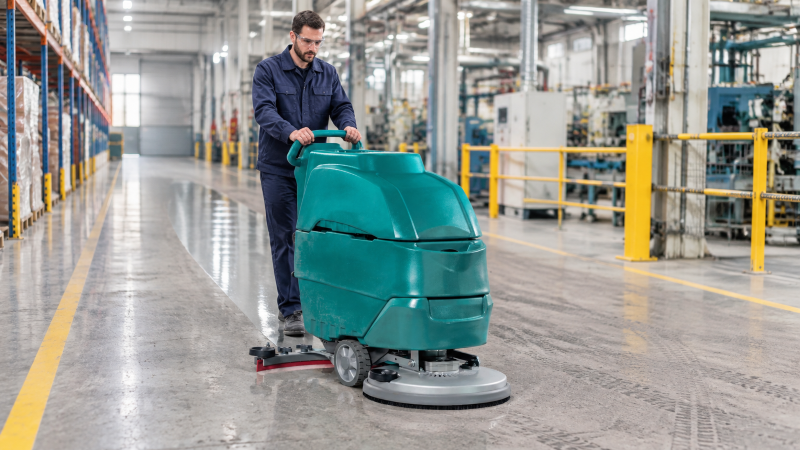
Compact walk-behind
Start here for narrow aisles, frequent turns, multiple doorways or small production cells.
Wide walk-behind
A middle option for long, medium-width routes where coverage matters but the site is not ready for a ride-on.
Ride-on
A stronger fit for long open runs, large floor plates and workloads that otherwise fatigue the operator.
The largest model is not automatically the best industrial scrubber. A wide machine that cannot clean the tightest area still requires a second machine or manual work. The warehouse floor scrubber selection guide covers route and workload differences in more detail.

For a ride-on shortlist, the complete ride-on buyer guide explains the additional dimensions, tanks and operating considerations.
A strong brand can still offer the wrong size for a building. A lower-priced machine can become the more expensive choice if it needs extra passes or cannot complete the cleaning window. The comparison should be based on the work the machine performs.
The 18-question floor scrubber buying checklist can be used as the scoring sheet.

 6Best industrial floor scrubber FAQ
The best model is the one that fits the site's route and floor, handles the actual soil, completes the cleaning window and has practical local support.
Use a ride-on for suitable long runs and large workloads; use a walk-behind where the route has tight access or frequent turns. Measure before deciding.
It can reduce the number of passes on an open floor, but only when the route allows continuous movement. Obstacles and turning can erase that advantage.
Use the same floor data, machine specification, trial conditions and support questions for every supplier. Compare the complete package rather than the model name alone.
Compare route, soil, floor, area and cleaning window before comparing brands. Then verify the leading model on the real floor and include refilling, emptying and daily preparation in the decision.
Shortlist an industrial scrubber for your site
Send the cleanable area, floor and soil, narrowest route, cleaning window and number of shifts. We can narrow the machine class before a trial.
Email: Donnie@terrascrubx.com
WhatsApp: +86 166 0187 1755
No. 600, Jiye Road, Sheshan Town, Songjiang District, Shanghai, China