Spills, foot traffic, cart wheels, and produce debris make grocery store floors some of the hardest surfaces to keep clean. This guide walks through five store zones, a three-shift cleaning schedule, and the two TerraScrub machines that handle everything from tight produce aisles to wide warehouse-club layouts.
The FDA Food Code requires retail food establishments to keep floors clean and dry to prevent slips and contamination. In a store that sees 2,000 to 5,000 shoppers a day, that is not a weekly job. It is a daily one, sometimes twice daily in high-traffic zones.
Mopping redistributes dirty water across the floor. It does not remove it. A walk-behind floor scrubber like the BA860 applies fresh solution, scrubs with dual 860mm brushes, and vacuums the dirty water into a recovery tank in a single pass. The floor is dry almost immediately. That matters in a grocery store where customers walk through the same aisle 30 seconds after you finish cleaning it.
If you want to compare scrubber models side by side, the complete floor scrubber spec comparison table lists every TerraScrub model with cleaning width, coverage rate, and tank capacity.
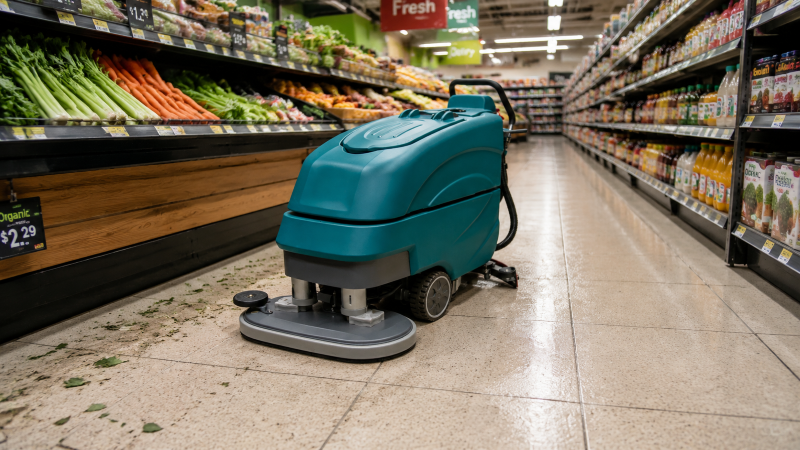
Not every part of a grocery store needs the same cleaning approach. Breaking the floor into zones helps you match the right method and machine to each area.
Aisle width is the single biggest factor. Most grocery aisles run 48 to 72 inches wide. You need a machine narrow enough to fit between shelves but wide enough to cover the floor in a reasonable number of passes. Two TerraScrub models cover the range:
For stores under 3,000 m², the BA530 with a 530mm deck is a more compact option. The full floor cleaning equipment resource guide covers every model if you need more options.
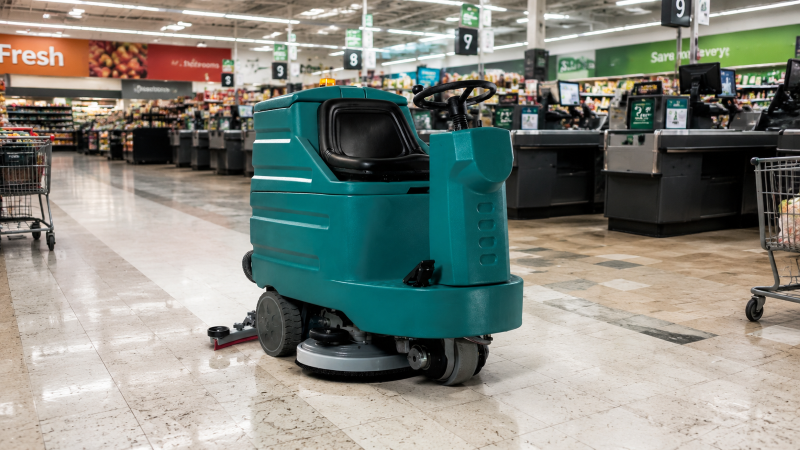
One cleaning pass per day is not enough for a busy grocery store. Split the work across three windows to keep floors safe without blocking shoppers.
Full store scrub with BA860 or A7. Focus on produce, entry, and checkout zones. Refill solution tank, check squeegee blades for wear. Floor must be completely dry before doors open at 7 or 8 AM.
Targeted scrub of high-spill zones only: produce, deli, dairy. Use the BA860 in spot-clean mode with reduced solution flow. Skip center aisles unless there was a spill. This pass takes 20-30 minutes.
Full store scrub with degreaser in bakery and deli. Hot water in solution tank for oil breakdown. End with a clean-water rinse pass in produce to remove detergent residue. Empty recovery tank, rinse squeegee, park on charge.
A grocery store scrubber runs 365 days a year. That is 1,000+ hours of brush time annually. Three habits keep it reliable:
1. Charge after every shift. Lead-acid batteries last longest when charged fully after each use. Do not let the battery sit below 30% charge overnight. The BA860 and A7 both use 24V/200Ah batteries that need 6-8 hours for a full charge, which fits perfectly between the post-close and pre-open shifts.
2. Flush the system weekly. Detergent residue builds up in the solution lines and recovery tank. Run clean warm water through the system once a week, then drain completely. This prevents clogs and odors, especially in the recovery tank where organic matter from produce and dairy can ferment.
3. Replace squeegee blades before they fail. Flip the blade when the leading edge shows wear (usually every 2-3 months in a grocery store). Replace entirely when both edges are rounded. If your scrubber stops picking up water, the squeegee is the first thing to check. The water pickup diagnostic guide walks through seven common causes and fixes.
Need help matching a floor scrubber to your store layout? Send your aisle width and total floor area to Donnie at TerraScrub. We will recommend the right model and send a quote within 24 hours.
Email: Donnie@terrascrubx.com
WhatsApp: +86 166 0187 1755