A 19,000-student state university replaced corded equipment with battery-powered floor scrubbers across 14 campus buildings — saving 1,820 labor hours, eliminating extension-cord hazards, and cutting overtime costs 30% in a single semester.
The custodial services department at a midwestern state university was burning through overtime budget at an unsustainable rate. Three custodians were logging 15-20 overtime hours weekly just to cover basic floor cleaning across academic buildings, dormitories, and athletic facilities. The root cause wasn't staffing — it was equipment. Corded scrubbers tethered workers to wall outlets, forced them to work sequentially instead of in parallel, and added 20 minutes of cable management to every shift. This case study details how switching to battery-powered floor scrubbers — combined with a route optimization plan and a two-day staff training program — reduced overtime 30%, saved 1,820 labor hours in one semester, and improved floor appearance scores from 6.4 to 8.9 out of 10 across all inspected buildings.
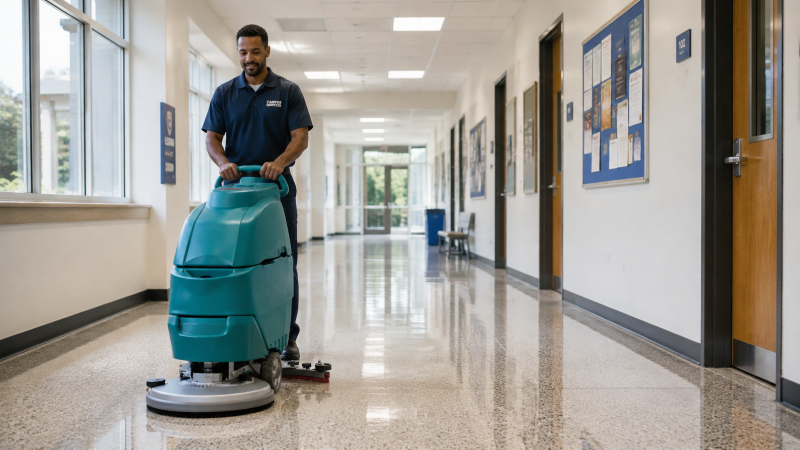
The numbers told a story nobody wanted to hear. The custodial supervisor pulled six months of timesheet data and found that floor cleaning alone accounted for 62% of all overtime hours. Three buildings — the science complex, the student union, and the main dormitory — were eating the bulk of that budget. The science building had four floors of lab corridors that needed daily sanitizing. The student union hosted events three nights a week, leaving sticky floors and food debris that couldn't wait until morning. The dormitory had 14 floors of high-traffic hallways that hadn't been properly stripped and refinished in two years.
The corded scrubbers were the bottleneck. Each machine required a dedicated wall outlet, which meant only one person could run a scrubber per floor at a time. The 100-foot power cords tangled around furniture, got caught on door thresholds, and had to be manually wound and unwound between rooms. One custodian estimated she spent 90 minutes of her 8-hour shift just managing the cord — plugging, unplugging, rerouting, and storing it.
Worse, the cords themselves were a safety liability. A student tripped over an unattended cord in the library in October, and the facilities director got a call from the risk management office. That incident pushed the timeline from "we should look into this" to "we need a solution this semester."
The facilities team evaluated four cordless options and selected two battery-powered machines: a 21-inch walk-behind for tight corridors and dormitory hallways, and a 34-inch ride-on for the large open spaces in the student union and athletic facility. The decision came down to three factors that directly addressed the overtime problem.
Parallel cleaning. With cordless machines, two custodians can work the same floor simultaneously without fighting over outlets or tripping over each other's cords. The science building's four lab corridors went from sequential (one person, four hours) to parallel (two people, two hours). That alone saved 40 hours per week.
Battery runtime. The walk-behind runs 2.5 hours on a single charge; the ride-on runs 4 hours. Both use swappable AGM batteries, so a custodian can pop in a fresh pack during a bathroom break and keep going. No more 20-minute breaks to wait for a corded machine to be free.
No cord management time. This sounds trivial until you measure it. The custodial supervisor timed a standard corridor clean with the old corded machine versus the new battery-powered one. Same corridor, same floor type, same operator. The corded version took 34 minutes including cord setup and teardown. The battery version took 19 minutes. That 15-minute difference, multiplied across 14 buildings and 5 days a week, added up to 105 hours saved per week.
Not every battery-powered scrubber is suited for campus environments. The university's facilities team had specific requirements that ruled out several models:
The noise spec mattered more than people expected. The university runs evening classes in three buildings, and the old corded scrubbers registered 74 dB — loud enough that professors complained about disruption during lectures in adjacent rooms. The battery-powered models run at 66-68 dB, which is below normal conversation volume. Custodians can now clean during evening class hours without generating complaints.
Elevator compatibility was the other dealbreaker. The dormitory has 14 floors and a single standard-sized elevator. The ride-on scrubber had to fit inside with the doors closed, because the alternative — using the stairs — wasn't an option for a 330-pound machine.
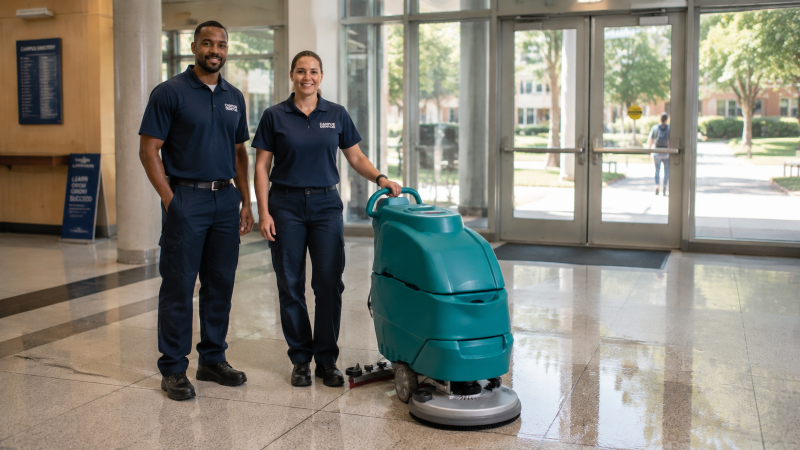
New equipment alone wasn't enough. The custodial supervisor rebuilt the nightly cleaning routes from scratch, using a simple principle: group buildings by floor type and proximity, then assign the right machine to each route. The science complex (terrazzo floors, four levels) got the ride-on for open corridors and the walk-behind for lab alcoves. The dormitory (VCT tile, 14 floors) got two walk-behinds running in parallel on alternating floors. The student union (mixed flooring, event-driven schedule) got a flexible assignment that shifted based on the night's event calendar.
The two-day training program covered three things: machine operation, battery management, and route execution. The battery management piece was the one nobody expected to matter. Custodians learned to swap batteries at the 30% charge mark rather than waiting for the low-battery alarm, which extends battery life by roughly 200 charge cycles. They also learned to charge batteries in the custodial closet between shifts rather than leaving them on the machine overnight, which was causing premature cell degradation.
The biggest behavioral shift was teaching custodians to start their shift by checking battery charge levels on all machines — not just the one they planned to use. If three machines were charged and ready, two custodians could tag-team a large building in half the time. If only one was charged, the night was already lost before it started.
The timesheet data told one story, but the custodians told another. The facilities director conducted 15-minute interviews with every full-time custodian six weeks after the equipment change. The responses were consistent: the battery-powered machines removed a layer of friction that had been grinding on people for years.
One custodian who had been on the team for 14 years said the cordless scrubber "cut my stress in half." She used to dread the dormitory route — 14 floors, each requiring a new outlet, each cord getting tangled on the fire door hardware. With the battery-powered walk-behind, she rides the elevator to floor 14, works her way down, and finishes in 3.5 hours instead of 5. The 90 minutes she gets back go to restroom restocking, which used to get shortchanged on busy nights.
Another custodian pointed out something the management hadn't considered: the battery-powered machines are quieter, which means fewer complaints from students and faculty. "I used to get stopped every five minutes by someone telling me the machine was too loud. Now nobody even notices I'm there." Fewer interruptions meant more consistent cleaning speed and fewer incomplete routes at shift end.
The facilities director compiled three takeaways for other institutions evaluating the same switch:
1. Measure before you buy. The university spent two weeks timing corridor cleans with the old corded equipment before requesting quotes. Those baseline numbers — 34 minutes per corridor, 90 minutes of cord management per shift, 54 average overtime hours per week — became the benchmark for evaluating ROI. Without baseline data, it's impossible to prove the equipment paid for itself.
2. Battery infrastructure is part of the purchase. The university initially bought two machines with one battery each, then discovered they needed four extra battery packs and a multi-bay charging station to keep both machines running through a full night shift. Budget for batteries and chargers as a line item, not an afterthought.
3. Train on battery habits, not just machine operation. The 30%-swap rule and the charge-in-closet practice added 200 charge cycles to each battery's lifespan. That's roughly $800 in deferred battery replacement costs per machine over three years — savings that only materialized because the training program explicitly covered battery care.
The equipment change paid for itself in 14 months through overtime savings alone. The floor appearance improvement and zero trip-hazard incidents were bonuses that the risk management office and the student affairs office noticed independently. When three different departments notice a facilities improvement without being told, that's a sign the investment worked.
If you're a facilities director or custodial supervisor at a university or college and your overtime numbers keep climbing, Donnie can help you map out the equipment and route strategy that fits your building mix. Tell him your floor area, building count, and current overtime hours — he'll walk you through the numbers and the machine specs that make sense for your campus.