A regional frozen-food distribution center transformed its freezer floor maintenance with heated squeegee blades, low-temperature degreaser, and zone-based rotation — cutting slip incidents 55% and slashing chemical costs 30% in six months.
A 45,000-square-foot cold storage facility in the Midwest was losing the battle against frost buildup, condensation pools, and ice patches on its freezer floors. Workers reported near-daily slip hazards. Management had tried spreading rock salt and hand-squeegeeing trouble spots, but nothing held up at -20°F. This case study walks through what actually worked: a ride-on scrubber with heated squeegee blades, a low-temp degreaser rated to -40°F, and a zone rotation plan that keeps each section on a 48-hour cleaning cycle. The result: slip incidents dropped from 11 to 5 in six months, chemical spend fell 30%, and the facility passed its USDA audit with zero floor-related findings.
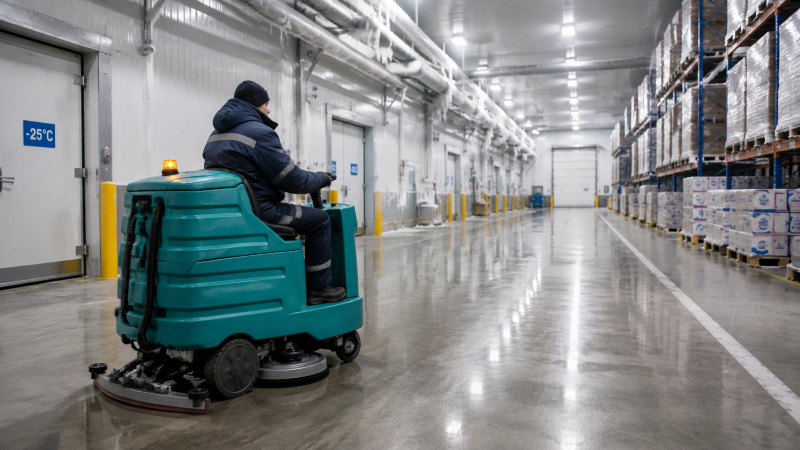
Standard floor cleaning equipment stops working properly below 32°F. Water freezes in the squeegee channels. Detergent loses viscosity and won't spread evenly. Recovery tanks ice over, and by the time the operator finishes one aisle, the solution they laid down five minutes ago has already turned to a slick film. At -20°F, the window between "wet floor" and "ice rink" is roughly 90 seconds.
This facility had been relying on a walk-behind scrubber designed for ambient warehouses. The squeegee blades would stiffen within ten minutes of entering the freezer, leaving a trail of unrecovered water that flash-froze into thin ice sheets. Forklift drivers started reporting their wheels sliding at intersections. Two workers went down in the same week — one on a patch of frozen condensation near the evaporator units, another on a film of unrecovered detergent near the loading dock transition zone.
The maintenance supervisor summed it up bluntly: "We were cleaning the floors and making them more dangerous at the same time."
Not every scrubber can operate at -20°F. The facility tested three machines before settling on one that survived a full 8-hour shift in the freezer without squeegee failure. The key features that mattered:
Heated squeegee blades. A built-in heating element keeps the squeegee assembly at 40°F, preventing the rubber from hardening and losing contact with the floor. Without this, recovery rates drop below 60% in sub-zero environments — meaning nearly half the water you put down stays on the floor.
Insulated solution tank. The solution tank is double-walled with a thermal layer that keeps the cleaning fluid above freezing for the duration of the shift. Standard tanks allow heat to bleed out within 20 minutes, and once the fluid drops below 32°F, it thickens and won't flow through the lines properly.
Low-temp battery chemistry. Standard lead-acid batteries lose 30-40% of their capacity at -20°F. The facility upgraded to AGM batteries rated for cold storage, which hold 85%+ capacity even at full freezer temperature. This means the machine can run a full shift without mid-shift battery swaps.
Salt-brine compatible recovery system. The recovery tank and vacuum motor are sealed against corrosive salt brine — critical because the loading dock transition zone tracks in road salt that eats standard components in months.
The detergent question is where most cold storage facilities give up. Standard floor cleaners freeze at around 28°F. You either dilute them with less water (which leaves residue) or you switch to a chemical that stays liquid at freezer temperatures.
The facility settled on a potassium-hydroxide-based degreaser formulated for cold storage, rated to -40°F. It maintains its cleaning action at -20°F without foaming or gelling, and it breaks down the oily film that accumulates from forklift hydraulic leaks and pallet residue. The dilution ratio is 1:256 — about 1 ounce per 2 gallons of water — which keeps chemical costs predictable.
One thing they learned the hard way: never use a citrus-based degreaser in a food-storage freezer. The citrus scent lingers at sub-zero temperatures and can be absorbed by packaging. The potassium-hydroxide formula is odorless once dry and leaves no residue that would trigger a USDA inspection flag.
Cleaning 45,000 square feet of freezer floor with one machine means you can't hit every section every night. The facility divided the floor into six zones based on traffic density and contamination risk, then built a 48-hour rotation cycle:
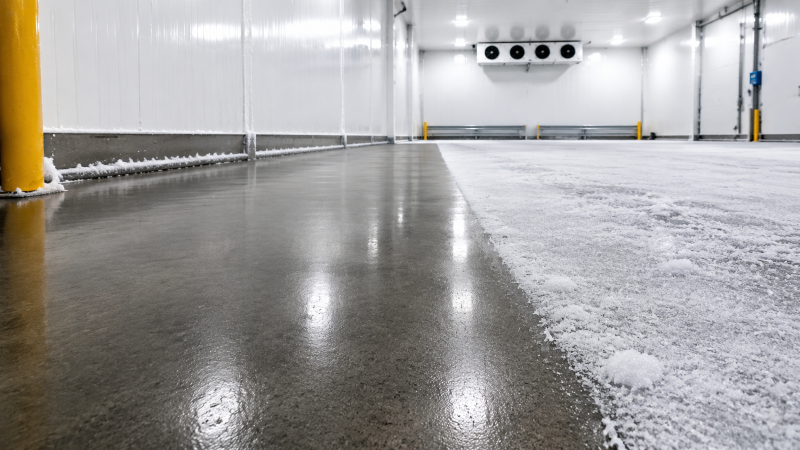
The loading dock transition zone (Zone A) gets the most attention because it's where road salt, water, and temperature differential all collide. The floor goes from 35°F at the dock seal to -20°F inside the freezer within about 15 feet of corridor. Condensation forms instantly on that transition strip, and without daily scrubbing, it builds into a visible ice layer within 48 hours.
Zone D — the evaporator drip zones — is the sneaky one. The defrost cycles on ceiling-mounted evaporator units dump meltwater onto the floor four times a day. Most of it freezes before it can evaporate, creating patches of rough ice that are nearly invisible under the LED lighting. The scrubber hits these zones every 24 hours to break up the ice before it accumulates.
Each cleaning shift runs 6 hours, split across two operators working 3-hour rotations. Cold storage floors need a different approach than ambient facilities — you don't just drive the scrubber in a straight line and call it done.
The protocol is built around three principles. First, the machine pre-warms for 15 minutes in the anteroom (held at 35°F) before entering the freezer. This brings the squeegee heating element up to temperature and prevents thermal shock on the rubber blades. Second, the operator works in 200-square-foot sections, laying down solution and recovering it within 60 seconds — well inside the 90-second freezing window. Third, after each zone, the recovery tank is dumped at a heated drain station in the anteroom to prevent ice buildup in the tank.
One operator handles Zones A, B, and D (the high-traffic zones) during the first 3 hours. The second operator takes Zones C, E, and F. They overlap on Zone A because the loading dock transition requires a double pass — one with degreaser, one with clean water rinse — to remove salt residue completely.
11 slip incidents in 6 months. Two required medical attention. Forklift traction warnings triggered 3-4 times per week. Ice patches visible on 15% of floor surface during morning inspection. USDA auditor flagged "floor condition" as an observation. Chemical spend: $1,200/month on rock salt + ineffective cleaners.
5 slip incidents in 6 months. Zero required medical attention. Forklift traction warnings dropped to less than 1 per week. Ice patches reduced to under 2% of floor surface. USDA audit passed with zero floor-related findings. Chemical spend: $840/month — a 30% reduction. Rock salt use eliminated entirely.
The biggest surprise wasn't the equipment or the chemistry — it was how much the defrost cycle schedule mattered. The facility's evaporator units were running defrost cycles every 6 hours, dumping meltwater onto the floor at unpredictable intervals. Once they synchronized the defrost cycles to run 30 minutes before each cleaning shift, the scrubber could hit the drip zones right after the water landed, before it had time to freeze into rough ice.
Another lesson: the anteroom temperature matters as much as the freezer temperature. The facility had been running the anteroom at 45°F, which created a 65-degree differential at the transition zone. Dropping the anteroom to 35°F narrowed the gap to 55 degrees and cut condensation formation by roughly 40%.
Cold storage floor cleaning is 30% equipment, 30% chemistry, and 40% timing. The most expensive scrubber in the world won't help if you're running it during a defrost cycle or hitting the transition zone when the dock doors are open. Get the schedule right first, then optimize the machine.
If you're running a freezer facility and fighting the same battle — frost, ice patches, slip incidents that won't go away — Donnie can walk you through the equipment and chemistry specs that work at -20°F. No generic advice, just what's been field-tested in real freezer environments. Reach out and tell him your facility size, operating temperature, and current pain points.