Tire marks are the floor problem that makes a clean warehouse look dirty. Forklifts, pallet trucks, and delivery vans leave black streaks that mopping won't touch, and they build up until every aisle looks like a brake test track. The good news is that tire marks sit on the surface rather than soaking into the concrete like oil, so they come off with the right chemical, the right brush, and a little pressure. This guide walks through the process step by step, from the quick fix to handling a whole warehouse floor.
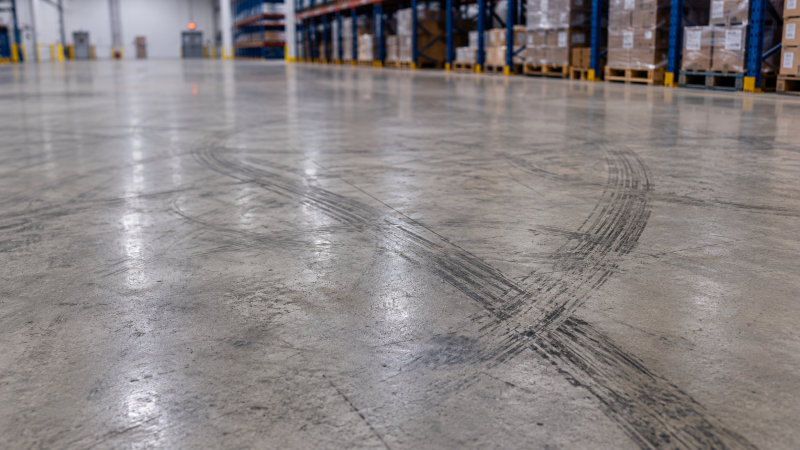
Oil soaks into concrete. Tire marks don't. What you're seeing is a thin layer of rubber that transferred from the tire to the floor, mixed with dirt and road grime. Because it sits on the surface, it responds to mechanical scrubbing — which is why a stiff brush or a disc brush removes it, while a mop just smears it around. Understanding that difference is the whole trick: you're not dissolving a stain deep in the slab, you're abrading a film off the top.
Get the loose dirt off before anything else. Scrubbing over sand just grinds it into the floor and dulls your brush.
This is where the marks actually come off, and on most floors no chemical is needed. On a small patch, a stiff brush in a circular motion works. On warehouse aisles, a floor scrubber with a disc brush does it far faster and with consistent pressure. If the floor also has oil or grease, add a low-foam degreaser to the clean water tank at the dilution on the label — the machine applies it as it scrubs, which is how scrubber chemicals are meant to be used. Warm water helps soften the film, but the brush is doing the work. Go over each mark a couple of times — the first pass removes most of it, the second cleans up the ghost.
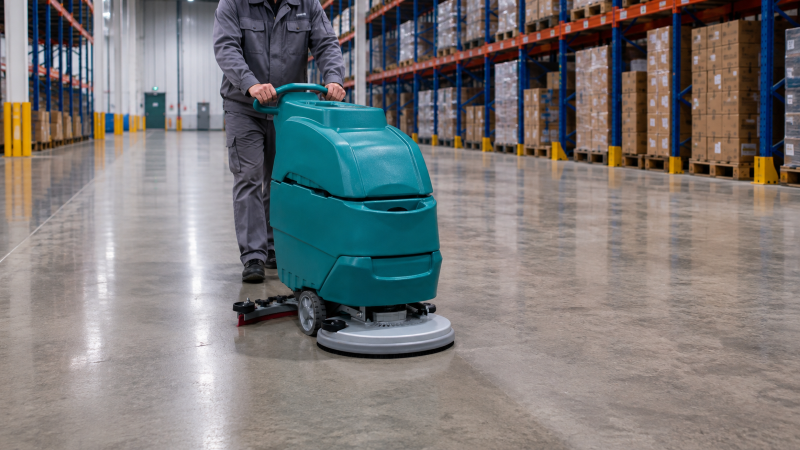
Rinse the area with clean water and pick the water up. With a scrubber, the squeegee and vacuum handle this in the same pass. Leftover water and loose rubber will just attract more grime back within days.
If the marks have been building up for months, one pass won't get them all. Run the aisle twice, then consider a seal or coating — sealed concrete releases tire marks much easier than raw concrete, the same reason sealing helps with oil, as covered in our oil stain removal guide.
| Method | Time for 100 m² | Effort | Best for |
|---|---|---|---|
| Stiff brush by hand | 2–3 hours | Very high | Small patches, garage floors |
| Walk-behind scrubber | 15–20 minutes | Low | Aisles and warehouse floors |
| Ride-on scrubber | 5–10 minutes | Low | Large open floors, full passes |
The right machine size depends on your floor area — our warehouse sizing guide has the math.
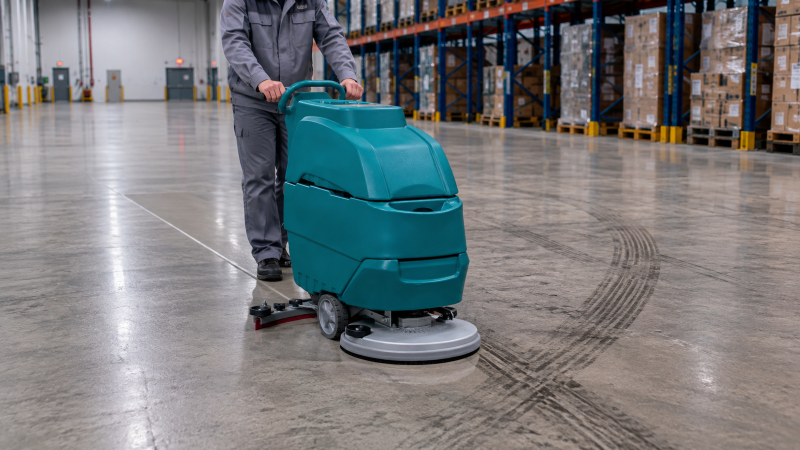
Mechanical scrubbing with a stiff brush or a disc brush. Tire marks are a surface film, so the brush lifts them off — no chemical is needed on most floors. If the floor also has oil, a low-foam degreaser in the clean water tank helps.
Yes, and it's the fastest way on large floors. The disc brush removes the marks mechanically, and the squeegee picks up the dirty water in the same pass.
They're being laid down again by the same tires. Sealing the floor and cleaning on a schedule keeps the new marks from building up into a visible layer.
Yes. Tire rubber grips raw concrete and leaves more film behind. A sealed surface is smoother, so marks stay on top and come off in a normal cleaning pass.
Tire marks are a surface problem with a straightforward fix: a disc brush and a rinse. On a warehouse floor, a machine does in minutes what a brush does in hours, so size it to your area and put tire-mark removal into your regular schedule. The A3 walk-behind handles most warehouses, and the A7 ride-on takes over when the floor is large or the cleaning runs daily. Pair it with the concrete cleaning guide and the streaks guide and your floors stay presentable without a fight.
Contact TerraScrub
Email: Donnie@terrascrubx.com
WhatsApp: +86 166 0187 1755
No. 600, Jiye Road, Sheshan Town, Songjiang District, Shanghai, China