
EQUIPMENT PLANNING · 2026
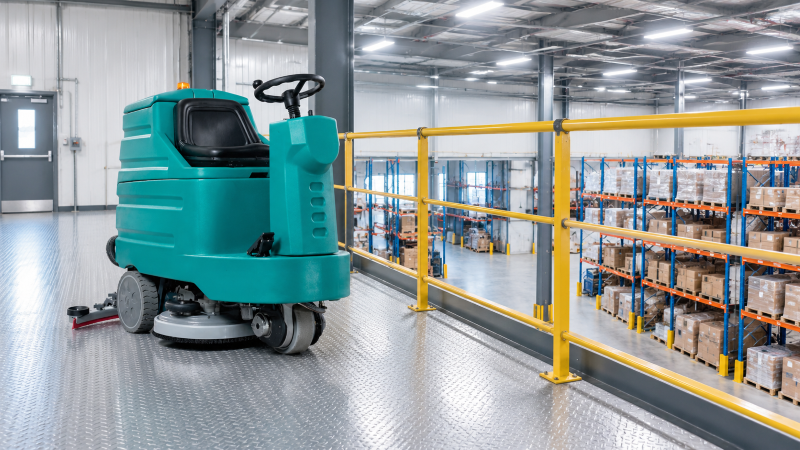
Getting the machine up there is the easy question. The hard one is whether the floor was designed for it — and ride-on scrubbers are heavier than most people expect, especially with full tanks. Weight, water, point loads at the wheels, and lift capacity all have to line up before a machine goes onto a mezzanine.
Spec sheets quote the machine's dry weight. On a mezzanine, what matters is the weight with full tanks:
That water doesn't just add weight — it adds weight high up and moving, which is exactly the load case a mezzanine is least forgiving about.
| Class | Dry weight | Practical note |
|---|---|---|
| Walk-behind (BA680) | ~190kg | Lightest class for upper floors |
| Walk-behind (BA730) | ~220kg | Larger tanks, still manageable |
| Dual-brush walk-behind (BA860) | ~300kg | Self-propelled, but heavy with 200L of water |
| Mid-size ride-on (BA850) | 580kg | Plus up to 375L of water |
| Oversized ride-on (A17) | 1,525kg | Ground-floor industrial machine |
For comparison of the lighter classes, see our walk-behind scrubber lineup guide.
 3Distributed Load vs Point Load
A mezzanine is rated for a load spread across its area. A scrubber doesn't spread its weight — it puts it through a few small contact patches at the wheels.
This is why the answer isn't "the machine weighs 300kg, so it's fine". It's a structural question, and it needs a structural answer.
Space is the other half of the question — widths and turning room are covered in our aisle width guide.
Right-sizing by area and shift length is the starting point — our warehouse sizing guide walks through it.
Can a ride-on scrubber go on a mezzanine?
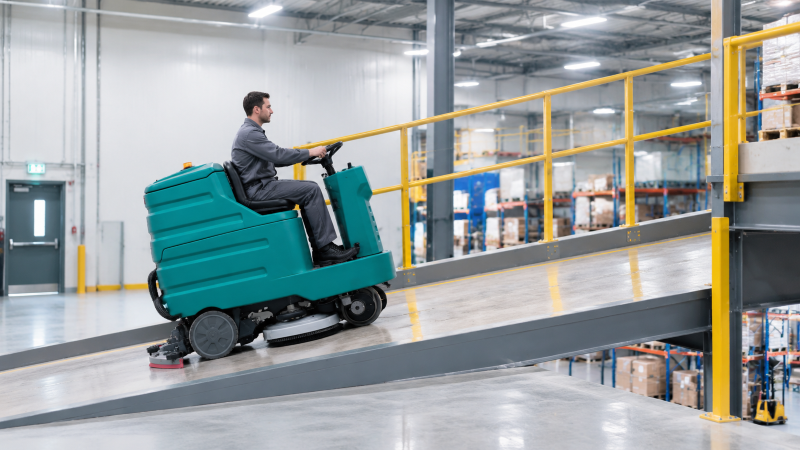
Only if the structure has been assessed for the machine's wet weight and point loads. Many mezzanines are rated for storage or foot traffic, not a moving machine with hundreds of litres of water.
Does the water really matter that much?
Yes. On large machines the tanks can hold more than half a tonne of water, and it sits high on the machine. Empty weights understate the real load significantly.
Will a goods lift handle one?
Check both the rated capacity and the internal dimensions. A 580kg machine plus water can exceed a light goods lift, and door width often rules out the machine before weight does.
Who confirms the floor can take the load?
A structural engineer, using the mezzanine drawings and the machine's load data. A supplier can give you weights and point loads; only the engineer can approve the structure.
What's the lightest practical option for upper floors?
A compact walk-behind or mini ride-on with modest tank capacity, used with partial fills where the cleaning window allows. It costs more refills and buys you a lighter footprint.
Before a scrubber goes upstairs, get three numbers: wet weight, point load at the wheels, and the lift's capacity and dimensions. Then let a structural engineer compare them to the mezzanine's rating. Everything else — class, tank size, schedule — is a decision you can make after that.
Contact TerraScrub
Email: Donnie@terrascrubx.com
WhatsApp: +86 166 0187 1755
No. 600, Jiye Road, Sheshan Town, Songjiang District, Shanghai, China