News Center

Floor Scrubber Buying Checklist: 18 Questions to Ask (2026)

Release Time:2026-10-15 Browse:5

BUYER'S CHECKLIST · 2026

Floor Scrubber Buying Checklist: 18 Questions to Ask Before You Order

Most scrubber purchases go wrong on details that were never asked about: a deck that won't fit the aisle, a tank that needs refilling mid-shift, spares that take weeks to arrive. This checklist covers 18 questions in four blocks — print it and take it to the demo.

1Block 1: Floor and Fit (Questions 1–5)

  1. What is the narrowest aisle, measured with stock in place? Not the drawing — the real gap at the tightest point.
  2. Which floor types are involved? Sealed concrete, epoxy, quarry tile, and vinyl behave differently under brushes and chemicals.
  3. Is the widest point the deck or the body? Decks often overhang the machine; ask for the outer dimension of both.
  4. Is there room to turn at the end of each aisle? A machine can fit an aisle and still be impractical if it has to back out.
  5. Will it pass through doorways, lifts, and ramps? Measure openings, not just floors.

The measurements to take and how they map to machine classes are in our aisle width guide.

2Block 2: Machine Specs (Questions 6–10)

  1. What area does one pass actually cover? Brush width and deck width differ, and two brushes don't double the width — ask for the real figure.
  2. What are the clean and recovery tank sizes, and how many refills per shift? Tank size decides how often the work stops.
  3. Is brush pressure adjustable? You need higher pressure for heavy soil and lower pressure for delicate or polished floors.
  4. How wide is the squeegee, and how does the vacuum recover water? Dryness is a spec, not a by-product.
  5. How much does the machine weigh? Relevant if you clean mezzanines, upper floors, or use a goods lift.
Checking scrubber dimensions against a warehouse aisle during a buying evaluation

3Block 3: Power and Runtime (Questions 11–14)

  1. What battery capacity is fitted, and how long does it run in real use? Rated runtime and working runtime are different numbers.
  2. How long is a full charge, and does that fit your shift pattern? Charge time can eliminate a machine as fast as runtime can.
  3. Where will it charge, and who is responsible? A charging routine nobody owns is a battery warranty claim waiting to happen.
  4. Are the batteries maintenance-free or do they need water checks? This decides whether someone must own that task weekly.

Capacity vs shift length is worked through in our battery capacity guide.

4Block 4: Service and Delivery (Questions 15–18)

  1. Who services the machine in my country, and in what timeframe? Ask for a name and a process, not a promise.
  2. Which wear parts are stocked locally? Brushes, squeegees, filters, and batteries are the items that stop work.
  3. What exactly does the warranty cover, and what's excluded? Get it in writing, including the battery.
  4. What's included at delivery — training, documentation, commissioning, and a demo on my floor? Delivery terms vary enormously between sellers.

5How to Score the Answers

Mark each answer as must-have, nice-to-have, or red flag. The red flags are what matter most:

Answer patternWhat it tells you
Can't give deck or body widthYou'll be the one discovering it doesn't fit
Vague on spares or serviceDowntime will be measured in weeks, not days
No demo on your floorYou're buying a specification, not a result
Quotes that list a price but no configurationComparisons become meaningless; ask for a written spec

Sizing comes first — coverage, tanks, and runtime all follow from your floor area and shift length. Our warehouse sizing guide shows the calculation.
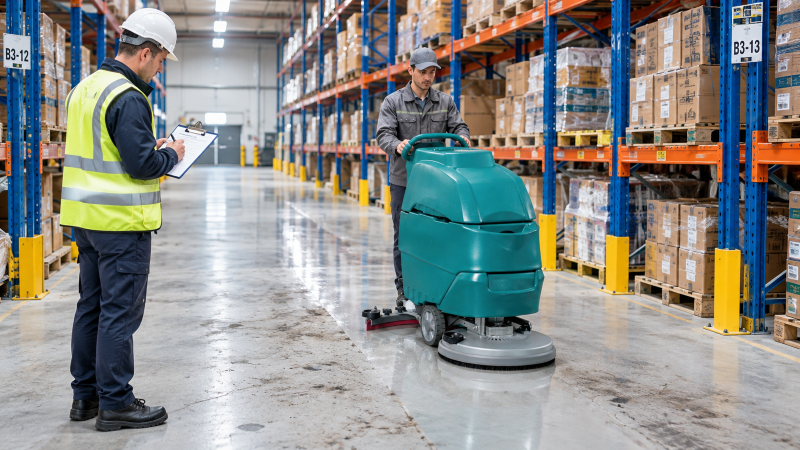
Supervisor scoring a floor scrubber demo against a buying checklist

Common Questions

What's the single most important question?

What's the outer width of the machine, including the deck? It's the one number that most often turns a good machine into an unusable one in a racked warehouse.

Can I buy without a demo?

You can, but you're accepting risk. A short demo on your own dirt, in your tightest aisle, with your operator answers more questions than any datasheet.

Should I buy bigger to future-proof?

Only if your floor area or shift length is genuinely growing. Buying a class above your needs usually means a machine that's harder to maneuver in today's aisles and heavier to run.

How do I compare two quotes fairly?

Insist both list the same items: machine, deck and brush width, tank sizes, battery capacity, charger, starter consumables, freight, training, and warranty terms. Without that, you're comparing unknown quantities.

What if two machines score equally?

Decide on service: which seller can get a squeegee, brush, or battery to you fastest, and who picks up the phone when the machine stops mid-shift.

Eighteen questions, four blocks, one rule: the machine has to fit your building before it has to impress you on paper. Ask the questions in writing, score the answers against your own floor, and the shortlist usually makes the decision for you.

Contact TerraScrub

Email: Donnie@terrascrubx.com

WhatsApp: +86 166 0187 1755

No. 600, Jiye Road, Sheshan Town, Songjiang District, Shanghai, China


Message Inquiry

*
*
*
*
验证码
*
Submit