SCRUBBER OPERATIONS · 2026
Deep cleaning isn't "scrubbing harder". It's a sequence: remove the dry grit, let the chemistry work, agitate with the machine, recover every drop of water, then inspect. Skip a stage and you either leave the soil behind or redeposit it on the floor you just cleaned.
| Situation | What it needs |
|---|---|
| Light dust, no visible marks | Routine scrub at normal speed and flow |
| Tyre marks that survive a normal pass | Deep clean: slower speed, higher pressure, second pass |
| Oil film or greasy build-up | Deep clean with degreaser dwell time |
| Hazy concrete that looks dirty when dry | Deep clean, then consider sealing |
| Before an audit, handover, or client visit | Deep clean full floor, targeted touch-ups |
Stage 1: Remove the dry grit
Sweep or vacuum before any water touches the floor. Grit under a brush acts like sandpaper, and wetting dry dust turns it into a paste that gets pushed into the surface.
Stage 2: Let the chemistry work
Apply degreaser at the label dilution and give it 5–10 minutes. This dwell time is what breaks the bond between oil and concrete — the full removal method is in our oil stain removal guide.
Stage 3: Agitate slowly
Drop the machine to a slow walking pace with higher brush pressure than a routine pass would use. Slower speed means more brush revolutions per metre — that's the actual cleaning force. Work in overlapping lanes, then run a second pass over the worst areas.
Stage 4: Recover the water completely
Deep cleaning lifts far more soil into the water than a routine pass, so recovery matters more, not less. Check the floor behind the squeegee by hand; if it's wet, the residue is staying on the floor. Worn squeegee blades are the usual culprit.
Stage 5: Inspect and treat by section
Let the floor dry and inspect under good light. Treat the remaining patches individually instead of re-running the whole floor — targeted work is faster and uses less water than a blanket second pass.
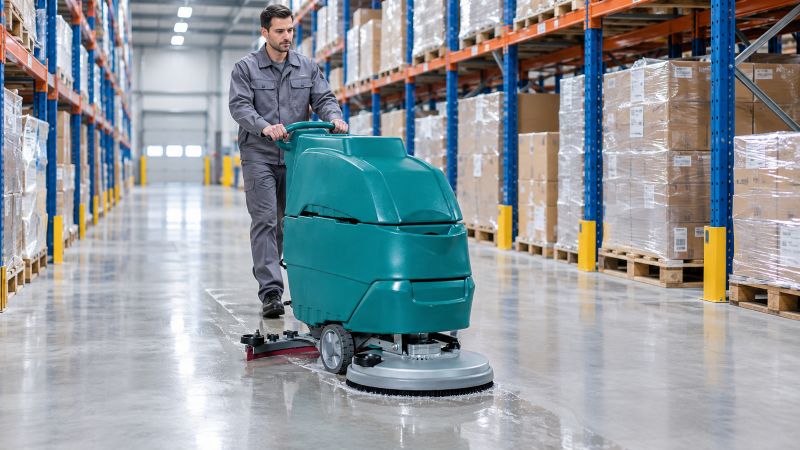
| Setting | Routine pass | Deep clean |
|---|---|---|
| Drive speed | Normal walking pace | Slow — more brush revolutions per metre |
| Brush pressure | Standard | Increased, where the machine allows adjustment |
| Solution flow | Low to mid | Higher, with refills planned — see our water usage and refill guide |
| Passes | One | Two over soiled areas, with inspection between |
| Speed expectations | Rated coverage is achievable | Expect roughly half the rated area per hour — a planning estimate, not a spec |
How often should a warehouse floor be deep cleaned?
Typically quarterly, or whenever tyre marks and oil film stop coming off with a routine pass. High-traffic docks and production areas may need it more often than storage zones.
Can one pass deep clean a floor?
Not usually. One pass with degreaser dwell time handles moderate soil; genuinely dirty areas need a second slower pass and individual attention to the worst patches.
How long does a deep clean take?
Plan on roughly half your machine's rated coverage per hour, because speed drops and passes double. A machine rated at 2,100 m²/h realistically covers about 1,000 m² an hour when deep cleaning.
Do I need a different machine for deep cleaning?
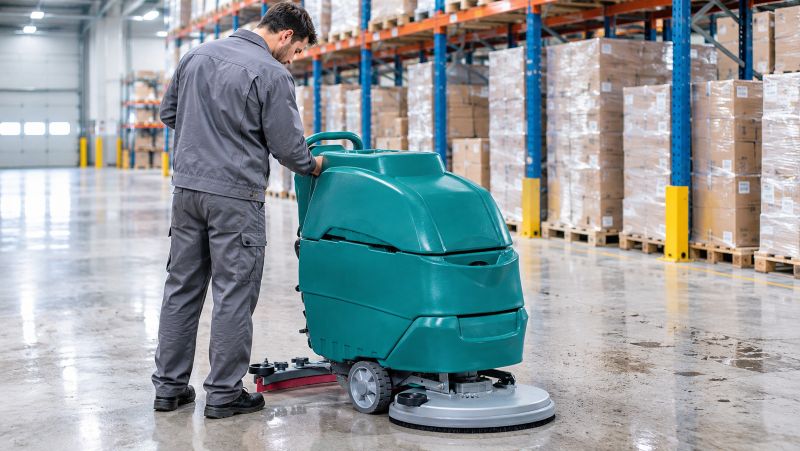
Usually not — you need the same machine run differently: slower speed, higher pressure where adjustable, more solution, and a second pass. Machines with adjustable brush pressure handle both routine and deep cleaning without a second purchase.
Is double scrubbing always necessary?
No. Double scrubbing earns its cost in loading bays, production lines, and traffic lanes. In light storage areas a single slow pass with proper dwell time is often enough.
Deep cleaning is a protocol, not a stronger scrub: clear the grit, give the chemistry time, agitate slowly, recover the water, then inspect and treat only what's left. Run that sequence quarterly and routine passes become faster, because the floor never gets the chance to load up again.
Contact TerraScrub
Email: Donnie@terrascrubx.com
WhatsApp: +86 166 0187 1755
No. 600, Jiye Road, Sheshan Town, Songjiang District, Shanghai, China