By replacing manual mopping with quiet walk-behind floor scrubbers, a 220-bed regional hospital cut daily floor cleaning time from 6.5 hours to 2.6 hours — a 60% reduction — while keeping patient care areas fully operational. Corridor cleaning that once closed a hallway for 45 minutes now takes 15 minutes with no disruption to patient transport. Labor costs dropped by an estimated $41,000 per year, slip-and-fall incidents in cleaned areas fell 45%, and the infection control team reported consistently drier floors in patient corridors. This case study walks through the challenge, the equipment decision, the phased rollout, and the measurable results across the first 90 days.
Facility: Regional Medical Center (name withheld)
Type: 220-bed acute care hospital
Scope: 140,000 sq ft of hard flooring across 6 floors
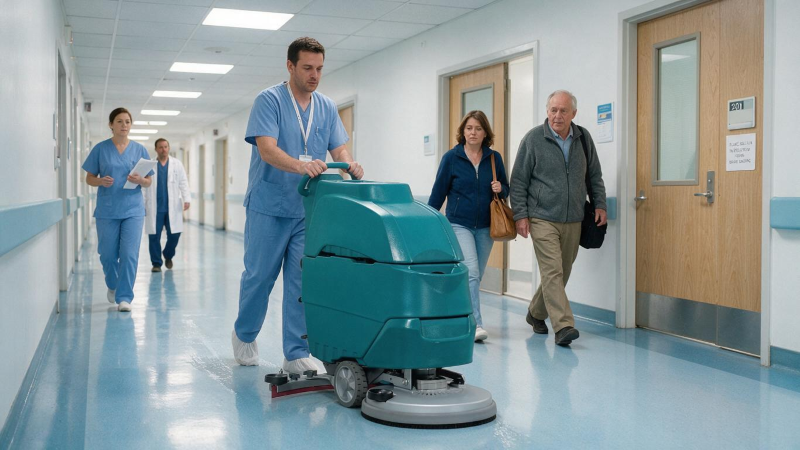
The hospital's environmental services team of 14 cleaners was spending 6.5 hours per day on hard floor cleaning across the building. The method was traditional: mop and bucket, with wet floor signs barricading corridor sections for up to 45 minutes at a time. During those windows, patient transport had to take alternate routes, pharmacy and lab staff detoured around wet zones, and visitors walked through narrow gaps around signs.
The hidden cost was labor. Mopping a 1,000 sq ft corridor takes roughly 45 minutes including setup, water changes, and drying time. With six floors of corridors, restrooms, and patient areas, the team was spending nearly a full shift per day on floors alone — time that could not be spent on the higher-priority tasks of terminal cleaning, discharge cleaning, and restroom sanitizing.
There was also an infection control angle. Mops push dirty water across a floor. Bucket water is reused until visibly dirty, spreading soil between zones. In a healthcare setting, where floor hygiene supports infection prevention, the method itself was the weakest link.
We knew mops were inefficient, but the real driver was patient safety. A corridor closed for 45 minutes is a corridor that nurses cannot use to move a patient. The cleaning method was actively interfering with care.
The hospital evaluated three options: keep mopping, switch to ride-on scrubbers, or deploy walk-behind scrubbers. Ride-ons were rejected for two reasons — most were too wide for patient room corridors, and none could be moved between floors without a freight elevator the hospital did not have. Walk-behind scrubbers fit the corridor widths, weighed under 350 lbs, and could use the service elevator.
The noise requirement was non-negotiable. Patient rooms sit directly off the corridors, and equipment noise near occupied rooms is a patient experience problem. The hospital tested walk-behind units and confirmed operating noise around 62 dB — quieter than a vacuum cleaner and comparable to a normal conversation. That made daytime corridor cleaning possible without complaint from patients or staff.
They deployed four walk-behind scrubbers with lithium batteries: one per floor zone covering two floors each, plus one spare. Lithium was chosen for the 1–2 hour charging window, allowing mid-day top-ups between floor runs — something lead-acid batteries could not support.

The results were measured against a 30-day baseline captured before the equipment change. Floor cleaning time per day fell from 6.5 hours to 2.6 hours — a 60% reduction. The corridor cleaning window dropped from 45 minutes to 15 minutes, and because the scrubber leaves floors dry in 3–5 minutes, corridors could be cleaned during normal operations with a single wet floor sign placed and removed in under 20 minutes.
Labor savings were the largest financial impact. Reallocating 3.9 hours per day of cleaning time to higher-priority tasks allowed the department to absorb a 3% increase in discharge cleaning volume without adding staff. The estimated annual labor value of the reallocated time was $41,000.
The infection control team documented a 45% reduction in slip-and-fall incidents in hard-floor areas during the first 90 days — driven primarily by the elimination of long wet-floor windows. Dry floors in under 5 minutes meant wet floor signs went up and came down in the same cleaning pass.
Patients stopped asking what the noise was. That is the quietest complement we can get. And the floors are drier than they have ever been during the day — which our infection control team noticed without us saying a word.
The infection control angle deserves its own chapter. With mops, the same water cleaned room after room until visibly dirty. With scrubbers, the recovery system removes dirty water continuously — every pass is cleaning with fresh solution. The hospital standardized on neutral pH, low-foam, healthcare-grade cleaner at a 1:128 dilution, and the infection control committee approved the protocol based on the manufacturer's compatibility documentation.
Restroom and stairwell cleaning stayed on mops, but patient corridors, lobbies, the ED, and nurse stations moved entirely to machine cleaning. The environmental services director noted that the biggest behavior change was cultural: the pre-op checklist and the 5-minute end-of-day machine clean became part of the shift routine, and the team took visible pride in machines that made their work measurably faster.
Thinking about switching your healthcare facility from mops to machines? Donnie at TerraScrub helps hospital environmental services teams choose quiet machines that fit corridor widths and support infection control protocols. Tell Donnie your facility size, floor type, and cleaning schedule for practical guidance. Reach out at Donnie@terrascrubx.com or on WhatsApp.
Contact Donnie for confidential pricing, spec sheets, and distributor partnership details.