
North Carolina runs one of the largest pharmaceutical and biotech corridors in the United States, with 300-plus companies clustered around Research Triangle Park and manufacturing sites stretching from Durham to Wilson. These facilities operate under FDA cGMP regulations, and every surface inside them, including the floor, falls under documented cleaning protocols. The TerraScrub C80 autonomous driverless floor scrubber was built for exactly this environment. It covers 2,040 m² per hour, navigates by LiDAR between production equipment, and leaves floors virtually dry through its parabolic squeegee system, which matters enormously in cleanroom zones where standing moisture is a contamination risk. This article breaks down how an autonomous floor scrubber fits North Carolina pharma plants, which ISO cleanroom classes it suits, what chemicals to run, and what to ask a supplier before signing off.
North Carolina's pharma and biotech corridor
RTP alone hosts operations from Merck, Biogen, Pfizer, Novartis, and dozens of contract manufacturers. The state's pharma sector generates over $20 billion in annual economic output, and new biotech campuses keep breaking ground in Holly Springs, Sanford, and Wilson. What ties these facilities together is scale: large-footprint production floors, classified cleanroom suites, warehouse-logistics wings, and multi-story lab towers, all under one roof.
The International Society for Pharmaceutical Engineering (ISPE) counts 25,000-plus members across 120 countries and publishes 70-plus guidance documents on facility design, cleanroom operation, and GMP compliance. NC facilities engineers rely on ISPE standards when specifying cleaning equipment for classified areas.
Why cleanroom floor cleaning is a cGMP issue
Floor contamination in a pharma plant does not stay on the floor. Foot traffic, forklift movement, and airflow all lift particles upward into the product zone. Under 21 CFR Part 211 (cGMP for Finished Pharmaceuticals), manufacturers must maintain facilities in a clean and sanitary condition, with written procedures for cleaning and maintenance. That means the floor scrubber you bring into a Grade C or Grade D cleanroom is not just a janitorial tool. It is GMP equipment.
Three things make a floor scrubber suitable for pharma cleanroom use. First, low particle emission: the machine itself must not shed fibers, aerosols, or hydraulic drips. Second, moisture control: the squeegee must recover solution so completely that the floor is dry to the touch within seconds, because standing liquid is a microbial growth surface. Third, documentation: the cleaning process must be repeatable and loggable for audit.
Autonomous floor scrubbers and contamination control
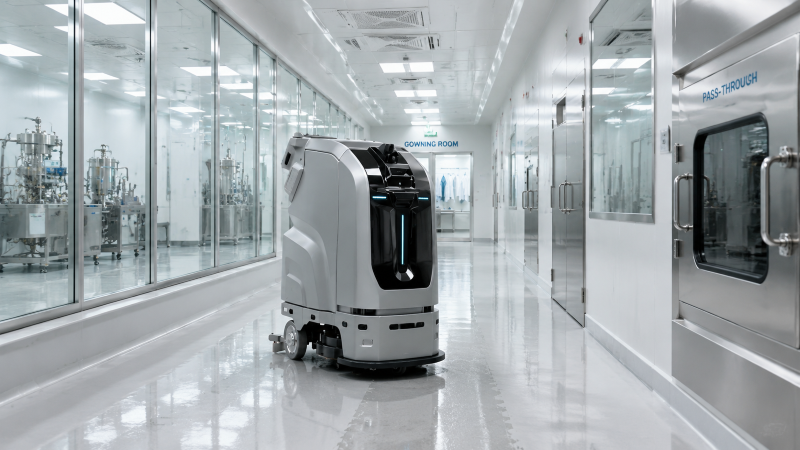
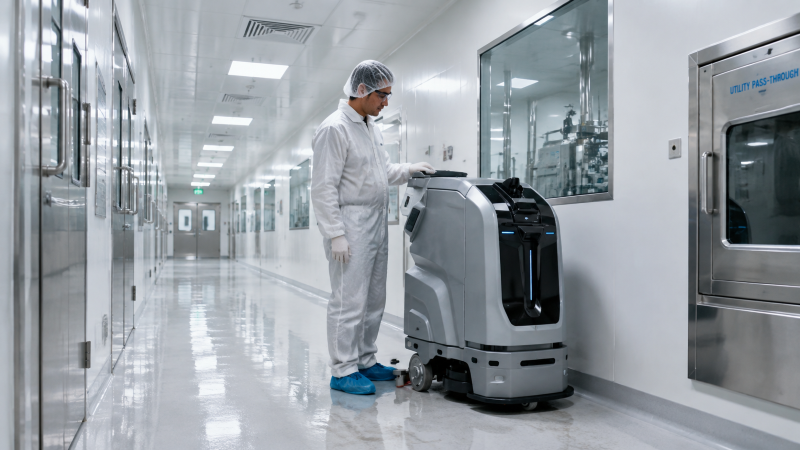
Here is where autonomous operation changes the conversation. Every time a human operator walks into a cleanroom, they bring particles, skin flakes, and microbial bioburden. Gowning protocols reduce this load but never eliminate it. An autonomous floor scrubber like the TerraScrub C80 enters the cleanroom, cleans the specified route, and exits without an operator walking alongside it.
C80 autonomous driverless scrubber
The C80 navigates using a 270° LiDAR sensor, a panoramic camera, a 360° depth camera, ultrasonic array, and IMU, planning its own path around production equipment and aisle obstructions. A touchscreen panel logs start time, route, and coverage area, giving facilities teams a cleaning record that maps directly to their GMP documentation requirements.
The C80's 510mm single-disc brush and parabolic squeegee bar recover solution so aggressively that the floor behind the machine shows only faint dry water-mark streaks. The squeegee leaves the floor virtually dry, which is the standard you need for ISO Class 7 and Class 8 cleanroom floors.

Matching the C80 to your facility's cleanroom zones
Not every zone in a pharma plant is a Grade A cleanroom. Most floor area sits in Grade C (ISO Class 7) and Grade D (ISO Class 8) zones, where controlled but non-sterile operations happen. The C80 fits these zones well. It is not designed for Grade A aseptic cores, where only validated stainless-steel mop systems belong, but for the surrounding corridors, gowning rooms, material airlocks, warehouse-logistics areas, and utility corridors that make up 80% of a pharma plant's floor space.
Cleaning capacity
510mm brush path at normal operating speed covers production corridors efficiently
Battery runtime
24V/120Ah battery delivers 6,120 to 8,160 m² per single charge
Machine weight
Light enough for raised access floors without deflection or tile damage
Tank capacity
70-liter clean water and 50-liter recovery tank for extended cleaning routes
Chemical selection for pharma floor cleaning
The chemicals you run through a floor scrubber in a pharma plant are not the same ones you use in a warehouse. Isopropyl alcohol (IPA) solutions at 70% concentration are common for cleanroom floor disinfection. Quaternary ammonium compounds work for general production areas. Hydrogen peroxide-based disinfectants are used in biotech suites where sporicidal activity is required. The C80's solution system handles all three, but you need to flush the system between chemical changes to avoid cross-contamination, and you should verify chemical compatibility with your cleanroom certifier.
Dilution ratios matter. Most pharma-grade disinfectants call for 1:128 or 1:256 dilution. The C80's 70-liter clean water tank, dosed at 1:128, covers approximately 3,000 m² of floor area per fill, which is enough for a single cleaning pass through a typical Grade D corridor network.
Planning a multi-zone cleaning protocol
A well-designed pharma cleaning protocol segments the facility into zones and assigns cleaning frequency by risk. Grade A zones get the most attention, but they are the smallest area. Grade C and D corridors, which the C80 handles, get daily or shift-based cleaning. Warehouse-logistics wings get weekly cleaning. The C80's autonomous routing lets you program different paths for different zones, so the machine runs a Grade D corridor route on one schedule and a warehouse route on another, all logged through the touchscreen interface.
If you want to see the full range of TerraScrub machines for different pharma zones, you can browse TerraScrub machines. For application guides and cleaning protocol references, the insights library covers maintenance, chemical selection, and facility planning. You can also visit our homepage for company background and factory capabilities.

What NC pharma plant managers should ask before buying
Before committing to a floor scrubber for a pharma or biotech facility in North Carolina, ask the supplier five things. What is the machine's particle emission profile, and has it been tested in a cleanroom environment? Does the squeegee system leave the floor dry enough for ISO Class 7 zones? Can the cleaning route and timing be exported for GMP documentation? What is the maintenance cycle, and can spare parts be sourced without halting production? Does the supplier understand cGMP and ISPE guidance, or are they just selling a machine?
TerraScrub manufactures the C80 and its full floor scrubber line from a 40,000 m² factory in Shanghai, China, with a one-year warranty and dealer-focused distribution. The C80 is available through TerraScrub's distributor network, and the team can provide specification sheets, cleaning route documentation, and chemical compatibility guides on request.
Planning a floor cleaning system for a North Carolina pharma or biotech plant? Talk to Donnie at TerraScrub about how the C80 autonomous scrubber fits your cleanroom zones, chemical protocols, and GMP documentation needs. Email Donnie@terrascrubx.com or connect on WhatsApp at +86 166 0187 1755.