Water spray, filtration, speed control, and sweep timing — practical dust suppression for parking lots, factory yards, and industrial roads
Outdoor sweeping kicks up dust. That is the simple truth every facility manager deals with when cleaning parking lots, factory yards, logistics hubs, and municipal roads. Dry dust becomes airborne the moment a side brush touches it, and without suppression, you are just relocating dirt from the ground to the air. The EPA regulates particulate matter (PM10 and PM2.5) as a criteria air pollutant, which means excessive dust from sweeping can trigger compliance issues at industrial sites. The six methods below — water spray suppression, filtration systems, side brush technique, speed control, sweep pattern strategy, and timing — cover everything you can do before, during, and after a sweep to keep dust on the ground where it belongs.
The physics is straightforward. A rotating side brush moving at 12 km/h flings fine particles — silt, sand, cement dust, road salt — into the air at velocities that carry them 3 to 5 metres horizontally before gravity pulls them back down. The finer the particle, the longer it stays airborne. PM10 particles (10 microns or smaller) can remain suspended for minutes. PM2.5 particles can linger for hours. OSHA's walking-working surfaces standard (29 CFR 1910.22) also requires employers to maintain safe working conditions, and airborne dust created by your own cleaning equipment is a hazard you can control.
The amount of dust a sweeper generates depends on four factors: surface dryness, particle size distribution, brush speed, and wind. You cannot control the weather, but you can control the other three.
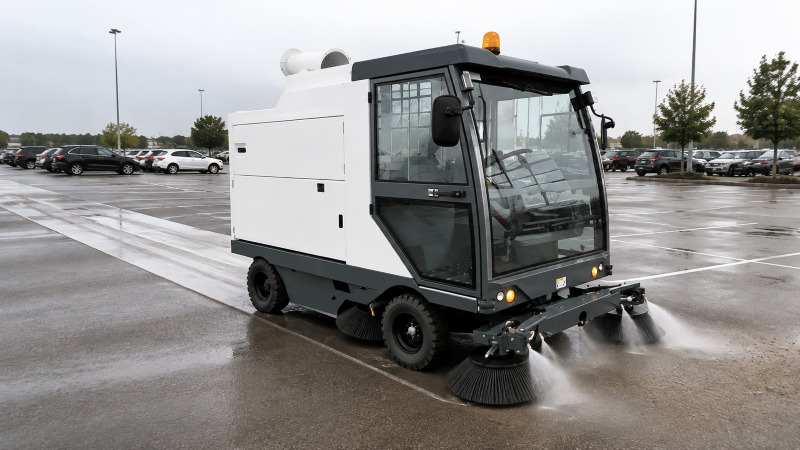
Pre-wetting the surface before the brushes reach it is the single most effective dust control method. Both the TerraScrub BA1900 and BA2100 have integrated water spray systems that mist the ground ahead of the side brushes. The water binds fine particles together, increasing their weight so the brush flicks them into the dust bin instead of launching them into the air.
A sweeper without a working filter is a dust launcher. The filter captures the finest particles that pass through the dust bin — the ones too small to see but large enough to cause respiratory issues. The BA1900 uses a 30 m² filter area with dual 600W suction motors. The BA2100 uses a 15 m² filter with negative-pressure centrifugal aluminium alloy blades. Both systems shake collected dust from the filter into the bin using a vibration motor.
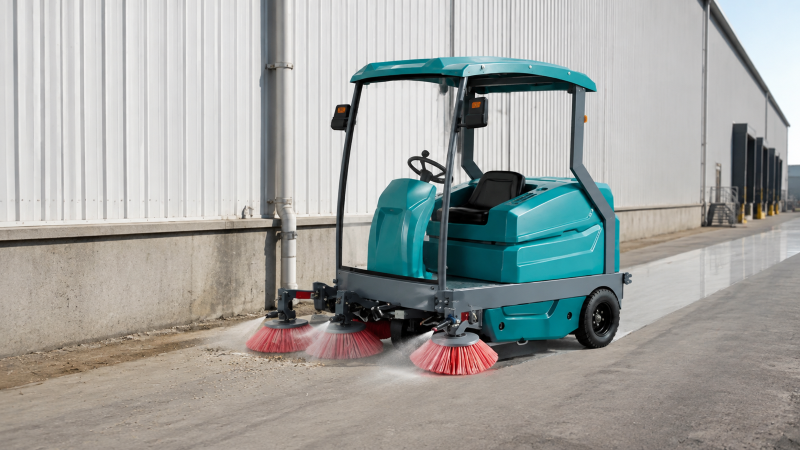
Side brushes are where most dust escapes. If the brush is angled too steeply, it flings debris outward instead of inward toward the main brush. If it spins too fast, it atomises dust before the suction can capture it. Both the BA1900 and BA2100 have adjustable side brush height and angle. For dusty surfaces, lower the brush so it just touches the ground — not deep enough to dig, just enough to flick debris toward the main sweeping path.
The BA1900 has four side brushes (two front 300mm, two middle 300mm). The BA2100 has four 600mm side brushes. On both machines, the front lifting arm adjusts to follow ground contours, which keeps the brushes in contact with uneven surfaces. For more on how side brushes handle corners, curbs, and edges, see our floor sweeper side brush guide.
Speed kills — not the operator, but dust control. At 12 km/h, the BA1900 and BA2100 are fast enough to cover 12,000 to 14,000 m² per hour. But on dusty surfaces, that speed creates a wake of turbulent air behind the machine that lifts settled dust. Reducing speed to 6-8 km/h on heavily dusted areas cuts airborne particles by roughly half. The machines still cover ground — 6,000 to 8,000 m²/h is substantial — but the air stays cleaner.
The direction you sweep matters more than most operators realise. Sweeping with the wind at your back means the air current carries dust away from the machine and the operator. Sweeping into the wind pushes dust back toward the brushes, which re-circulates it. On open sites like parking lots and logistics yards, plan your sweep pattern so each pass moves downwind. In enclosed or semi-enclosed areas like loading bays, sweep from the outer perimeter inward, containing dust rather than spreading it.
The cheapest dust control method costs nothing: sweep when conditions are right. Early morning dew lightly binds surface dust. After a light rain, the ground is naturally damp and dust stays put. Avoid sweeping during high-wind conditions — anything above 20 km/h will spread whatever you pick up right back across the site. In dry summer months, schedule sweeping for early morning or late evening when humidity is higher and wind is calmer.
Both machines handle outdoor dust, but they serve different scales. The BA1900 is the heavier duty option — 1,180 kg, 14,000 m²/h, 620L water tank, 30 m² filtration, and a 9 MPa high-pressure cleaning gun for post-sweep washing. It is built for municipal roads, large industrial parks, and cold-weather operations where the closed cabin and 7,500W traction motor matter. The BA2100 is lighter at 680 kg, covers 12,000 m²/h, and carries 300L of water. It is better suited for logistics hubs, distribution centres, and facilities that need fast coverage without the extra weight and cost.
Not sure which sweeper fits your site? Tell us your area size, surface type, and dust level. We will recommend the right TerraScrub model and dust suppression setup. No obligation.
Questions about outdoor dust control or TerraScrub sweepers?
Donnie@terrascrubx.com WhatsApp: +86 166 0187 1755