

INDUSTRIAL SCRUBBER GUIDE · 2026
A 1,000 m² warehouse can look straightforward from a drawing. The real cleaning job is usually decided by racking, pallet trucks, cross aisles and how often the operator has to stop. When an older compact scrubber starts turning a 10,000 m² shift into five or six hours of repetitive work, the first question is not simply whether a wider machine cleans better. It is whether the wider path can get through the route without creating a new bottleneck.
The TerraScrub BA860BT sits in that decision. It has an 860 mm brush path, two 560 W brush motors, a self-propelling drive and 95 L / 105 L tanks. Below is what those figures mean in a working warehouse or factory, where the BA860 fits, and when the 660 mm BA660BT is the more sensible choice.
The BA860 family uses the same 24 V / 200 Ah lead-acid battery and the same 95 L clean-water and 105 L recovery tanks in both widths. The main differences are the cleaning width, squeegee width, theoretical coverage, footprint and weight.
| Specification | BA860BT | BA660BT |
|---|---|---|
| Power | 24 V / 200 Ah lead-acid battery | 24 V / 200 Ah lead-acid battery |
| Cleaning width | 860 mm / 34 in | 660 mm / 26 in |
| Squeegee width | 1,100 mm | 1,080 mm |
| Theoretical coverage | 4,200 m²/h | 3,600 m²/h |
| Drive and brush motors | 500 W traction; 2 × 560 W brush | 500 W traction; 2 × 560 W brush |
| Suction and lift motors | 500 W suction; 100 W lift | 500 W suction; 100 W lift |
| Tanks | 95 L clean / 105 L recovery | 95 L clean / 105 L recovery |
| Dimensions | 150 × 95 × 124 cm | 143 × 76 × 118 cm |
| Weight | 300 kg | 295 kg |
Specifications reflect the current published BA860 product configuration. Confirm voltage, battery configuration and final dimensions on the quotation for your destination market.
The complete machine configuration is available on the TerraScrub BA860 walk-behind floor scrubber page.
The rated 4,200 m²/h is a theoretical coverage figure. It assumes continuous cleaning at a set travel speed with no turns, refills, tank dumping, congestion or second passes. Those interruptions are normal in a warehouse, so the figure is best used for comparing machines, not for promising what one operator will finish in an hour.
A SIMPLE PLANNING EXAMPLE
10,000 m² ÷ 4,200 m²/h = 2.4 theoretical cleaning hours. That is machine-on time at the rated condition. It does not include emptying and refilling, moving around parked pallets, waiting for forklifts, or cleaning a second pass where soil is heavy.
For shift planning, the more useful method is to treat 4,200 m²/h as the upper end and build the schedule from the actual route:

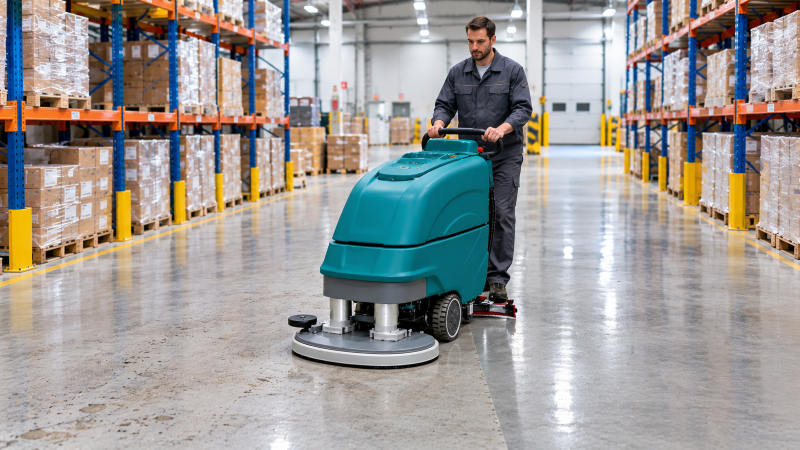
The published selection guidance places the BA860BT in large open areas with aisle widths of 1,000 mm or more and a cleaning workload of 10,000 m² or more per shift. That is a useful starting point, but a tape measure at three points on the route is more useful than a catalogue chart alone.
| Check | What to measure or observe | Why it matters |
|---|---|---|
| Narrowest passage | Clear width after pallets, columns, guard rails and open doors | Cleaning width is not the same as total machine width or safe operating clearance |
| Turn into cross aisles | The actual path an operator must steer, including rack-end protection | A clear straight aisle can still be impractical if each turn requires reversing |
| Doorways and gates | Opening width, threshold height and any ramp transition | The machine must pass with its squeegee and handle configuration in place |
| Floor loading and slopes | Relevant ramps, lifts, mezzanine edges and floor-load limits | The BA860 weighs 300 kg before the operator, water and any carried items |
| Charging position | A practical route to the charger and enough space for the battery configuration | Charging location affects both operator routine and daily uptime |
A measuring plan is also a good way to compare a walk-behind with another machine class. The TerraScrub walk-behind scrubber comparison explains where compact, medium and large walk-behind formats differ.

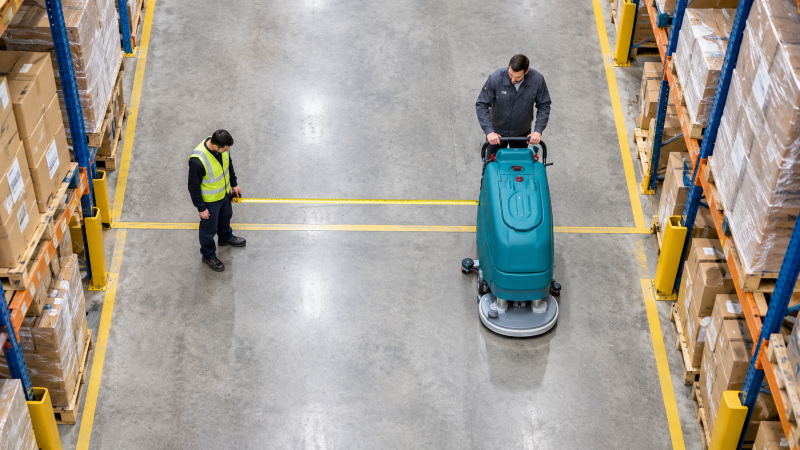
Two brush discs across an 860 mm path do more than add width. Each disc has its own 560 W motor, and the machine has a separate 500 W traction motor. In daily use, the combination addresses three practical problems on large concrete floors:
Water recovery deserves equal attention. The 1,100 mm squeegee is wider than the brush path and lifts the dirty water into the 105 L recovery tank. If the squeegee is worn, misaligned or set poorly, the floor can look clean under the brush and still feel wet behind the machine. That is why a demonstration should be judged from the condition of the floor behind the operator, not only from what the operator sees immediately in front.
These two models share the same battery, dual-brush layout, self-propelling system and tank capacity. The smaller BA660BT is not a stripped-down version; it changes the width and coverage to fit a different set of buildings.
Choose BA860BT when
Choose BA660BT when
Do not use the cleaning width as the only doorway measurement. The BA860BT's published body size is 150 × 95 × 124 cm, while the squeegee is 1,100 mm wide. Ask for a route check with the machine in its operating configuration. A 860 mm brush is useful only if the operator can keep it moving without repeatedly folding it up or reversing.
This machine is aimed at industrial routes where width and forward coverage reduce repeated work. The strongest fits are long warehouse aisles, distribution-centre floor plates, manufacturing bays and large open production areas with a defined cleaning route.
It is weaker in three common situations:
For a large, simple route, a ride-on scrubber may also deserve consideration. The deciding issue should be route length, operator exposure and handling space, not the size of the building alone.
A large scrubber loses its advantage if a blocked squeegee or dirty tank forces an extra pass. Keep the routine short enough that operators will actually follow it:

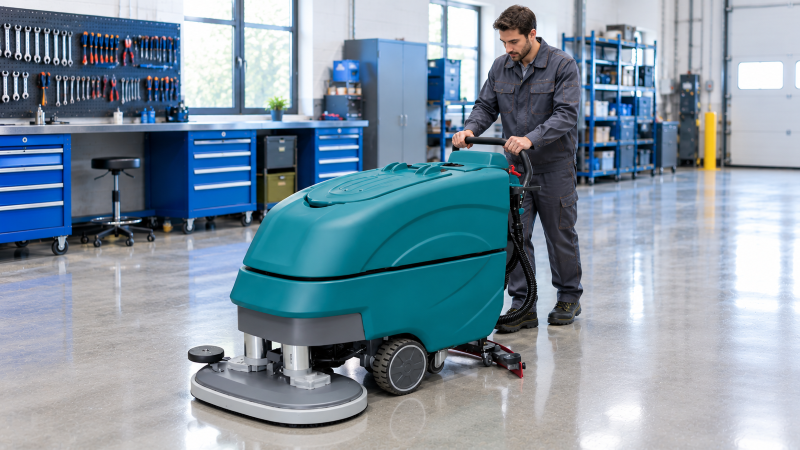
A supplier cannot recommend the right width from floor area alone. Send these details with the inquiry and the comparison becomes much more useful:
4,200 m²/h is the theoretical maximum based on the machine's cleaning path and rated travel. A real warehouse route with turns, obstructions, refills and extra passes will take longer. Use it to compare the BA860BT with another machine, then estimate the actual schedule from a timed route.
It is a credible class to evaluate when the route has aisles of 1,000 mm or more and the cleanable area is around 10,000 m² or more per shift. The final answer still depends on aisle layout, turning space, soil level and how many hours are available. At the theoretical rate, 10,000 m² is 2.4 machine hours before real-world interruptions.
The published selection guidance recommends aisles of 1,000 mm or more. Measure the clear width after pallets, columns and open doors, and check the turning path into cross aisles. If the clear passage is much tighter or the operator would have to reverse repeatedly, compare the 660 mm BA660BT before choosing the wider model.
The published BA860 configuration uses a 24 V / 200 Ah lead-acid battery. Battery specification should be confirmed for the export destination and final quotation. The machine's operating and charging instructions take priority over general battery advice.
Choose the BA860BT when wide, open routes allow the extra 200 mm of brush path to be used continuously. Choose the BA660BT when doors or aisles are tighter and the route has many short turns. Both models share the same drive, brush-motor and tank configuration, so the practical route is the deciding factor.
The BA860BT is a strong candidate for large industrial routes with open aisles and a workload near or above 10,000 m² per shift. Its value comes from combining an 860 mm dual-brush path, traction drive and large tanks, not from the headline coverage number alone. Measure the narrowest passage, count the turns and time a real route before deciding between the BA860BT and the 660 mm BA660BT. The full machine specifications remain on the BA860 product page.
Discuss a warehouse or factory route
Send the daily cleanable area, narrowest aisle and doorway measurements, floor type and destination country. We will compare the BA860BT with the BA660BT and other suitable walk-behind formats.
Email: Donnie@terrascrubx.com
WhatsApp: +86 166 0187 1755
No. 600, Jiye Road, Sheshan Town, Songjiang District, Shanghai, China