A regional fitness brand with 25 clubs and 620,000 sq ft of rubber, tile, and concrete floors replaced inconsistent mopping with one battery-powered scrubber playbook. Same headcount. Better floors. 35% less time per clean.
A 25-location gym chain was spending too many labor hours on floor care with wildly inconsistent results. Some clubs looked spotless. Others had chalk dust buildup in weight rooms and sticky residue near smoothie bars. The operations director rolled out compact battery-powered scrubbers to every location, paired with a single cleaning protocol covering rubber, tile, and concrete. Within four months, labor time per clean dropped 35%, floor appearance scores leveled out across all 25 clubs, and slip incidents in locker rooms fell to near zero. They did it without adding a single staff member.
Each club had its own way of doing things. Location managers bought whatever mop heads and cleaning chemicals they liked. Some clubs used string mops. Others had flat microfiber pads. A few had old auto-scrubbers that broke down more often than they ran.
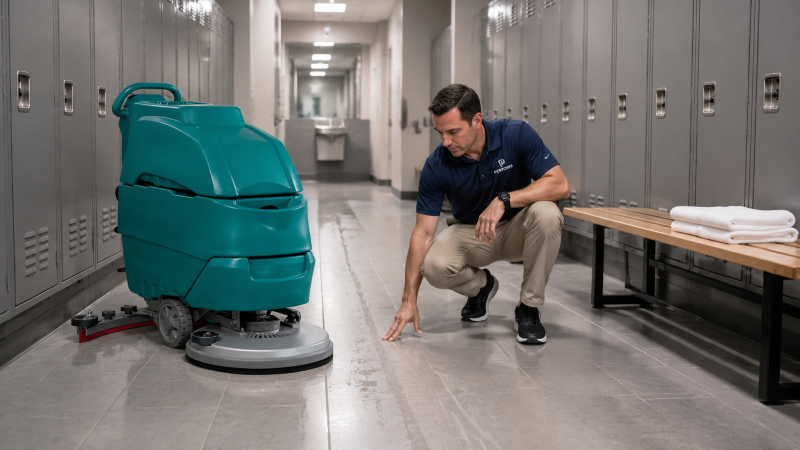
The result was predictable. Floor appearance scores ranged from 6.2 to 8.9 across the 25 locations. Members at the low-scoring clubs complained about sticky locker room floors and chalk dust that never fully came off the rubber surfacing in functional training zones. The operations director was fielding two or three member complaints per week about floor cleanliness.
Each location spent roughly 4.5 hours per day on floor care with manual mopping. Across 25 clubs, that was over 3,300 labor hours per month just on floors. And the floors still were not consistently clean.
The chain had grown from 8 to 25 locations in three years. Floor care quality dropped with every new club they opened. Adding more custodial staff was not in the budget. The operations director needed a way to get better results from the same team.
The operations team tested three machines over a six-week period. They needed scrubbers that could handle three very different floor surfaces, fit through standard doorways, and run long enough to cover a full club on one battery charge.
They settled on two models from TerraScrub: a compact walk-behind for tight areas and locker rooms, and a small ride-on for larger open floor plans in big-box locations. Both run on battery power, which meant no cords to trip over and no restriction to outlets.
Gym floors have a lot of obstacles: benches, kettlebells, cable machines, dumbbell racks. A corded machine would constantly get snagged. Battery-powered scrubbers let staff clean around equipment without stopping to unplug and replug. The machines also draw less water than mopping, which matters for rubber floors that trap moisture if oversaturated.
Buying the same machines for every location was step one. Step two was making sure every club used them the same way. The operations director wrote a single floor care playbook and distributed it to all 25 location managers.
Each club was divided into four zones: weight room, functional training, cardio area, and locker rooms. Staff clean two zones per day on a rotating schedule, so every zone gets a full machine scrub every 48 hours.
One neutral cleaner for rubber and tile. One degreaser for concrete near smoothie bars and supplement stations. No location could substitute. This eliminated the residue problems caused by managers buying random products.
Machines charge overnight in a designated station. Each morning, the opener checks battery level, squeegee blade condition, and brush pad wear. Any issue gets logged in the operations app before cleaning starts.
Once a week, staff run the scrubber over all four zones in a single shift. This catches corners that might get skipped during the two-zone daily rotation and keeps the floor appearance score consistent.
The operations director visits three randomly selected clubs each month and scores floor appearance on a 10-point rubric. Scores below 8.0 trigger a retraining session for that location's staff.
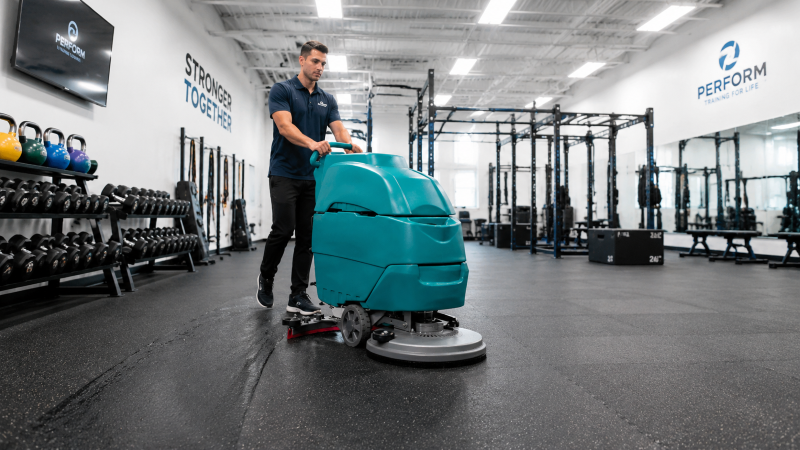
The walk-behind scrubber solved this in two passes. The rotating brush agitates the rubber surface to lift chalk and dirt out of the grooves, and the squeegee immediately vacuums the dirty water away before it can settle back in. No film. No residue. No second mop pass needed.
A single heavy deadlift session can deposit enough chalk on a 200 sq ft platform to turn a mop head grey in one pass. The scrubber's 65-liter recovery tank handles an entire functional training zone before needing a dump, which keeps staff moving instead of stopping to rinse pads every five minutes.
Four months after rolling out the scrubbers and playbook to all 25 locations, the operations director pulled the numbers. The improvements were across the board.
The gym chain's operations director put it simply: "Mops move dirt around. Scrubbers remove it." That distinction matters in a gym environment where sweat, chalk, and protein shake spills create real hygiene concerns, not just cosmetic ones.
Battery-powered scrubbers also solved the staffing problem. The same number of employees now finish floor care in less time, which frees them up for the rest of their cleaning duties: disinfecting equipment, restocking supplies, and wiping down high-touch surfaces. No overtime. No new hires. Just better tools.
Before standardization, the difference between the best and worst floor scores was 2.7 points. After four months, that gap closed to 0.8 points. Members walking into any of the 25 clubs now see the same level of floor cleanliness, which strengthens brand trust across the entire chain.
You do not need 25 locations to benefit from this approach. Even a 3-club chain or a single large facility can apply the same principles:
Standardize the equipment. Same machines, same brushes, same chemicals everywhere. This eliminates variables that make floor quality unpredictable.
Write it down. A one-page cleaning schedule with zone assignments, chemical guidelines, and machine checks takes the guesswork out of daily floor care.
Audit regularly. Score your floors on a simple rubric. If you cannot measure floor quality, you cannot improve it.
Let machines do the heavy work. If your staff is spending more than 3 hours a day on floors with mops, a battery-powered scrubber will pay for itself in under 18 months at most facilities.
Running multiple fitness facilities and tired of inconsistent floor quality? TerraScrub supplies battery-powered scrubbers to gym chains, health clubs, and multi-location operators across North America. Reach out to Donnie to discuss the right machine mix for your floor types and square footage.