
Walk-Behind (A3)
21" path, 2,200 m²/h. Best for tight areas under 25,000 sq ft. Operator walks behind. Good for machine shop nooks and maintenance corridors.
Choosing the right floor cleaning equipment for PA's industrial floors — from machine specs to aisle widths and OSHA compliance
Pennsylvania manufacturing plants run thick with history and heavy foot traffic, from metal fabrication shops outside Pittsburgh to food processing lines in the Lehigh Valley. The floors take a beating — cutting fluid drips, forklift tire dust, pallet debris, and oil spots that compound shift after shift. A TerraScrub A7 ride-on floor scrubber handles 5,500 m²/h with a 34-inch dual-brush deck, which is the sweet spot for most PA plant floors between 80,000 and 200,000 square feet. This guide walks through what matters when picking a floor scrubber for Pennsylvania manufacturing — machine sizing, aisle compatibility, battery runtime, chemical selection, and OSHA slip-resistance requirements — so you can spec the right unit without overbuying or undersizing.
PA ranks among the top manufacturing states in the country. According to the National Association of Manufacturershttps://terrascrubx.com/machines, manufacturing supports roughly 12 million jobs nationwide and contributes over $2.3 trillion to the U.S. economy. Pennsylvania alone houses thousands of manufacturing establishments across metals, machinery, food processing, plastics, and chemicals.
That scale of production means floors accumulate contaminants fast. A dry mop or push broom doesn't cut it when you've got coolant residue bonding to polished concrete, or hydraulic oil creating genuine slip hazards near press lines. Industrial floor scrubbers apply solution, scrub mechanically, and vacuum the dirty water in one pass — leaving the floor clean and dry enough to walk on within minutes.
OSHA's walking-working surfaces standard (29 CFR 1910.22) requires employers to keep floors clean and dry wherever possible. Floor scrubbers with effective squeegee recovery directly address this compliance requirement by removing liquid contaminants rather than spreading them.
The biggest mistake we see from plant managers in Pennsylvania is buying a machine that doesn't fit their aisles. You need to measure the narrowest aisle where the machine will operate — including clearance for turning at the end of the row — before looking at any specs.
21" path, 2,200 m²/h. Best for tight areas under 25,000 sq ft. Operator walks behind. Good for machine shop nooks and maintenance corridors.
34" path, 5,500 m²/h. Best for 80,000+ sq ft main production floors. Operator sits and drives. Dual brushes cover wide aisles fast.
For most Pennsylvania manufacturing plants — think 50,000 to 200,000 sq ft of cleanable floor area — the A7 hits the right balance. It's 65 inches long, 35 inches wide, and 51 inches tall, so it clears standard 8-foot-wide forklift aisles with room to spare. The dual 34-inch brush deck covers a 34-inch cleaning path, meaning a 100,000 sq ft floor takes roughly 4-5 hours of scrubbing per shift.
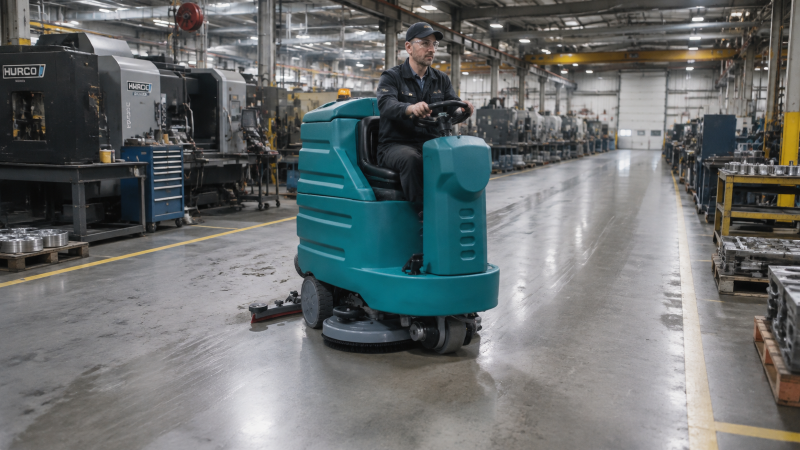
The A7 was built for exactly the kind of mixed-contaminant floors you find in PA manufacturing. Here's what matters on the spec sheet:
The two 34-inch disc brushes soft-start to prevent chemical splash on sensitive machinery nearby. Brush pressure is adjustable, so you can dial it down for epoxy coatings or crank it up for bare concrete with embedded oil.
The 200Ah battery pack delivers 3-4 hours of continuous scrubbing per charge. At 5,500 m²/h, that's 16,500-22,000 m² covered per charge — enough for most single-shift operations without a mid-shift swap. The traction motor (800W) handles ramps and slight grade changes common in older PA facilities.
140 liters of clean solution and 150 liters of recovery capacity means fewer refill trips. With a standard 1:128 dilution of neutral cleaner, one full tank covers roughly 3,000 m² before you need to drain and refill.
Different manufacturing processes leave different residues, and your chemical choice has to match. Here's a quick guide we give Pennsylvania plant managers:
Metalworking fluids and cutting oils: Use an alkaline cleaner (pH 9-11) with degreasing surfactants. Dilute at 1:64 to 1:128 depending on soil load. Avoid acid-based products — they can etch polished concrete.
Food processing residues: Use a neutral or mildly alkaline sanitizer-rated cleaner. Follow FDA-approved dilution ratios. Rinse the recovery tank thoroughly after each shift to prevent bacterial growth.
General industrial dust and dirt: A neutral cleaner (pH 7-9) at 1:128 is usually sufficient. Over-concentrating doesn't clean better — it leaves residue that attracts more dirt.
Always test a new chemical on a small, inconspicuous section of floor first. Some older Pennsylvania plants have aging floor coatings that react poorly to high-pH or high-solvent products.
OSHA standard 29 CFR 1910.22(a)(2) specifically requires that "the floor of every workroom shall be maintained in a clean and, so far as possible, dry condition." For Pennsylvania manufacturers, that's not just about passing inspections — it's about keeping workers on their feet.
The A7's parabolic squeegee bar follows the brush deck and recovers solution as the machine moves, leaving the floor virtually dry. That matters because wet floors are the number one cause of slip-and-fall incidents in manufacturing environments. If your current cleaning method leaves puddles or streaks, you're creating the hazard you're trying to remove.
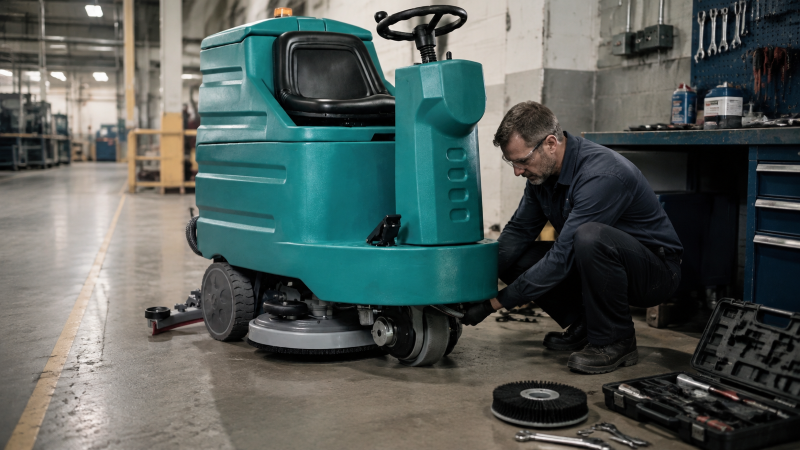
Running the A7 on a manufacturing floor isn't complicated, but a 5-minute pre-shift routine keeps it performing. Here's what we recommend:
Check the brush pressure setting — it should match yesterday's floor conditions unless you're switching areas. Inspect the squeegee blade for nicks or tears; a damaged blade leaves streaks. Top off the solution tank with properly diluted chemical. Verify the battery charge level reads above 80% for a full-shift run. Drain and rinse the recovery tank if it wasn't done at the end of the last shift.
That's it. Five minutes, and your machine is ready to cover 100,000+ square feet of manufacturing floor.
When evaluating a floor scrubber purchase, Pennsylvania manufacturers should look beyond the sticker price. A ride-on unit like the A7 costs more upfront than a walk-behind, but the labor savings compound quickly. One operator on a ride-on covers the same ground as 3-4 workers with walk-behinds or mops — and the quality is consistently better because the machine applies consistent brush pressure and solution flow every pass.
Factor in chemical costs (roughly $0.02-0.05 per square foot depending on dilution), battery replacement cycles (3-5 years for quality AGM batteries), and squeegee blade replacements ($30-60 per set, every 3-6 months depending on usage). These are predictable, budgetable expenses — unlike the cost of a worker's compensation claim from a slip-and-fall on a poorly cleaned floor.
Want to spec the right floor scrubber for your Pennsylvania manufacturing plant? TerraScrub machines cover walk-behind to ride-on options. Browse the insights library for more plant floor cleaning guides, or visit our homepage to see the full product line.