
Physical
1,160 × 580 × 1,210 mm (46in × 23in × 48in). 254 kg. Fits standard 4-foot server room aisles with clearance on both sides.
Autonomous floor cleaning for mission-critical facilities — moisture control, static safety, and 24/7 operation in the Phoenix metro data center corridor
Arizona's Phoenix metro has grown into one of the largest data center markets in North America, with facilities spread across Mesa, Chandler, Goodyear, and Phoenix itself. These buildings run 24/7 with raised floors, sensitive rack equipment, and strict contamination control — meaning floor cleaning has to happen without excess moisture, without human traffic in restricted zones, and without disruption to uptime. The TerraScrub C80 intelligent driverless floor scrubber is built for exactly this environment: it navigates autonomously using dual LiDAR and vision systems, scrubs 2,040 m²/h with a 510mm path, and leaves floors virtually dry behind the squeegee so there's zero risk to raised-floor air intakes. This guide covers equipment selection for Arizona data center floors, moisture and static control requirements, the Uptime Institute's operational standards relevant to facility cleaning, and how autonomous scrubbers fit into a 24/7 maintenance schedule.
Arizona draws data center investment for practical reasons. Low natural disaster risk (no hurricanes, minimal seismic activity), relatively affordable land, and power infrastructure already built for heavy industrial use. The Phoenix metro area now hosts hundreds of megawatts of commissioned data center capacity, with major hyperscale and colocation operators expanding aggressively.
According to the Uptime Institute, whose Tier Standard has been used in the design and operation of thousands of data centers across 120+ countries, operational reliability depends on every facility system — including environmental maintenance like floor cleaning — performing consistently without introducing risk. A floor scrubber that leaks water near a raised-floor plenum isn't just a cleaning problem. It's an uptime problem.
Uptime Institute's Global Data Center Survey (2026, now in its 16th year) tracks operational trends across the industry. Contamination control and environmental monitoring remain top operational concerns for facility managers — floor cleaning equipment directly affects both.
Standard commercial floor cleaning assumes wet floors are acceptable for 10-15 minutes after scrubbing. In a data center, that assumption can cost millions. The raised-floor plenum pulls conditioned air upward through perforated tiles, and any moisture on or near those tiles gets distributed into the cold aisle and across server intakes.
Three things matter above everything else when you're scrubbing data center floors:
The squeegee has to recover virtually all solution. No trailing water, no puddles at turn points, no wet streaks near rack intakes. The C80's parabolic squeegee follows the brush path and leaves the floor dry to the touch within seconds.
Data centers run 24/7. Cleaning can't wait for "after hours" because there are no after hours. The C80 operates at conversation-level noise, meaning technicians working on racks in the same aisle won't even notice it's running.
Restricted zones, badge-access areas, and hot/cold aisle layouts mean a human pushing a scrubber through a server room is both inefficient and a security logistics problem. The C80 navigates on its own using 270-degree LiDAR, panoramic cameras, and 360-degree depth sensors — it maps the aisle, plans the path, and avoids obstacles in real time.
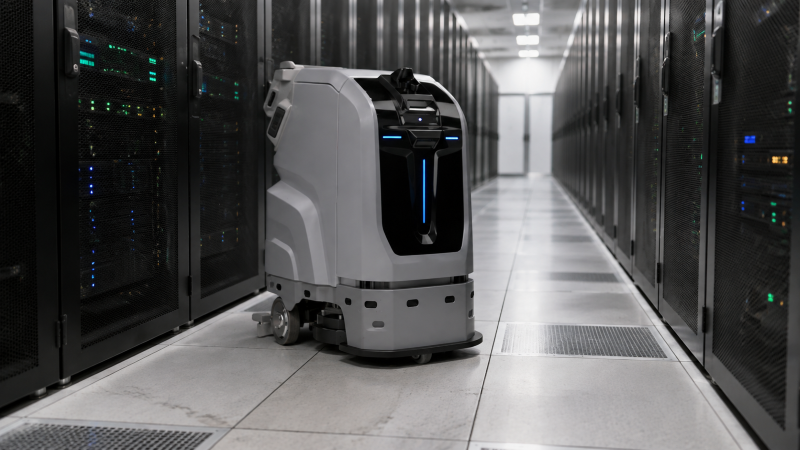
The C80 was designed specifically for environments where autonomous, low-moisture cleaning is non-negotiable. Here's what the spec sheet looks like:
1,160 × 580 × 1,210 mm (46in × 23in × 48in). 254 kg. Fits standard 4-foot server room aisles with clearance on both sides.
510mm brush path, 2,040 m²/h coverage. 70L solution / 50L recovery tanks. 3-4 hours runtime per charge.
Dual navigation: vision + laser. 270-degree LiDAR, panoramic camera, 360-degree depth camera, ultrasonic sensors, IMU. Autonomous path planning with real-time obstacle avoidance.
One-touch start, touchscreen interface. Pre-programmed routes for repeatable cleaning patterns. Optional disinfection module for biological contamination control.
At 2,040 m²/h with a 3-4 hour runtime, one charge covers 6,120-8,160 m² of data center floor. For a 50,000 sq ft (4,645 m²) colocation facility, that's a full clean cycle on a single charge with battery to spare.
Raised access floors in data centers typically have anti-static coatings or conductive properties. Your cleaning chemical can't interfere with that. Here's what we recommend for Arizona data center managers:
Raised floor tiles (HPL or bare steel): Use a dedicated anti-static neutral cleaner (pH 7-8) at 1:256 dilution. Never use wax, polish, or anything that leaves a film — it creates an insulating layer that defeats the static-dissipative properties of the tile.
Sealed concrete in non-raised areas: Neutral cleaner at 1:128. The C80's adjustable brush pressure handles bare concrete without damaging the anti-static sealer that most data centers apply to slab areas.
Epoxy-coated corridors and loading docks: Mildly alkaline cleaner (pH 9-10) at 1:64 for heavier soil loads from dock traffic. These areas see more dirt and less sensitive equipment, so you can afford slightly more aggressive chemistry.
Always verify chemical compatibility with your raised-floor tile manufacturer before the first clean. Some HPL tiles react poorly to certain surfactants, and a damaged anti-static surface is expensive to remediate.
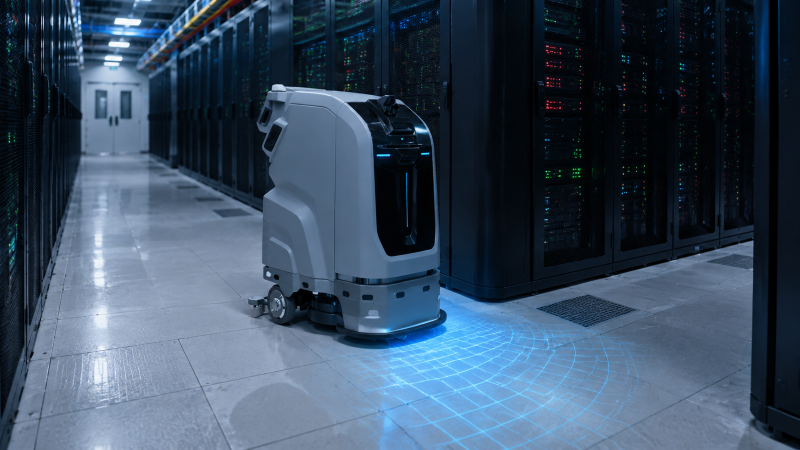
The C80's biggest advantage in a data center is that it doesn't need a human following it. You program the route once, and the machine repeats that route on schedule. For Arizona data centers running three shifts, that means:
Day shift: The C80 runs a light-touch cycle on main corridors and loading dock areas during the busiest foot traffic period. Operators can schedule it for 10 AM-noon, avoiding the early morning shift change rush and lunch traffic.
Night shift: Full deep-clean cycle covering all aisles, including restricted cold aisles that see less foot traffic but accumulate fine dust from air handling. The C80 maps and follows the aisle layout, avoids active work zones, and returns to its charging dock autonomously.
Weekend: Optional disinfection module run for biological contamination control in high-security zones where biological monitoring is part of the compliance protocol.
An autonomous scrubber like the C80 has a higher upfront cost than a walk-behind. But the operational math is straightforward. One C80 running two cycles per day covers the same ground as a full-time cleaning technician working 8 hours with a walk-behind — and it does it without badge access logistics, without scheduling conflicts, and without human error in contamination-controlled zones.
Factor in chemical costs (lower than walk-behinds because the C80 dispenses solution at a controlled rate with no over-application), battery service (24V/120Ah pack, 3-5 year lifecycle), and consumable replacements (brush every 6-12 months, squeegee blades every 3-6 months). The C80's navigation sensors are solid-state with no scheduled maintenance.
Need autonomous floor cleaning for your Arizona data center? TerraScrub machines include the C80 driverless scrubber plus walk-behind and ride-on options for every zone. Browse the insights library for more facility maintenance guides, or visit our homepage to explore the full product line.