
A floor scrubber's purchase price tells you maybe 30% of the story. Over five years, what you actually pay comes down to four buckets: the machine itself, labor to run it, consumables and replacement parts, and the hidden cost of downtime when the thing breaks mid-shift. This 5-year breakdown walks through each one, with real numbers from facilities running the TerraScrub C80 autonomous scrubber, so you can budget without surprises and compare machines on total cost, not just sticker price.
What goes into floor scrubber total cost of ownership
Most facility managers look at the purchase price and stop there. Bad move. The total cost of ownership (TCO) for a floor cleaning machine splits roughly like this: 25–30% machine acquisition, 45–55% labor, 10–15% consumables (brushes, squeegee blades, detergent), and 5–10% maintenance and repairs. ISSA cleaning industry data puts labor at over 90% of cleaning costs when you factor in wages, benefits, and supervision — which means a machine that cuts labor hours does more for your budget than a cheaper sticker price ever will.
Rule of thumb: if a machine costs $5,000 less upfront but requires a full-time operator, you lose that $5,000 in labor within the first 6–8 weeks. TCO flips the script on "cheap."
Year-by-year floor scrubber cost breakdown
Acquisition and setup
Purchase or lease payment, operator training, charging station install. Heaviest spend year. An autonomous unit like the C80 needs minimal training — set the route, press start, walk away. Budget 100% of machine cost here.
Routine consumables
Brushes, squeegee blades, detergent, filter pads. Battery top-ups for flooded lead-acid units. Minimal repairs if the machine is used per spec. Typically 8–10% of purchase price.
First service milestone
Squeegee assembly service, brush motor inspection, battery health check. Budget 10–12% of purchase price. Well-maintained machines sail through this; neglected ones start bleeding money.
Battery replacement window
Depending on charge cycles (typically 500–1,500 for lead-acid, 2,000+ for lithium), batteries may need replacing. This is your second-largest expense after the initial purchase. Lithium packs cost more upfront but last longer per cycle.
Residual value and decision point
A well-maintained scrubber retains 40–50% of its value at year 5. A neglected one retains maybe 15–20% and costs you in downtime along the way. This is where TCO discipline pays off — or doesn't.

Where the C80 autonomous scrubber changes the TCO math
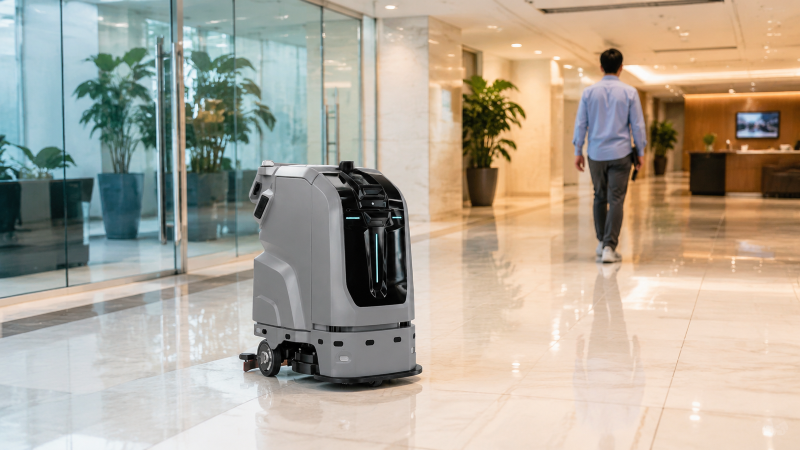
The TerraScrub C80 shifts the TCO equation because it runs without an operator. You're not paying someone $18–25/hour to push a machine back and forth. The C80 covers 2,040 m²/h on a 510mm cleaning path, runs 3–4 hours per charge, and navigates autonomously using LiDAR plus vision systems. At 4 hours of autonomous cleaning per day over 5 years (roughly 250 working days/year), that's about 5,000 operator hours eliminated. Even at $20/hour, you're looking at $100,000 in labor savings — and the C80 costs a fraction of that figure.
TerraScrub C80 Intelligent Driverless Floor Scrubber
510mm cleaning path · 2,040 m²/h · 24V/120Ah · 70L/50L tanks · 254 kg · LiDAR + vision navigation
| Spec | Value |
|---|---|
| Cleaning width | 510 mm (20 in) |
| Productivity | 2,040 m²/h |
| Dimensions (L×W×H) | 1,160 × 580 × 1,210 mm (46in × 23in × 48in) |
| Battery | 24V/120Ah maintenance-free |
| Runtime | 3–4 hours per charge |
| Navigation | Vision + Laser dual navigation, 270° LiDAR |

Floor scrubber ROI — when does the machine pay for itself?
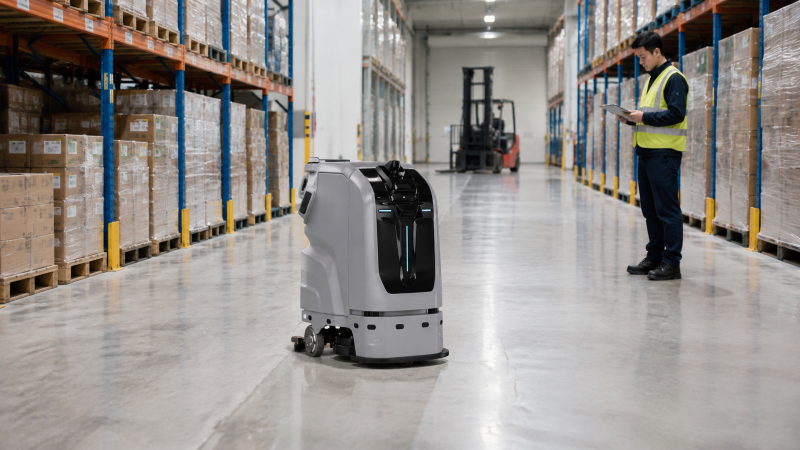
For autonomous units like the C80, the payback period typically falls between 12 and 18 months, depending on facility size and cleaning frequency. Manual walk-behind scrubbers take longer — usually 24 to 36 months — because you're still paying an operator the entire time. The math is simple: divide the machine cost by monthly labor savings. If a C80 saves you $2,000/month in labor and the machine costs $X, payback = X ÷ 2,000 months. Most facilities hit break-even before the first battery replacement.
Quick TCO comparison
Manual walk-behind over 5 years: machine + ~5,000 labor hours + consumables + maintenance. C80 autonomous over 5 years: machine + near-zero labor hours + consumables + maintenance. The labor delta alone typically exceeds the entire machine cost by year 2.
Want to see how the numbers work for your specific facility? Every building is different — square footage, cleaning frequency, current labor rates all shift the calculation. Check out TerraScrub's full machine lineup to compare models, or browse our insights library for more cost analysis and buying guides. The TerraScrub homepage also lists current product lines and industry applications.
Running your own TCO numbers? Send your facility size, current cleaning hours, and labor rate to Donnie — he'll build a 5-year cost breakdown for your specific operation, no strings attached.