

A 2 million sq ft international airport terminal cleans 85% of its hard floors during a 6-hour overnight window using a zone-based ride-on scrubber strategy, cutting slip-and-fall incidents by 40% and cutting cleaning time by 3 hours per night.
This international airport terminal covers roughly 2,000,000 sq ft of hard flooring across concourses, gate areas, retail zones, security checkpoints, and baggage claim. Every night between the last departure and the first morning flight, a cleaning crew of 12 has about 6 hours to get those floors back to presentable and safe. This case study covers how they do it: the ride-on scrubber setup, the zone-by-zone strategy, the overnight shift timeline, battery and crew logistics, and the results after 8 months of running the program. The terminal replaced a mop-and-bucket crew with three ride-on scrubbers and two walk-behind units, reorganized the floor into six cleaning zones, and built a timeline that gives each zone a fixed window. Slip-and-fall incidents dropped 40% in the first two quarters. Floor appearance scores went from 6.2 to 8.7 on the terminal's internal audit. And the crew finishes with time to spare before the first departure boards light up.
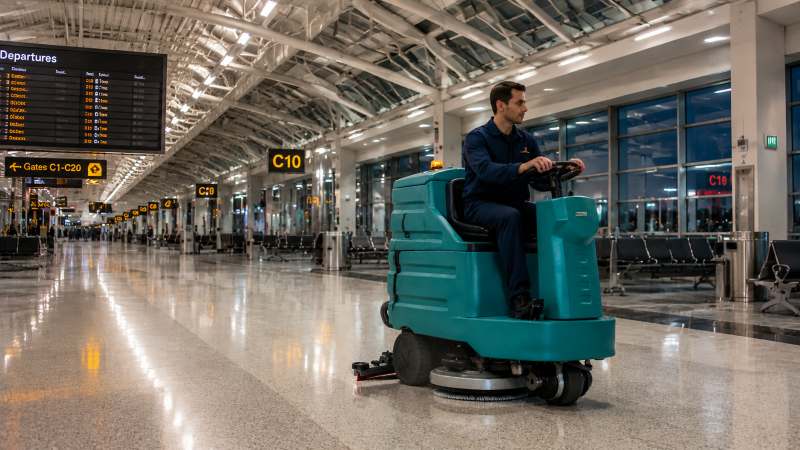
An international terminal does not sleep, but it does slow down. Between 23:00 and 05:00, passenger traffic drops to a trickle. Gate areas empty out. Retail shutters come down. That is the window, and it is narrow. The terminal's facilities team had been running a 15-person mop-and-bucket crew that needed 8 hours just to cover the main concourses, and they were not getting to the satellite gates at all.
The problem was not effort. The crew worked hard. The problem was that mopping 2 million sq ft is mathematically brutal. A person with a mop covers about 1,500 sq ft per hour. Even with 15 people working simultaneously, that is 22,500 sq ft per hour. To cover 2 million sq ft at that rate takes 88 labor-hours per night, which is not physically possible in a 6-hour window.
A ride-on floor scrubber, by comparison, covers 25,000 to 30,000 sq ft per hour depending on the model and floor conditions. Three ride-on machines running simultaneously cover 75,000 to 90,000 sq ft per hour. That math works. The terminal's facilities director approved the equipment switch and restructured the entire overnight cleaning operation around it.
The terminal deployed three ride-on scrubbers for the main concourses and wide corridors, and two walk-behind scrubbers for narrow gate alcoves, restroom entrances, and security checkpoint areas where the ride-on machines could not maneuver. The ride-on units carry 140-liter solution tanks, which means each machine can run for about 90 minutes before refilling. That refill cycle became the backbone of the shift timeline.
Floor type drove the equipment choice. The terminal has three main floor surfaces: polished terrazzo in the main concourses, porcelain tile in restroom and retail zones, and sealed concrete in baggage claim and utility corridors. All three are compatible with the same scrubber setup, but solution flow rates differ. Terrazzo needs a medium flow to avoid streaking. Porcelain tile takes a lower flow because the grout lines hold water. Sealed concrete can take a higher flow for faster coverage. The crew adjusts the flow setting at each zone boundary, which takes about 30 seconds.
The overnight shift runs on a fixed timeline. Every zone has a start time, an end time, and a buffer. The buffer matters because if one zone runs over, the next zone starts late, and the whole shift collapses. The facilities manager built the timeline around the 90-minute refill cycle of the ride-on scrubbers, scheduling refills and tank dumps at zone transitions so the machines never sit idle waiting for water.
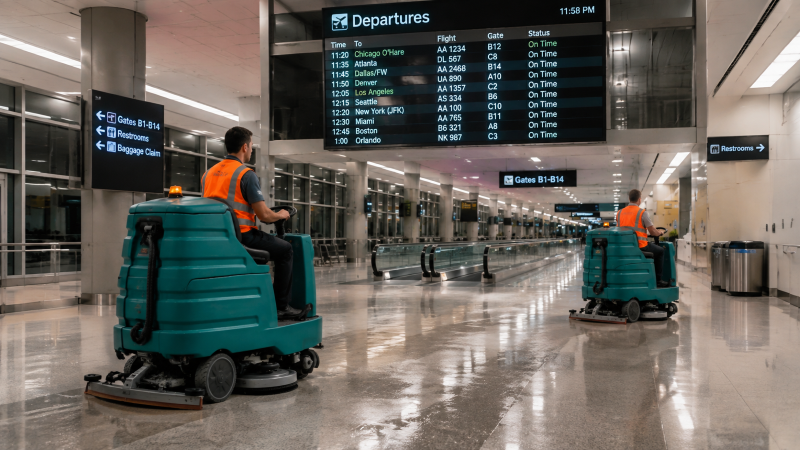
The terminal is mapped into six cleaning zones, each with a defined floor type, equipment assignment, and priority level. Priority is based on passenger traffic patterns: zones that see the most foot traffic during operating hours get cleaned first and get a second spot-check pass before shift end.
Battery management is the hidden challenge in a 6-hour continuous scrubbing operation. Each ride-on scrubber runs on a 24V battery system that gives about 3.5 to 4 hours of runtime under normal scrubbing load. The overnight shift needs 5 to 6 hours of machine time per unit, which means one battery swap per machine per shift.
The terminal solved this by keeping a fully charged spare battery on the charging rack for each ride-on unit. The swap happens at the 02:10 station stop, timed with the tank refill. Two operators lift out the depleted battery, drop in the charged one, and the machine is back running in under 5 minutes. The depleted battery goes on the charger and is ready for the next night.
Crew scheduling follows the zone map. The 12-person shift breaks into three 4-person teams. Each team has one ride-on operator, one walk-behind operator, and two support crew who handle refills, battery swaps, spot cleaning, and inspection. The team structure means no one is idle and no machine waits for support.
After 8 months running the scrubber-based overnight program, the terminal's facilities team pulled the numbers. The results were clear enough that the airport authority approved expanding the program to the satellite terminal in the next budget cycle.
The mop crew was working harder than anyone in the terminal. The problem was not the people, it was the method. Once we put ride-on scrubbers on those floors, 2 million square feet went from impossible to routine.
Managing floors at a large facility and running out of overnight hours? Donnie at TerraScrub helps airports, distribution centers, and large commercial facilities design ride-on scrubber programs that fit tight time windows. Tell Donnie your floor area, surface types, and overnight schedule for a practical equipment and zone strategy. Reach out at Donnie@terrascrubx.com or on WhatsApp.
Contact Donnie for confidential pricing, spec sheets, and distributor partnership details.